
A protected floppy may refuse to run even when all its ordinary files have been copied. The program can inspect track layout, unusual data or timing that a file copy never preserved. The Software Preservation Society, also known through the earlier CAPS name, addresses that deeper part of software preservation.
Its Interchangeable Preservation Format, or IPF, describes both disk data and how it is arranged. That differs from treating a disk as only a numbered list of decoded sectors.
Capture first, interpret afterwards
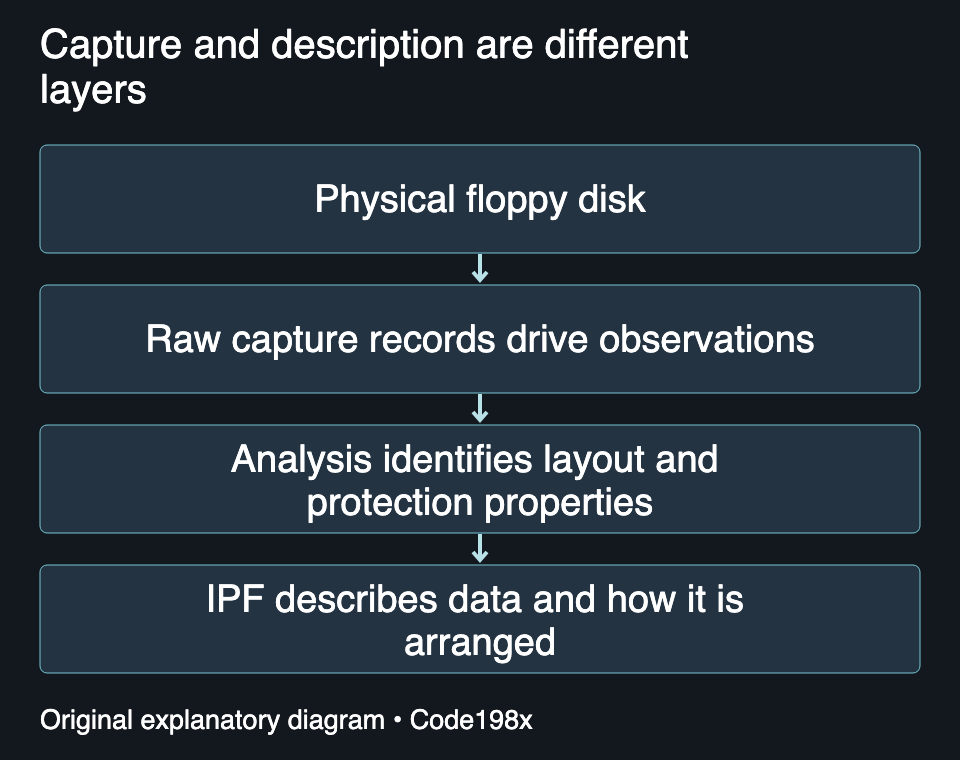
Low-level capture tools such as KryoFlux record information from the drive below the filesystem’s view. A stream capture retains observations of magnetic transitions and timing. Analysis then asks what structure those observations represent.
Jean Louis-Guerin’s technical investigation describes the SPS workflow as reconstructing a disk’s mastering description. The resulting IPF can describe layout and protection properties without being a verbatim container for every raw timing measurement. (IPF Documentation 1.6, sections 1.4–1.5.)
Preserve the protection’s evidence
Disk protection could depend on properties outside an ordinary sector image. Retaining a description of those properties allows a compatible consumer to reproduce the reads expected by the software.
WinUAE, for example, lists IPF among its supported floppy-image formats. The image and its decoder still need a suitable emulator around them: describing a disk is not the same as emulating every part of the computer.
A description is also an interpretation
Louis-Guerin identifies his document as an investigation drawing on source material and discussions, with cautions about possible errors and speculative details. It is useful technical evidence, but should not be mistaken for a guarantee that every disk or every image has been preserved perfectly.
Keeping raw captures, analysis and a usable preservation image distinct makes later checking possible. A future investigator may have a better explanation for an awkward track. The earlier observations can still matter even when today’s interpretation is enough to run the program.
Sources
- Jean Louis-Guerin, Interchangeable Preservation Format Documentation, version 1.6, April 2018, sections 1.1–1.5: independent technical investigation, including its stated limits.
- Jean Louis-Guérin, KryoFlux Stream File Documentation, revision 1.1, 1 December 2013: raw stream representation.
- WinUAE, Basic features: the emulator’s own list of supported floppy formats.