
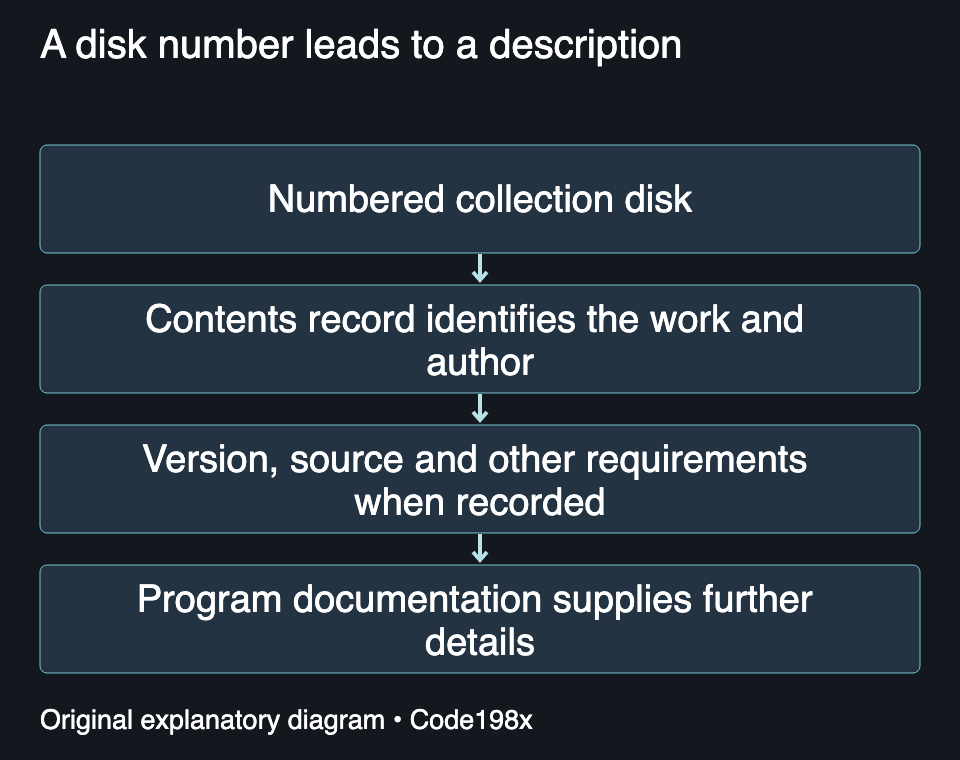
NetHack 2.3 needed two disks in Fred Fish’s Amiga library. The contents file for disk 189 tells the reader that the other part is on 190, that both are required, and that source is included. It credits the wider development team and Olaf Seibert for the Amiga work.
That small catalogue entry captures the library’s practical value. It did more than assemble programs: it helped readers identify what they had, whom to credit and what else they needed to use it.
Freely redistributable did not mean ownerless
Fish’s introduction dates the library’s start to November 1985. It gathered tools, games, programming examples, editors, compilers and other Amiga software, supplied through contributions from many users.
His distribution notes distinguish several reasons for including a work. Some carried explicit redistribution permission; some were placed in the public domain; others arrived through their authors or public networks under the conditions he describes. These were not one uniform licence. Fish separately disclaimed a compilation copyright in the collection itself. (Distribution, revised 24 December 1990.)
The author’s own notices therefore remained important. A disk sold by a copying service was not proof that every included program had lost its copyright.
A catalogue that travelled with the disk
The collection’s numbered contents files named programs, summarised their purpose and often identified a version, earlier disk or source availability. Disk 47, for example, credits Eric Graham for The Juggler. Different kinds of work could share a disk: an animation, a terminal program and a developer’s example were all useful to an Amiga owner.
Finding and using the contents
The library’s size made searching a job in itself. Amiga Computing recommended Aquarium, a database of the collection, in its June 1991 discussion.
Fish’s own introduction also warns that many programs expected experienced users and that early disks often supplied command-line programs without icons. Access to a disk did not automatically supply the knowledge needed to run everything on it. The notes, source and user groups helped bridge that gap, before network archives such as Aminet made another distribution route available.
Sources
- Fred Fish, ReadMeFirst and Distribution, revised 24 December 1990: original collection notes.
- Amiga Freely Redistributable Library, Contents: original records for disks 47, 189 and 190.
- Amiga Computing, June 1991, p. 27: contemporary collection and Aquarium coverage.