
Wolfenstein 3D is id Software’s 1992 first-person shooter, released through Apogee. You guide B. J. Blazkowicz through a Nazi stronghold, searching for exits while fighting guards and conserving ammunition and health.
Its shareware release gave players an episode to copy and try, with further episodes available to buy. That distribution connected a technically striking PC game to an audience that could pass it on directly.
A useful restriction
The walls follow a square grid. A room can look convincing from inside even though its plan is far simpler than a freely modelled building. The engine uses that restriction to find visible walls quickly.
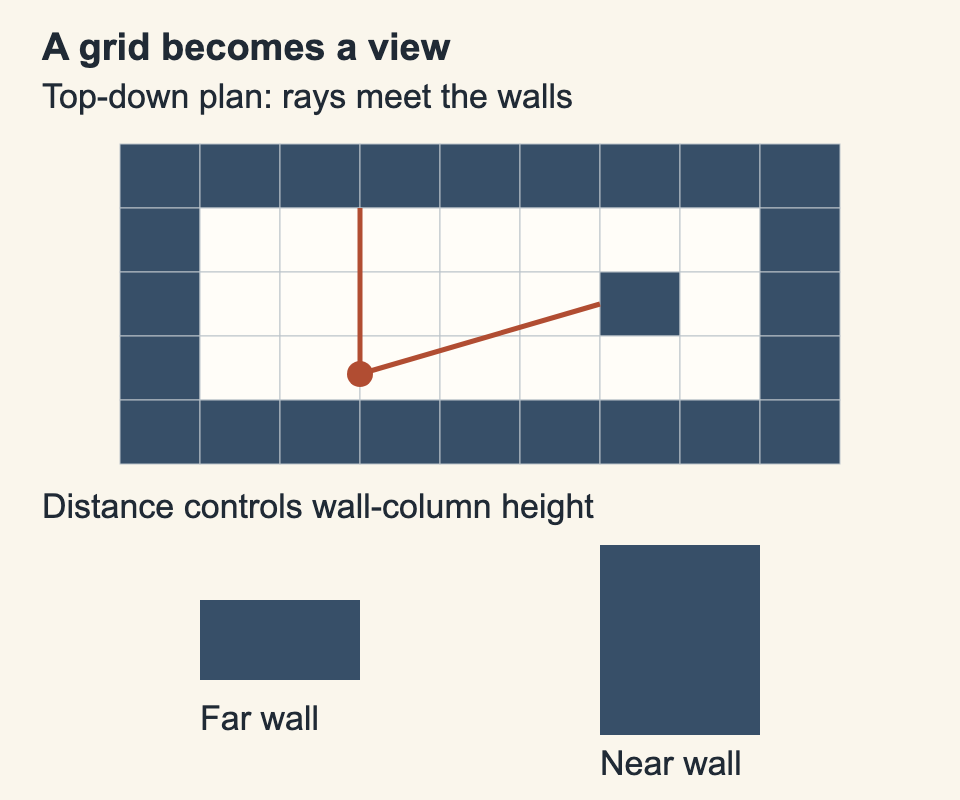
For each column of the view, a ray travels outward until it meets a wall. The distance determines how tall that wall column appears, and which strip of its texture to draw. Enemies and objects are drawn as scaled pictures within the scene. The released renderer separates the wall pass from those scaled objects.
Speed through a designed space
This arrangement gives the game its directness: turn, read the next corridor, act. It also limits the architecture. The world cannot freely stack rooms or slope its floors as a later polygon environment can.
The team’s next major shooter, Doom, changed the representation to allow more varied spaces. Ultima Underworld, also released in 1992, put a first-person view to a different purpose, combining exploration with conversation and role-playing systems.
John Carmack’s source-release notes describe the raycasting architecture and its compromises. That code makes the design inspectable: a small set of geometric rules supports the impression of a much larger place.
Sources
-
id Software, Wolfenstein 3D source release: John Carmack’s original release notes and DOS project; the later GitHub upload preserves the source.
-
id Software, WL_DRAW.C: Original renderer, WallRefresh, ThreeDRefresh and scaled-object drawing.
-
Fabien Sanglard, Game Engine Black Book: Wolfenstein 3D: Author’s published source for the Action Phase: 3D Renderer chapter; raycasting, wall columns and grid constraints.
-
Apogee / 3D Realms, Wolfenstein 3D product page: Original publisher’s product record states the initial release was 5 May 1992; preserved copy of the publisher page.