
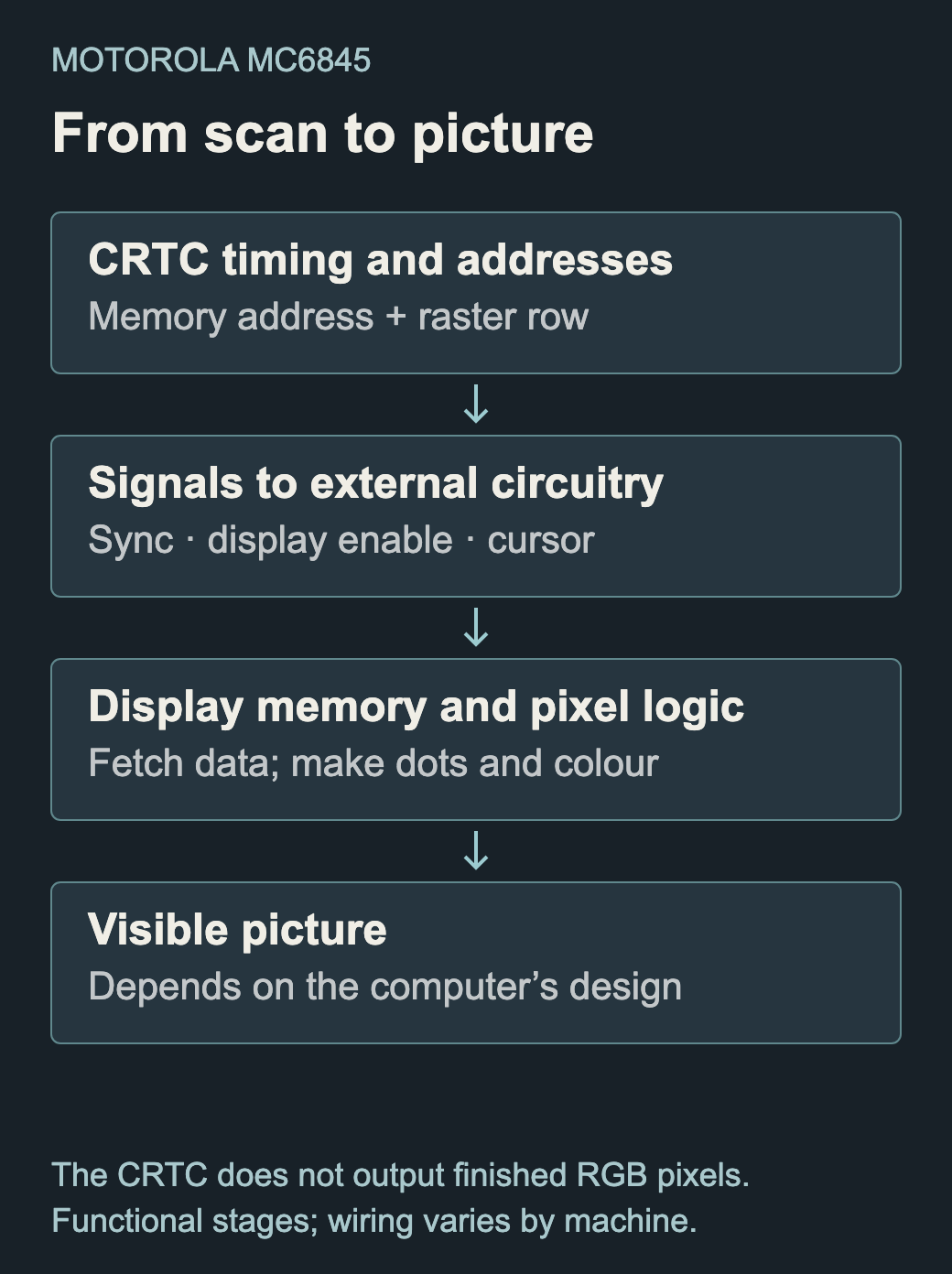
The Motorola MC6845 CRT Controller, or CRTC, supplies the timing and addresses needed to scan a display. It does not take a byte and produce its finished coloured pixels by itself. Character-pattern, pixel and colour circuitry outside the CRTC completes that work. Two computers can therefore share a 6845 while arranging their screens and colours differently.
Motorola’s data sheet describes video timing and refresh-memory addressing as its central jobs. The BBC Micro and Amstrad CPC show why that distinction is useful: identifying the CRTC is only the beginning of understanding either machine’s display.
Counting across and down
Programmable registers describe horizontal and vertical totals, displayed areas, sync positions and character height. Memory-address outputs identify display locations; raster-address outputs identify a row within the character cell. External logic can use that combination to find a character pattern or arrange a bitmap display.
The numbers are counts in the controller’s timing scheme. A horizontal displayed count is not automatically a count of final coloured pixels. The input clock, pixel circuitry and machine’s chosen mode determine how those units appear on the screen. (MC6845 data sheet, CRTC description and register functions.)
Moving the start, shaping the cursor
Start-address registers choose where the display’s sequence of memory addresses begins. Changing that address can move the view through display memory without copying all its bytes. The result depends on how the computer connects those addresses to its actual RAM; a linear CRTC address is not a universal physical-memory formula.
Cursor registers select its location and the raster rows where the cursor signal is active. Again, this is a signal for the surrounding display circuitry to use. It is not a finished cursor bitmap stored inside the CRTC.
A light-pen input captures the current display address for later reading. The processor can use the captured value to work out where the pen detected the scan. The complete operation still depends on the pen interface and the computer’s screen layout.
The compatible-part trap
The BBC’s Advanced User Guide describes the CRTC alongside the rest of its video system and gives the register settings used for its modes. That machine-specific layer is essential. A register table from another computer cannot supply it.
Later compatible controllers also differ in some register and timing behaviour. A routine exploiting a particular sync-width value or readback effect needs the actual fitted part’s documentation. “6845-compatible” is a useful family description, not evidence that every unusual setting behaves identically.
Sources
- Motorola, MC6845 CRT Controller data sheet: timing, address generation, cursor and light pen. Original data sheet.
- Andrew Bray, Adrian Dickens and Mark Holmes, The Advanced User Guide for the BBC Microcomputer, Cambridge Microcomputer Centre, chapter 18: CRTC operation within the BBC display system.