
The Mega Drive VDP draws from reusable patterns in 64KB of video RAM. Tile maps arrange them into scrolling planes A and B. A sprite table places moving objects. Colour RAM supplies palettes, and scroll settings change which part of a map is visible. Sega’s Mode V turns those pieces into the Mega Drive’s principal display system.
The 315-5313 is an early implementation’s part number. Later boards integrate the hardware differently, so it is more useful to identify the VDP’s function and display mode than to assign that number to every Mega Drive.
The window replaces part of plane A
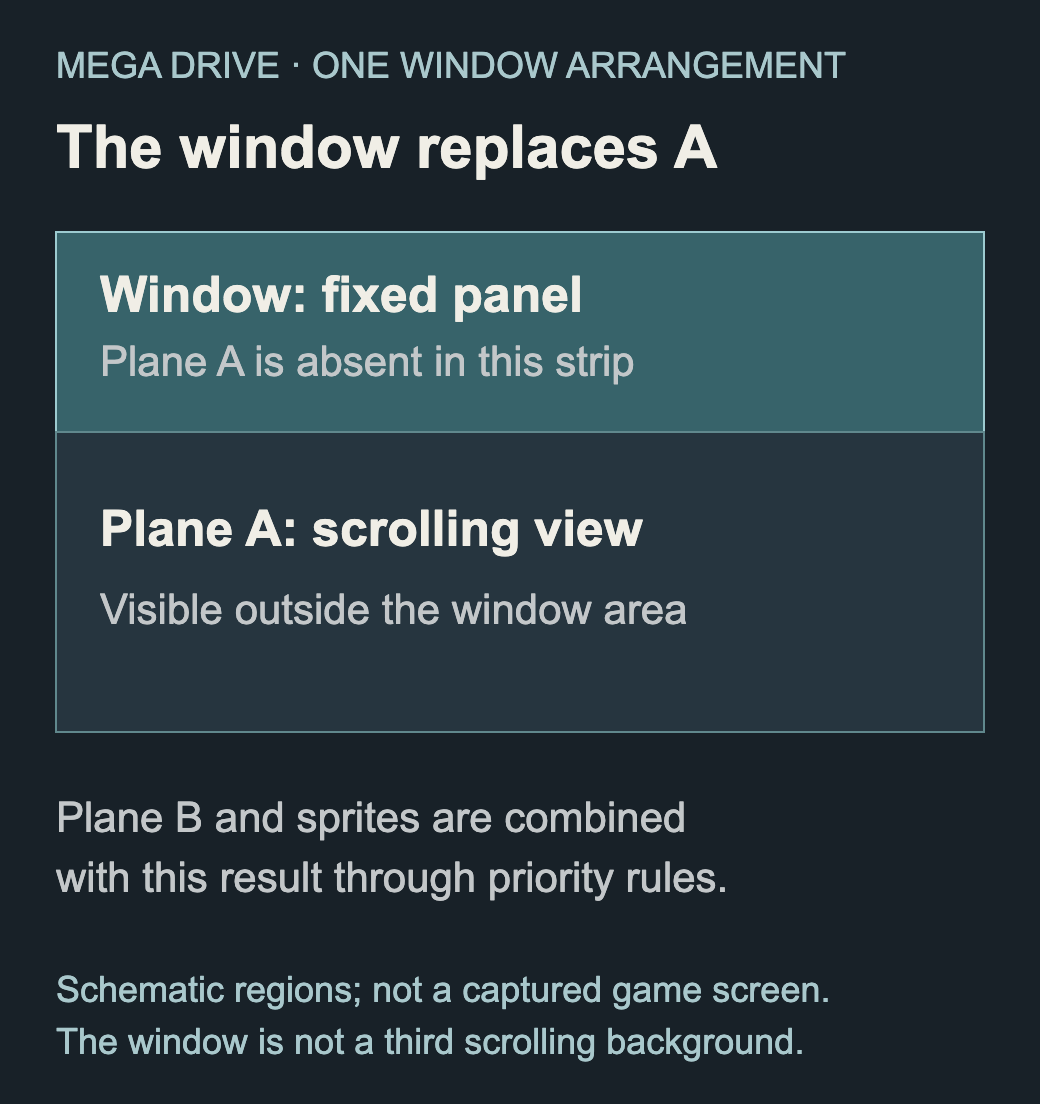
A window can keep a score panel or other fixed information still while the world scrolls. It has its own name table and position settings. In its designated area it replaces plane A; it is not a third scrolling background that can overlap A independently. Plane B and sprites still take part in the display’s priority rules. (Sega, window display; Charles MacDonald, window and priority sections.)
Each map entry names a tile and carries attributes such as palette, flips and priority. Reusing one tile with several attributes saves pattern storage. Sprites have their own format and ordering rules. A sprite’s priority bit controls its relationship to background pixels; its place in the sprite list also matters when sprites overlap.
Video RAM has several tenants
Patterns, name tables, sprite attributes and horizontal-scroll data share the same video RAM. Colour RAM and vertical-scroll RAM have separate roles. A plan that counts only picture patterns leaves out memory the tables themselves need. (Sega, VDP memory organisation.)
This also explains why a screen can move without copying an entire bitmap. Updating a scroll value changes the view into a tile map. Updating a map entry changes which pattern appears. Replacing pattern data changes the artwork used wherever that pattern is referenced.
DMA has a cost
The VDP can transfer data from the 68000’s address space, fill video RAM or copy within it. Those operations are not identical. An external-memory DMA transfer stops the 68000 while the VDP uses its bus. A VRAM fill or copy lets the CPU continue, but restricts what software may safely do through VDP ports. (MacDonald, DMA.)
Display fetching also consumes memory access slots, so available transfer capacity changes between active display and blanking. Hardware assistance reduces the CPU instructions needed for a transfer; it does not remove the transfer’s time or bus requirements. That is a useful boundary when comparing this chip with the Master System VDP or a software-drawn display.
Sources
- Sega, Genesis Software Manual, February 1992 revision: VDP, window, sprites and DMA. Original editions and corrections.
- Charles MacDonald, Sega Genesis VDP Documentation, version 1.5f, 2000: first-hand technical investigation. Preserved author text.