
The Super Nintendo sound system runs a program of its own. The main processor sends information through four 8-bit communication ports. A Sony SPC700-series CPU core inside the S-SMP runs the sound driver, while the S-DSP turns waveform data into sound. They share 64KB of audio RAM, separate from the main processor’s work RAM. (Nintendo, SNES Development Manual, Book I, sections 2-22 and 3-1.)
That arrangement makes a music command a conversation between processors. The game can request a tune or an effect; the sound driver decides how to play it. The main CPU does not have to generate every sample itself.
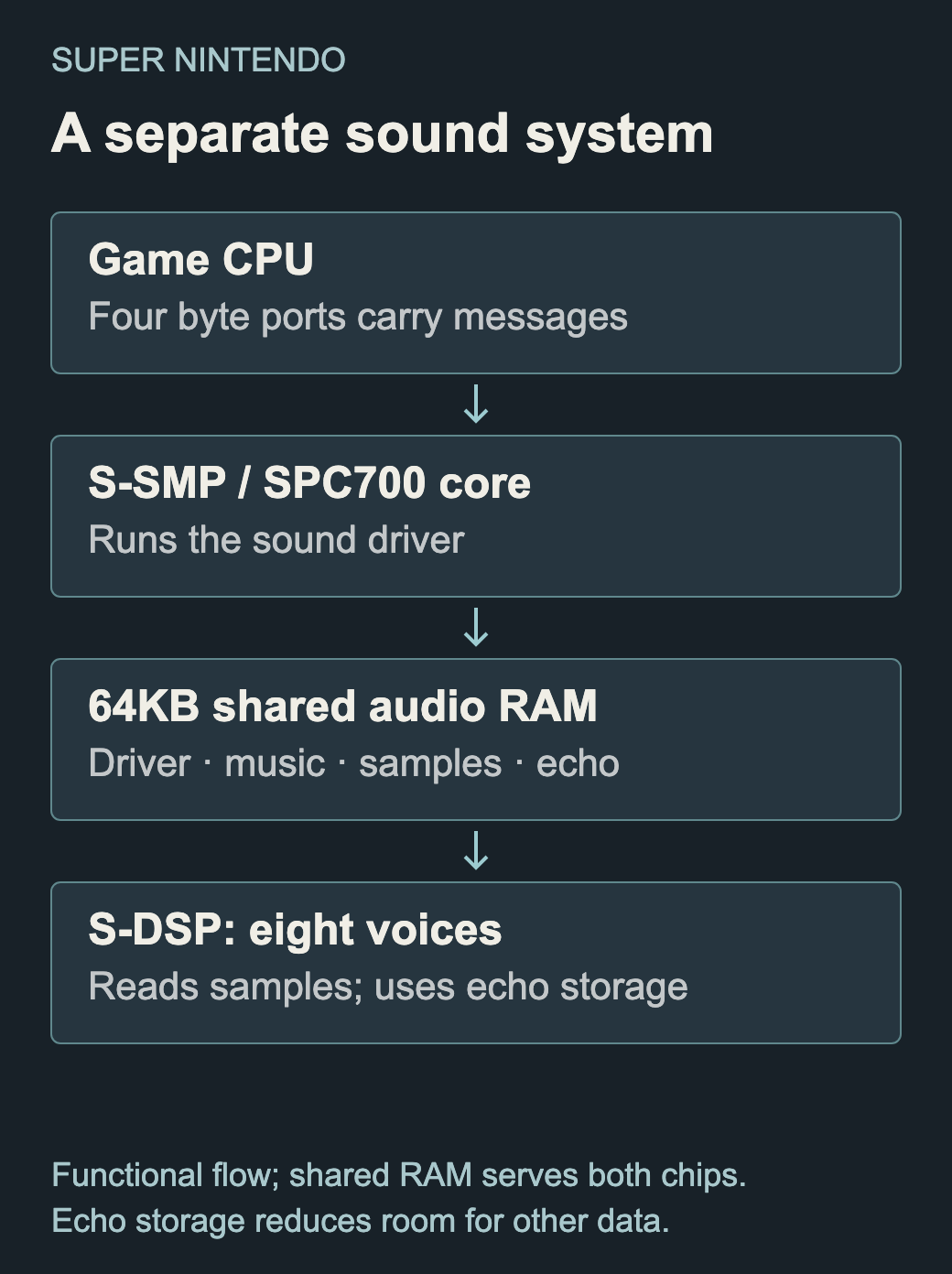
Eight voices from stored waveforms
The S-DSP provides eight voices. Each can read sampled waveform data with its own pitch and volume settings. Envelopes control how a note changes level, and separate left and right volume settings place it in the stereo output. The DSP also provides noise and echo functions. These are hardware facilities that a driver programs, rather than eight complete songs stored inside the chip.
Nintendo’s sound manual specifies BRR, or Bit Rate Reduction, for the waveform data. A block contains a one-byte header and eight bytes holding sixteen 4-bit sample codes. Header settings control reconstruction and mark endings or loops. Those codes describe compressed waveform data; they do not mean that the final sound has only sixteen possible amplitudes. (Book I, section 3-2.)
A reusable sample can serve many notes because the DSP changes the playback pitch. The music data tells the driver when and how to use it. The result therefore depends on both the instruments placed in RAM and the program arranging them.
Echo consumes memory too
The 64KB has several jobs: driver code, music data, samples and echo storage must coexist. Echo is not a ninth independent sample voice. Its buffer occupies part of the same RAM, and Nintendo explicitly warns that an incorrectly initialised echo area can overwrite the driver or waveform data. (Section 3-9, caution 5.)
That constraint helps explain why audio planning matters on the Super Nintendo. A larger instrument set or longer echo leaves less room for something else. It also separates this system from FM synthesis, where programmable operators generate changing waveforms instead of taking the same sample-playback route.
Sources
- Nintendo, SNES Development Manual, Book I, sections 2-22 and 3-1–3-9: system roles, BRR, ports, DSP registers and programming cautions. Original manual scan.
- SNESdev, S-SMP: modern technical corroboration of component names, shared RAM and register access. Technical documentation.