
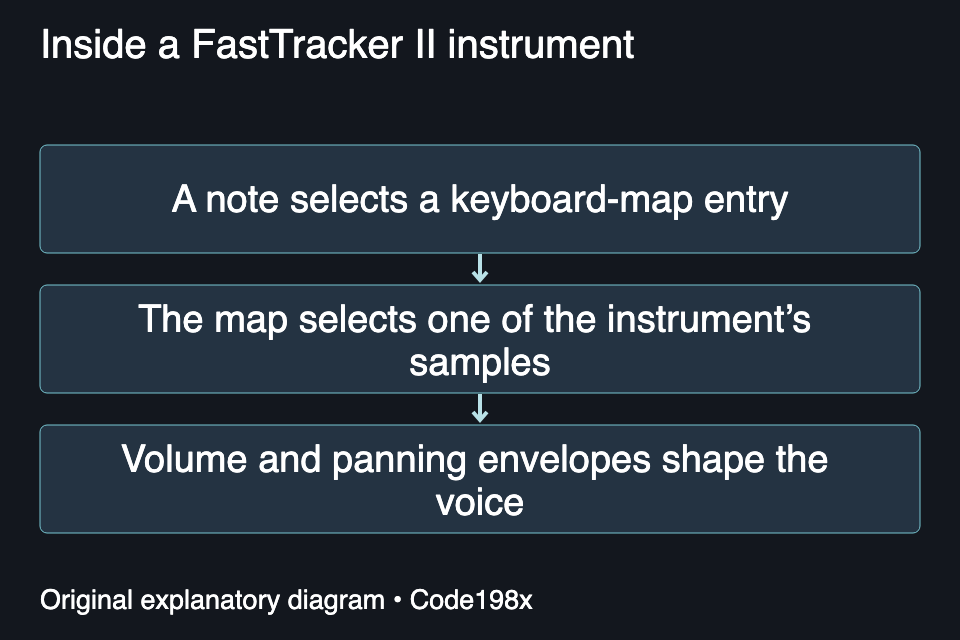
In FastTracker II, an instrument can choose different samples for different notes and carry its own volume and panning envelopes. A musician does not need to repeat every small change in loudness in the pattern. The instrument can describe part of the sound’s behaviour itself.
Fredrik Huss and Magnus Högdahl, of Triton, explain that aim in the introduction to the version 2.08 manual. They wanted instruments to make composition easier, rather than compete only by adding more effect columns.
Notes, samples and instruments
A sample holds a waveform. An instrument adds a keyboard map and settings that can apply to several samples. A low note can select one recording and a high note another, while an envelope shapes their loudness over time.
The XM format stores that organisation: pattern order, note events, instruments, sample maps and envelope points. Its sample headers also describe loops and sample properties. A module therefore contains instructions for constructing a performance, rather than a finished recording of one. (Mr. H, XM format description, instrument and sample sections.)
Patterns remain reusable
The pattern editor retains the tracker idea of rows and channels. XM permits varying pattern lengths, and the order table decides which pattern comes next. Repeating a musical section need not mean storing another identical pattern.
Playback still depends on the interpretation of effects, envelopes and pitch calculations. Loading another tracker’s file is not a promise that every detail survives conversion to XM.
The DOS program and its later clone
The modern ft2-clone runs on Windows, macOS and Linux. Its maintainer documents a player ported from the original source alongside additional sample tools and mixing changes. It carries the older working style forward, but its extra facilities should not be assigned retrospectively to the DOS release.
Sources
- Urban Jonsson, FastTracker v2.08 manual, February 1996, introduction and sections 4.1–4.2.
- Mr. H of Triton, XM module format description, 1994: original format text preserved by libxmp.
- 8bitbubsy, ft2-clone README: the modern implementation and its documented differences.