
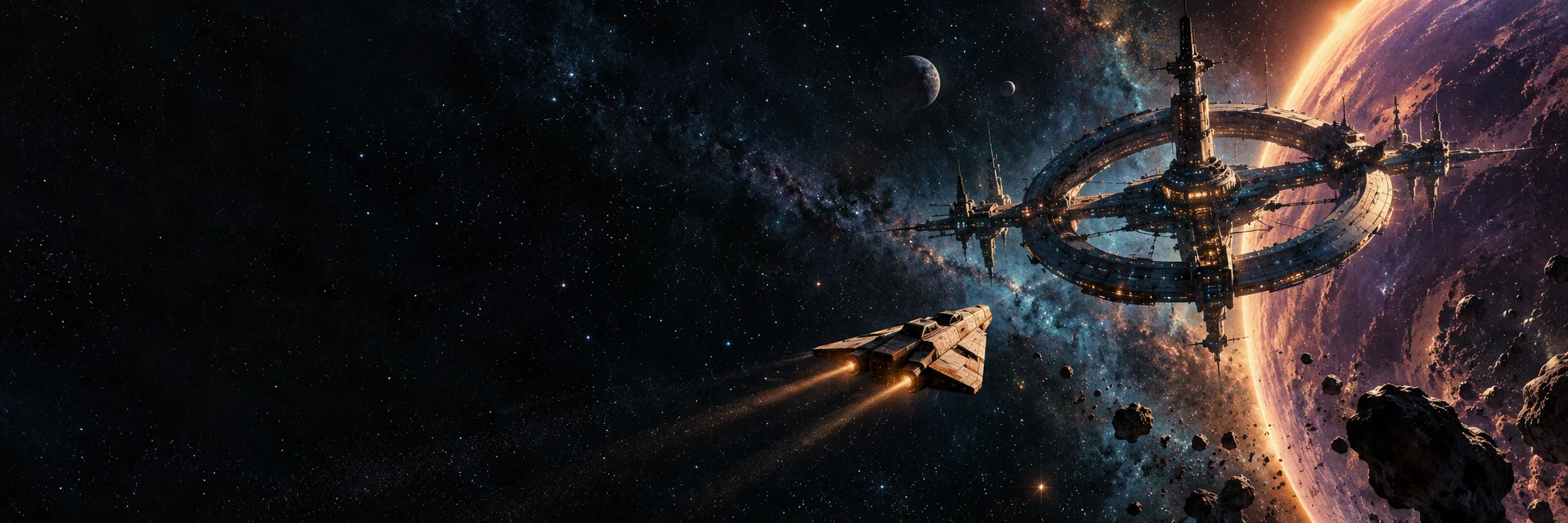
You have a spaceship. Now you have to make a living.
Commander Jameson is docked at Lave with 100 credits, a pulse laser and an unpromising combat rating: Harmless.
There is no admiral waiting to give you orders. No first level lights up. The ship is yours, the market is open, and the stars on the chart are places you can try to reach.
That is an exciting invitation. It is also a rather alarming one. Buying food looks manageable. Flying a cargo through space and getting it into a rotating station may prove more demanding.
Ian Bell and David Braben’s Elite, published by Acornsoft in 1984, makes those activities depend on one another. Trade gives a journey a purpose. Flying puts the investment at risk. Getting home gives the next purchase meaning. What looks like a space combat game can become a story about the trip you almost survived with everything you owned in the hold.
We begin on the BBC Micro, where the original game offered this enormous prospect through white lines, coloured instruments and a keyboard. Its universe is less elaborate than the one you might imagine while playing. Understanding how the two work together is part of its appeal.
One hundred credits and a decision
Before launching, there is time to look around the menus. The status screen tells us who we are, what we have and where we are. The market tells us what is available and what it costs. The chart shows where we could go.
These screens turn a vague ambition—make money in space—into questions we can answer. How much can we afford? Which goods might be useful elsewhere? Is that system close enough? What kind of place is it?
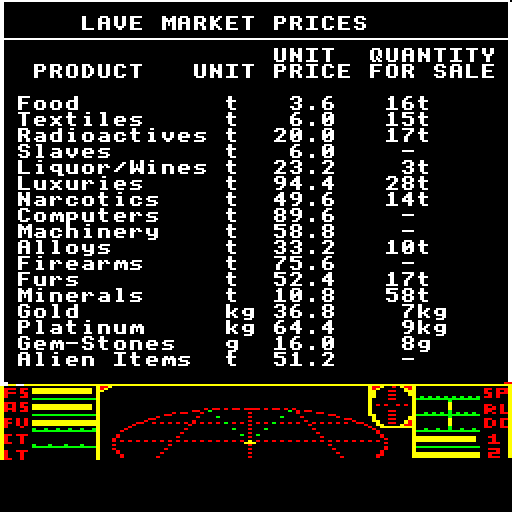
The market makes space travel a purchasing decision. Food costs 3.6 credits per tonne in this starting market, with 16 tonnes available; other goods may be priced by the kilogram or gram. Own capture of Elite, Acornsoft, 1984, BBC Micro. Active display cropped from emulator output.
Notice the units. A tonne of food and a gram of gemstones cannot be compared by reading the price column alone. Even before flying, the game asks us to connect numbers with things.
Consider a deliberately modest example. At the displayed price, buying 12 tonnes of food costs 43.2 credits. From a starting 100, that leaves 56.8 credits unspent. The arithmetic is straightforward; the decision is not finished.
A profit requires somewhere willing to pay more. The destination has to be reachable. The cargo has to arrive. Fuel and other expenses matter. Spending every last credit on the most tempting item would leave no financial room for the rest of the trip.
We have not earned anything by buying cheaply. We have exchanged cash for a possibility.
That is a much stronger reason to care about the flight than a separate score for a good purchase. The ship now carries part of our future. The market’s quiet table has changed what a pirate encounter will mean.
The historical table also lists enslaved people as a commodity. That convention deserves acknowledgement rather than being smoothed into a cheerful account of buying and selling. It reduces people to cargo within the game’s economy. Recognising it does not require accepting it as a harmless model for games we make ourselves.
A chart becomes a route
The short-range chart places Lave among nearby systems. A fuel-range circle makes a limit visible: the ship can reach some destinations, while others lie beyond its current supply.
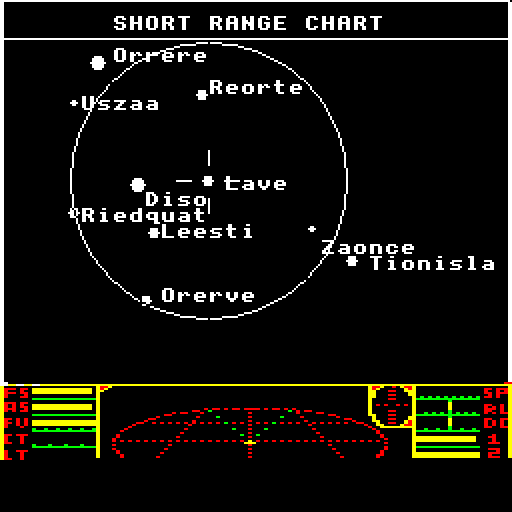
The chart turns distance into a choice. A name near Lave is not automatically a safe or profitable destination, and the range circle does not tell us what to buy. Own capture of Elite, Acornsoft, 1984, BBC Micro.
A star map could have been a backdrop. Here it is something we consult. We move between the chart, system information and market, building a plan from several partial views.
The original guide explains the broad trading opportunity: agricultural and industrial worlds have different needs. Food and manufactured goods can be worth different amounts on different sides of that relationship. Economy is a clue, not a guarantee that every purchase will produce a particular profit. 1
The map also creates a difference between the nearby and the possible. At the beginning, the next few stars are practical problems. A larger chart promises more than we can sensibly use yet. We can imagine travel long before we have the equipment or confidence for it.
There is no need for every point to contain a unique authored adventure for that promise to work. Distance, fuel and remembered experience can make neighbouring systems feel different. A place can become important because it is where you made a good trade—or barely got away.
Three journeys inside one trip
A trip in Elite crosses several kinds of distance. Buying and planning happen while docked. A hyperspace jump connects star systems. Within a system, you still have to fly to a station and dock before selling the cargo.
The distinction matters because reaching the destination system is not the same as arriving safely.

An original explanation of the trading loop. The chart handles interstellar choices; flight and docking decide whether the cargo reaches the market. This is not a route recommendation or a promise of profit.
The jump compresses an enormous distance. Local flight then gives some of that distance back to us as time, navigation and possible trouble. We do not manually steer every light year, but we cannot select a star and instantly collect our earnings either.
The game’s J jump drive can speed local travel when nearby masses do not block it. 1 That makes empty space and occupied space feel different. Quiet travel can be shortened; another body nearby may require our attention.
This is a useful design choice. Travel needs enough duration for the journey to feel real, and enough danger for decisions to matter. It also needs relief from stretches where there is little to do. Those aims pull in different directions. A faster travel control with conditions is one way to negotiate between them.
It leaves an interesting question for the player. Have we been stopped because something dangerous is near, or merely because something is near? The interruption itself invites a look at the instruments.
Learning which way is up
Launch, and the neat trading screens give way to a view through the front of the ship. The planet is suddenly a huge presence. The stars move. Small changes in direction can send familiar things out of sight.
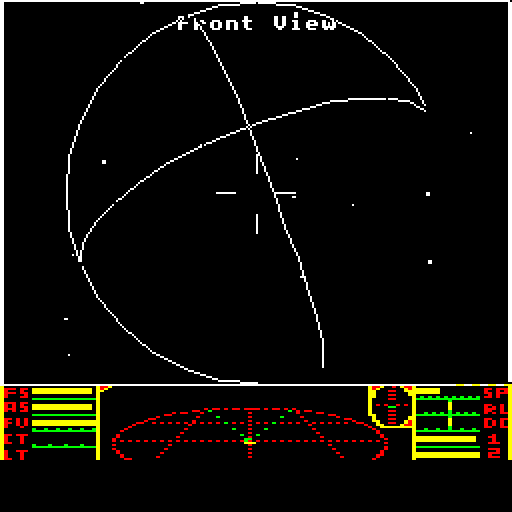
White lines give the planet volume, while the coloured dashboard remains fixed beneath the view. The contrast separates the world we move through from the instruments we use to understand it. Own capture of Elite, Acornsoft, 1984, BBC Micro.
The essential steering actions are pitch and roll. Pitch raises or lowers the nose. Roll turns the ship around its forward axis, rotating the view. To turn towards something at the side, you combine those movements rather than steering it like a car.
That can take a moment to understand. A target which has slipped to the right is not necessarily solved by holding a “turn right” key. First you may roll until it lies in a useful direction, then pitch towards it.
The world’s movement supplies feedback. The ship’s own cockpit does not need to swing around on screen for you to feel a turn. A planet rolling across the window can communicate it perfectly well.
We can compare this with Spacewar! without pretending the games simulate space in the same way. Spacewar makes velocity and thrust central to a two-dimensional duel. Elite gives us a three-dimensional pilot’s view, speed control, pitch and roll, and rules chosen for its own trading and combat. “Set in space” does not prescribe one correct set of movement rules.
That is a valuable connection to Maths for Games. A game can borrow position, direction, distance and rotation from mathematics, then choose how those quantities should behave for the experience it wants.
Seeing what is outside the window
A front view is necessarily incomplete. A ship may be above, below, beside or behind us. Looking in the wrong direction does not make it disappear from the situation.
The elliptical scanner is Elite’s compact answer. A mark locates an object around our ship; a vertical stem shows its height relative to the scanner’s plane. A flat display can therefore carry a useful picture of three-dimensional surroundings. It is an instrument to learn, not a second literal window. 2
At first the scanner can feel like more information competing for your attention. With practice, it can tell you where to look and how the situation is changing. The front view is useful for recognising and aiming. The scanner helps you stop treating that view as the whole world.
The other instruments answer equally practical questions. Speed tells you how quickly you are committing to an approach. Shields and energy tell you how much trouble you can survive. Fuel limits the next interstellar choice. A compass helps you find the body you need to approach.
The dashboard is busy because the job is busy. That does not make every bit of it equally easy to learn. The player has to develop a habit of looking away from the exciting thing in the window to check the quieter warning below it.
This is one of the pleasures of getting better at a simulation. An initially bewildering panel becomes a set of answers to questions you now know to ask.
A fight has an economic cost
A distant speck grows into a ship. It may pass, approach or attack. An encounter interrupts the plan we made at the market.
The laser gives us a direct way to respond, but keeping a moving opponent in the sights takes work. We are steering while the other ship moves. Firing adds heat. Missiles provide another possibility, with their own targeting and countermeasures. Our shields and energy make the condition of the ship matter throughout the encounter. 1
A space battle could have been a separate arcade round. Elite makes it part of the same life as the cargo hold.
Suppose we survive by using an expensive expendable weapon. The flight is a success, but the trade may be less profitable than expected. Suppose we stay to fight for a bounty and lose the cargo instead. A tempting extra reward has overturned the whole purpose of the trip.
Running away can therefore be a sensible decision. The important question is not always whether we could win. It may be whether this fight is worth taking.
The game’s legal status complicates that judgement. Piracy and carrying illegal goods can bring trouble from the authorities. The market offers opportunities which the rest of the world does not treat as equivalent. A possible profit carries more than a price.
There is a limit to what this system explains about morality. A legal-status indicator is a set of game rules, not a complete ethical model. It is useful because it changes risk and response, but we should not let the existence of a rule settle every question raised by the fictional world.
For design, the interesting achievement is that the systems meet in the same encounter. Money, equipment, cargo, reputation and flying ability all influence what a good decision looks like.
The last few metres can spoil everything
After making it through the flight, the station is a relief. It is also the final obstacle between us and the market.
The entrance is a slot in a rotating structure. We have to approach the correct face, line up and enter with a suitable orientation. The station does not stop rotating because a nervous new trader has arrived.
It is a memorable way to make arrival physical. A menu option saying “dock” would remove the part where our competence is most plainly on display. Here, an ordinary working task can become the climax of the journey.
Position and orientation are different problems. We can be pointing towards the station from an awkward place, or be in a promising place while facing the wrong way. The docking code checks more than whether two shapes overlap. Mark Moxon’s source analysis separates heading, alignment, approach position and rotation, alongside the station’s hostility. 3
We do not have to memorise the numerical tolerances to understand the experience. The important thing is that the picture corresponds to several conditions which must come together. “I reached the station” is not yet “I made a safe approach”.
A docking computer can eventually take over the task. That is more than a convenient upgrade. It changes a repeated part of the game which the player may already have spent a long time learning.
For someone who enjoys manual docking, automation can feel like giving away a small performance. For someone worn down by it, the same purchase can be liberation. An upgrade can have value because of what it lets us stop doing.
We should resist borrowing the best-known sound from a later version. The BBC original is not accompanied by the C64 docking rendition of The Blue Danube. Different versions contributed different parts of the series’ remembered atmosphere; the Elite reference entry follows those adaptations.
The next purchase changes the next journey
Once docked, we can sell, refuel, consider equipment and prepare to leave again. A successful flight has made the next decision different.
More money gives us options. Cargo capacity affects how much can be traded. Better weapons and defensive equipment can change which encounters feel manageable. Fuel scoops offer another way to gather fuel or collect cargo. A docking computer changes arrival. An escape capsule offers a costly form of survival. These are abilities with consequences, rather than a single rising “power” number. 1
The sequence creates goals at different scales. Right now, we want to survive this approach. Next, we might want one particular upgrade. Farther ahead lies a bigger journey or a better combat rating.
Those goals can support one another. A profitable trade helps pay for equipment. Equipment may make future flights easier or open another way to earn. More confidence encourages a more ambitious destination. The player builds a plan out of what has happened so far.
That loop can also become repetitive. Once a safe and profitable routine is familiar, repeating it may provide money without much discovery. Choosing a riskier destination can restore interest, but it is worth asking how much of the work the game is asking the player to do in keeping things interesting.
An open game needs worthwhile alternatives, not only permission to do the same thing indefinitely. Elite gives trade, combat, exploration and equipment different roles, but its freedom does not guarantee that every player will enjoy setting their own pace.
What does “Elite” actually measure?
The title points towards a combat rating. Becoming rich and reaching Elite are related possibilities, not the same achievement.
That distinction creates a productive mismatch. A careful trader may become successful by avoiding fights. A pilot pursuing rank must engage with combat. The game gives a name to one form of accomplishment while allowing a broader life around it.
Saving a commander makes that life persistent. We can stop, return and continue with the money, equipment and record we have built. The next session does not have to begin with a fresh 100 credits and an empty history.
Acornsoft also took achievement beyond the screen. Its launch advertising invited players who reached Competent or above to send a code for certification and a chance of a prize. 4 A personal record could become something the publisher recognised.
The original cassette game’s central appeal does not depend on an authored campaign. The BBC disc release added special missions and more ships. Braben’s later account identifies that distinction explicitly. 5 Missions can interrupt the working routine with a particular request, but they should not obscure how much the ordinary journeys already supply.
There is no need to describe the game as an endless supply of unique stories. Its rules repeat. What changes is the player’s position within them: what we can afford, what we know, what we are willing to risk, and what just happened on the way home.
How does a galaxy fit?
The chart seems impossibly generous when you remember the BBC Micro’s memory. The answer is not that Bell and Braben typed in thousands of complete worlds and somehow squeezed them smaller.
A deterministic procedure—a repeatable set of steps—generates system information from a small seed. Give it the same starting numbers and it produces the same results. The game can therefore regenerate familiar systems instead of storing a large separate description for every one.
The classic universe has eight galaxies of 256 systems each. Six-byte system seeds supply information used for names, positions, economies and other properties. Moxon’s analysis shows how the individual bits do several jobs. The preserved original source also exposes the chart’s 256-system loop and the eight-galaxy cycle. 67
The result feels stable. Lave does not become a new random place whenever we consult the chart. That stability lets knowledge have value. We can remember a neighbourhood, compare routes and form habits.
This is procedural generation, but the interesting part is what the generated data does for play. Economy helps distinguish trading opportunities. Position and fuel turn the map into reachable routes. Government helps signal danger. A name gives us something to remember.
A procedure can also reveal its repetitions. There are not thousands of entirely different activities waiting behind those names. The game creates variation within a common structure. That is enough to make a large playground, but it is not the same as making every destination individually deep.
The lesson for a maker is useful and demanding: generate things which support decisions. A very large number is not a substitute for reasons to care about the results.
Lines which feel solid
The ships are three-dimensional objects drawn with lines. A model can be described by corners, the edges connecting them, and information about its faces. As the viewpoint changes, the game works out where visible parts should appear on the two-dimensional display. 8
The absence of filled surfaces does not prevent us reading a solid craft. Edges change shape with perspective. A ship grows as it approaches, rotates as it manoeuvres and occupies a recognisable volume. Choosing which edges to show helps the picture make sense.
That is why the wireframe is more than an economical decoration. It gives us information we need for flight and combat. The shape of an opponent and the way it turns are part of understanding what is happening.
The dashboard and window also ask different things of the display. Fine white lines help the space view remain sharp. Colour distinguishes the instruments beneath it. The BBC version changes its display configuration partway down the frame to serve both purposes. 9
Technical ingenuity matters because it reaches the player. We can see a world move and still read the instruments needed to survive it. Knowing the hardware trick adds another layer of appreciation, but the experience works before we know its name.
Two students, and the people who helped it leave Cambridge
Bell and Braben were students at Jesus College, Cambridge. Nicole Segre’s December 1984 interview describes a friendship which became a collaboration, with Bell coming from his earlier Freefall. Braben’s later FAQ recalls his own earlier experiments with three-dimensional space. Acornsoft supplied a BBC Micro to Braben during development. The college and local publisher were practical parts of the opportunity, not just scenery behind two names. 510
The authors’ accounts do not provide one perfectly consistent allocation of every idea. The contemporary interview credits Braben with the trading scenario; his later FAQ tentatively credits Bell. That is a good reason to describe the game as a joint creation, rather than settle an uncertain design credit through confidence of tone. 510
Braben later credited Acornsoft’s David Johnson-Davies with allowing time for testing and refinement before setting a release date. 5 That is an important production contribution. A publisher can affect what players receive by deciding when a promising game is ready to leave development.
None of this makes the work effortless. Combining a trading economy, cockpit, flight, combat, charts and a lasting commander record leaves many places for one part to disturb another. The finished game has to remain coherent across them. An elegant individual routine is only useful if the whole journey works.
Cambridge’s university and computing networks are part of this particular story, just as Sheffield’s shop and mining family are part of Monty’s. They are not explanations of how everyone in either city thought. They show two concrete ways people, access and local relationships could make a game possible.
A universe which began before loading
Acornsoft did not ask buyers to imagine the whole thing from a cassette label. Its advertisement sold the package as an expedition: The Dark Wheel, a flight training manual and a game which could recognise achievement. BBC cassette buyers were asked for £14.95; the disc edition was £17.65. 4
Robert Holdstock’s novella placed human lives and danger around the trading routes. The manual adopted the voice of training a pilot. A ship identification poster and reference material helped make the abstract shapes into a fleet with names and purposes. Acorn’s own contemporary report describes these printed contents as part of its plan to draw players into a complex game. 11
These materials perform different jobs. Instructions reduce uncertainty about operating the game. Fiction makes us curious about the life we might lead there. Recognition charts make unfamiliar shapes worth noticing. The package can promise a much richer world than the program directly simulates.
That promise needs care. Braben’s later FAQ explicitly says generation ships described in the surrounding fiction were not in the game. 5 A reader can imagine a larger universe without every piece of it becoming a hidden feature to discover.
Bell’s surviving development guide is revealing about that shared invention. His 2015 preface distinguishes his own fictional contributions from additions likely made by Holdstock or Piers Dugeon, and identifies material supplied to Acornsoft while the manuals and novella were being prepared. 1 The universe was written and presented by more people than the two whose code made it run.
For this study, a comparison with space adventure stories is useful: a small trader, dangerous journeys, strange names and a life beyond the next encounter are familiar fictional pleasures. Specific claims that one film or tabletop game caused a particular feature need creator testimony. We do not need to label every resemblance an influence to enjoy how the game invites that imagination.
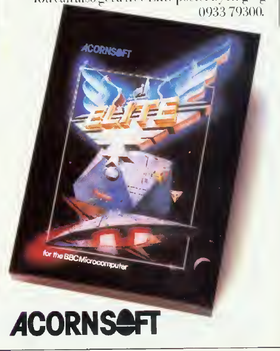
The package was part of the promise. Detail from Acornsoft’s advertisement in Acorn User 27, October 1984, PDF page 19. Box artwork by Philip Castle. Cropped and reduced for discussion of the marketed package; underlying artwork remains with its owners.
Original advertising spread · Excerpt provenance and credits.
Four decades beyond Lave
The view from the BBC Micro is the beginning of a much longer journey. Follow Elite forward and the tiny white-line planet becomes somewhere you can land; the solitary trader becomes one pilot among other people; the story told around the program becomes something players can help shape.
The sequels did more than make the pictures richer. They kept returning to a question the original had made so inviting: what would it be like to own a ship and live out there?
Frontier: Elite II — that planet is somewhere you can go
In 1993, Frontier: Elite II took that promise onto the Amiga, Atari ST and PC. David Braben developed the sequel. It replaced the original’s small fictional galaxies with a model of the Milky Way, including our own Solar System. Its solid ships and worlds gave the view weight and colour, and you could fly down to planetary ports instead of doing all your business in orbit. 512
That changes the meaning of the planet outside the window. It is no longer only a landmark to steer by. A journey can take you from a spaceport on the ground, up through an atmosphere, across a star system and down to another landing place.
The flight model makes an equally large change. Turn the engines off and the ship keeps moving. Pointing the nose somewhere else does not instantly send you in that direction: you need thrust to change your velocity. Gravity matters too. Braben’s explanation in the manual makes those Newtonian ideas part of learning to fly. 12
Imagine accelerating towards a station, then realising that you have left the braking far too late. The mistake belongs to the journey before the final approach. You can be pointing away from your destination while still hurtling towards it.
The game helps with an autopilot and accelerated time. Those aids matter because convincing distances and a patient player are different resources. A trip might be impressive at its natural scale and intolerable if we had to wait through every second of it. 12
There is more to do with the ship as well: carry passengers, take delivery jobs, pursue military work or replace the craft itself. The bulletin board helps turn distant places into opportunities and obligations. A promised delivery gives your journey a deadline; buying a different ship makes you think about what sort of work it can support. 12
These are wonderfully ambitious additions, but they change the flavour of the experience. Understanding relative velocity can be rewarding; it can also make a fast-moving encounter harder to follow. More realistic motion offers new pleasures and asks more of the pilot. It does not automatically produce the same kind of fight as the original, only better.
First Encounters — the galaxy has news, and a point of view
Frontier: First Encounters followed in 1995 on PC. Its manual still concerns itself with flying, trading, crew and contracts, but it also offers something worth lingering over: newspapers. 13
You can buy journals with different editorial loyalties. The Imperial Herald and Federal Times do not have to tell the same story about the same universe. The manual encourages readers to compare their accounts and notice what sits between the lines. Manda Scott and Braben receive the story credit; Scott and several other writers also contributed the journal material. 13
That is a substantial step beyond a planet’s short generated description. News gives the world a present tense. Something may have happened while you were elsewhere. Someone has decided how to describe it. A pilot who is only trying to earn money can still encounter a larger political story.
It also changes where the fiction lives. The Dark Wheel helped players imagine a life around the first Elite before they launched. Here, some of that imaginative work happens at the controls, through publications you can choose to read during the career itself.
The game’s troubled release belongs in this history too. Braben later described it as a botched release and discussed the dispute which followed. 5 We should not let a list of ambitions stand in for what buyers actually received. An idea can be fascinating while the released experience struggles to fulfil it.
The useful legacy is the attempt to put authored events, competing voices and an open-ended working life together. Freedom does not have to mean that nothing significant happens until the player arrives.
Elite Dangerous — other people live here too
Frontier Developments released Elite Dangerous on 16 December 2014, thirty years after the original. Its return had been backed through crowdfunding, and Frontier published it itself. 14 This was now the work of a studio and its players, rather than two students getting a new game onto a BBC Micro.
The familiar pleasures remain easy to recognise: choose a ship, plan a trip, watch the instruments, worry about the cargo and earn enough to change what you can attempt next. The setting is again the Milky Way, using real astronomical information alongside procedural generation. But another commander can now be a real person. Open Play, Private Groups and Solo let players choose whom they encounter while participating in the shared galaxy. Solo is not an offline copy of the universe. 1516
That gives an old risk a new character. In 1984, the ship approaching you was part of the program. In Dangerous, an encounter may also involve another person’s plans, judgement or generosity. The same space can support a quiet solo expedition, a trip with friends or a much less predictable meeting.
Flight takes another route through the series’ competing ambitions. Flight Assist applies counterthrust to help control the ship; switching it off lets a pilot keep travelling in one direction while pointing another way. Supercruise handles travel within systems, with hyperspace jumps between them. 15
That is not Frontier’s flight model transplanted unchanged into a shinier cockpit. It is a new set of choices about how flying should feel, how long travel should take and what a pilot should have to manage. The family resemblance survives without every sequel making the same decisions.
From the cockpit to the surface, and into a community
Horizons began adding planetary landings in 2015, including travel over suitable worlds in the Scarab surface vehicle. Odyssey, released on PC in May 2021, let commanders leave the ship on foot for exploration, settlements and missions. 151718
The distinction is worth keeping. Frontier had already let players reach planetary surfaces in 1993. Dangerous did not invent that ambition; it revisited it with different technology and limits. Odyssey extended the view again, from being the pilot of a machine to being a person standing beside one. Neither expansion means that every kind of planet suddenly became available to explore.
The people playing also made their own kinds of work. The Fuel Rats organised to help commanders stranded without fuel, developing rescue procedures around the game’s refuelling tools. 19 Running short of fuel could become a reason for strangers to cooperate across a great distance, rather than only a failed journey.
There is something rather lovely about that continuation. The original gave us a ship and asked what we would do with it. Some later players decided to use theirs to get someone else home.
An ongoing galaxy also depends on ongoing development. In March 2022, Braben announced the end of console development, while new content would focus on the PC codebase after Odyssey. 20 The series’ history therefore includes different futures for people who bought it on different machines. Growing a universe involves support, production and business choices as well as adding places to visit.
Across these decades, the ambitions keep meeting one another: a ship worth learning, distances worth crossing, work worth doing, and a world which feels as though it continues beyond the window. The Elite Dangerous entry follows the later game in more detail; the Frontier Developments history follows the studio behind it. The original’s significance includes all of that unfinished, sometimes awkward, often extraordinary journey.
A big reputation, with a small starting point
The December 1984 interview reported 13,000 copies sold within two weeks and a much larger Christmas forecast. 10 A forecast is not a final total, and later recollections of overall sales differ. The Vault entry keeps those claims and the later versions together.
The game’s journey onto the Commodore 64, Spectrum and other machines made its experience available beyond Acorn’s audience. Those adaptations took the original to new audiences; the sequels then changed what living in its universe could mean. Their differences help us see which ideas endured and which were reconsidered.
What is striking about the original is how much begins with an ordinary task. Buy something. Take it somewhere. Sell it. Do it well enough to try again with better options.
That task gives scale to the universe. A nearby star matters because we can reach it. A distant ship matters because of what we are carrying. A station matters because the journey is not over until we get inside.
We could borrow many ideas for original teaching examples: projecting a few points into a window, making a scanner legible, generating a stable little star chart, or giving two markets different needs. None requires copying Elite’s ships, names, fiction or code, and none commits us to rebuilding the entire game.
The larger design question is how those pieces help one another. Elite’s market gives flight a reason; flight gives the market a risk; docking turns arrival into an achievement. The next time we look at a table of prices, there is a journey behind the numbers.
Sources and further reading
-
Ian Bell, Elite Players’ Guide, version 7, 24 March 1984, with 2015 preface. Original development guide, mainly by Bell with trade-mode contributions by Braben. Not every preview idea or fictional statement describes a released feature; evidence notes separate them. The released manual’s preserved text provides a further comparison.
-
Mark Moxon, “The 3D scanner”, Elite on the 6502. Source analysis of scanner position and height.
-
Mark Moxon, “Docking checks”. Source analysis of alignment, position, heading, rotation and station hostility; the study does not reproduce the numerical test as a full docking guide.
-
Acornsoft, Acorn User 27, October 1984, Elite advertisement, preserved magazine. Package, competition and advertised prices; distinguish them from different prices printed in the preview review.
-
David Braben, Frontier’s Elite FAQ, archived 12 March 2002, author-site archive. Retrospective collaboration, publisher/testing credit, BBC disc/cassette distinction and generation-ship clarification. Personal allegations elsewhere in the FAQ are not adopted.
-
Mark Moxon, “Galaxy and system seeds”. Seed data, system properties and deterministic generation.
-
Ian Bell and David Braben, original BBC cassette source, ELITED at preserved revision 6ba1c7f633926501e687d9f1acfe76606e9467d7, BASIC source lines 1460–1470 and 4392. Original chart loop and galaxy-cycle comparison; no code is redistributed here.
-
Mark Moxon, “Ship blueprints”. Model structure; distinguishes vertices, edges and faces.
-
Mark Moxon, “The split-screen mode in BBC Micro Elite”. Source and hardware analysis of the changing display configuration.
-
Nicole Segre, “Limitless horizons for the Elite team”, Acorn World, part of Acorn Programs, December 1984, pp. iv–v, preserved transcription. Contemporary interview, collaboration, Acornsoft support and early reported sales.
-
Acorn News, December 1984, p. 3, Elite report. Publisher-side account of development, secrecy, presentation and printed contents; promotional framing is not independent reception research.
-
GameTek, Frontier: Elite II, French-edition ship manual, 1993, preserved scan. Navigation and flight; shipyard, trading and introductory journey; David Braben’s technical-flight appendix, printed pp. 91–93. The English account paraphrases the French text; scan metadata is not the release date.
-
GameTek / Frontier Developments, Frontier: First Encounters manual, 1995, Franke Scheper’s February 2000 Word/WWW adaptation, pp. 10–11 and 126. Journals and credited story/writing contributors. A reformatted manual reproduction, not an original printed scan.
-
Frontier Developments plc, “Announces full public release of Elite: Dangerous”, RNS 9578Z, 16 December 2014. Primary company release statement, self-publication and funding through Kickstarter and Frontier’s site; not Steam’s later release date.
-
Frontier Developments, Elite Dangerous Players Guide, V2.40. Printed pp. 16–17: Horizons chronology and game modes; pp. 46–47: Flight Assist; travel sections cover normal space, supercruise and hyperspace. This retained version describes its period, not every feature or binding in 2026.
-
Frontier Developments, official Elite Dangerous Steam description, inspected 18 October 2026. Shared galaxy, play modes, astronomical/procedural setting and player activities; store marketing is not independent reception evidence. Steam’s 2 April 2015 date describes that storefront, not the December 2014 original launch.
-
Frontier Developments, official Elite Dangerous: Odyssey Steam page. PC release on 19 May 2021, on-foot exploration, settlements and missions; do not imply unrestricted access to every planet.
-
Stephen Benedetti, Frontier community manager, “Elite Dangerous Horizons Fold Down”, 27 October 2020. Primary account of Horizons features, including landings and the Scarab, and their integration into the base game; not the original expansion’s release date.
-
The Fuel Rats, “History” and “Surly’s Vision”. Participant records of organising refuelling, rescue procedures and cooperation; dates displayed in the group’s in-universe chronology. No independent audit of rescue totals or service availability is claimed.
-
David Braben, Odyssey console-development update, official German edition, 10 March 2022. Primary announcement ending console development and focusing new content on the PC post-Odyssey codebase. English paraphrase of the dated statement, not a current support promise.
Own captures support selected starting-state, market, chart and launch observations. Wider behaviours also rely on original documentation and inspected source analysis; this is not a claimed complete playthrough. Evidence, credits and limits records those boundaries. The header and trading-loop diagram are original illustrations. Rights in Elite remain with their owners; no game media, audio, complete route guide or code is distributed.
This study has not yet been fact-checked. Selected early encounters were observed; a complete playthrough is not claimed. Original documents and source analysis support the wider account.
Elite · Ian Bell & David Braben · Acornsoft · BBC Micro · 1984. Own screenshots illustrate criticism and review. Rights in the game remain with their owners. The header and explanatory diagrams are original illustrations. Photographs and advertising carry their own credits and rights records alongside each image.
Canonical study · Evidence and capture credits · More game studies