

The first one lands safely. It gets up, starts walking and has no intention of stopping.
Another follows. Then another. Somewhere ahead is a drop, a wall, water or something with teeth. The little figures do not know which. You do, and the mouse pointer is suddenly a considerable responsibility.
Lemmings, developed by DMA Design and published by Psygnosis in 1991, makes saving a crowd feel both ingenious and faintly ridiculous. You cannot steer each creature through the level. Instead, you give selected individuals jobs: dig here, build there, stand still and turn the others round. A few actions can make a safe path for everyone. A slightly misplaced action can make a much larger disaster. 12
The joy is in getting those actions to work together. A builder finishes a staircase just before the crowd arrives. A tunnel opens onto the right ledge. A stream of little figures reaches the exit, and a place which seemed impossible a few minutes ago suddenly works.
Just dig
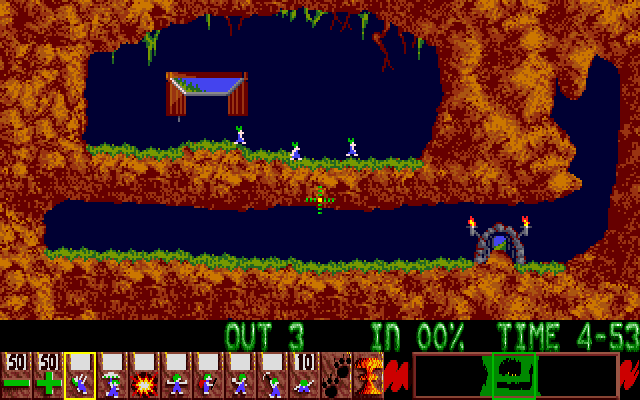
Our Emu198x capture of Lemmings, DMA Design/Psygnosis, 1991, Amiga. The walkers are on the upper platform; the exit is below. Digging changes the ground between them.
The opening level, Just Dig!, is a fine invitation. Instead of asking us to memorise all eight jobs before starting, it gives a simple situation and a useful tool. A creature can dig down through the ground towards a route to the exit. We can see what changes, and the following lemmings benefit from the opening. 13
That last point is the beginning of the whole game. One small job has changed the route for everyone behind it.
A direct-control game usually asks us to keep making the right movement: move right, stop, jump. Lemmings asks us to arrange conditions under which movement will turn out well. Once a safe tunnel exists, every walker reaching it can use it without a separate command.
The distinction becomes especially clear if we imagine clicking on each creature and carefully guiding it home. That would be a different game, with a great deal of repetitive work. Here the satisfaction is finding a small intervention which does useful work repeatedly.
It also makes cause and effect visible. The lemming digs; the ground disappears; later walkers take the new route. We can understand the relationship without knowing how the program represents either a creature or a hole.
The easier levels matter for more than politeness. They let us build a working idea of the world before the world starts asking several things at once. Later difficulty can then come from combining familiar possibilities.
Little creatures, dependable habits
A walking lemming continues until something changes its situation. A wall turns it round. An edge makes it fall. A sufficiently dangerous fall kills it, while a floater can descend safely with an umbrella. A climber can get up a vertical surface that would turn a normal walker back. 2
These habits are limited, which is why we can plan around them. The crowd does not independently decide that our lovely bridge looks risky or that the exit is boring. We are responsible for arranging the route, but we can rely on the creatures to keep following their rules.
An individual also has a current activity. A walker and a builder behave differently at the same piece of ground. A builder does not have to be a completely separate kind of creature; it is a lemming whose present job changes what happens next.
This gives us a concrete way into states in a program. The word state means the information which matters to its next behaviour: walking or digging, facing left or right, and whether it has learnt a permanent ability such as climbing. A useful explanation begins with the visible difference, then opens the code-sized idea behind it.
We should not mistake simple individual rules for a simple game. The paths of many creatures overlap. A tunnel dug for one group can divert another. A builder can become a walker at precisely the moment we are busy elsewhere. The difficulty grows from those interactions.
Eight jobs, many combinations
The original set of skills gives us ways to change a lemming, the terrain or the movement of the crowd. 2
| Job | What it changes | The question it creates |
|---|---|---|
| Climber | The individual can climb vertical surfaces | Where will it go after reaching the top? |
| Floater | The individual can survive a long fall | Does the landing lead anywhere useful? |
| Bomber | A countdown ends in an explosion | What must be removed, and what else is nearby? |
| Blocker | Other walkers turn back | How will we open this route again? |
| Builder | A short staircase is added | Will it reach, and when will it stop? |
| Basher | A horizontal passage is dug | Is there suitable ground ahead, and where does the passage emerge? |
| Miner | A diagonal downward passage is dug | Will the slope reach the intended place? |
| Digger | Ground directly below is removed | Who else will fall into the shaft? |
The questions are as important as the definitions. Knowing which icon means builder does not tell us where to begin building.
Give a lemming the right job in the wrong place and it may perform that job perfectly while ruining the plan. A tunnel can be beautifully horizontal and still emerge over water. A staircase can be complete and still stop short of the ledge.
That makes the game more interesting than selecting the tool with the same name as the obstacle. We need to reason about the result in the actual landscape. Several jobs can contribute to the same route, and a tool which looks irrelevant may become useful once we have changed something else.
Imagine a crowd approaching a pit while one pioneer is building a bridge. A blocker can keep the crowd away until the bridge exists. The builder and blocker solve different parts of one problem: making a crossing and buying enough time to make it.

An original invented example, not an actual level solution. Holding the crowd and preparing its route are separate tasks which can support each other.
Twelve bricks are not a bridge to anywhere
A builder lays twelve steps, then pauses briefly before returning to walking unless given another building assignment. 2 That limit makes the starting position a resource.
Start too far from a gap and some of the steps are spent getting to it. Start near a low ceiling and the ascent can run into it. Start in the wrong direction and a technically successful staircase goes somewhere we did not want.
Now suppose the gap needs two building assignments. We must return to that particular worker at the right time and spend another use of the skill. The job has changed from one click to a small appointment we need to keep.
Meanwhile, the rest of the level continues. A builder’s finite supply creates a reason to look away from the crowd, while the crowd creates a reason not to look away for too long.
That is how a game can produce urgency without requiring an enemy to hunt the pointer. Our own earlier decisions create future demands on our attention. We are managing the consequences of work already in progress.
The ground remembers
A basher’s passage stays open. A digger’s hole stays dug. A builder leaves steps behind. The landscape becomes a record of what we have done.
That matters because a job can outlast its worker. The lemming which builds a bridge may walk away, but the bridge keeps helping others. One creature’s brief action can become shared infrastructure.
A blocker makes that persistence especially visible. It turns back the crowd, and we need a plan for opening the route again. The manual calls bombing it one way to get rid of it. 2 The word “one” matters: we should investigate how the terrain and a creature’s current activity interact, rather than assume that learning an icon definition has taught us the whole system.
Terrain also creates dependencies. Digging a passage may be safe only after the crowd has been contained. Removing that containment may be safe only after the far end is ready. We can know all the individual actions and still perform them in a disastrous order.
The same few tools now offer a chain of changes to work out. We do not need to discover a ninth tool; we need to put the ones we know together. The screen is both a place and a partly constructed solution.
For our own examples, this is a worthwhile distinction to preserve. A decorative explosion changes what a game looks like. An explosion which removes ground changes what can happen there afterwards. The destructible terrain entry follows that broader idea.
A crowd is also a clock
The trapdoor does not normally release everyone in one lump. New creatures arrive over time, and the release-rate controls change the spacing of that stream. The level also has a time limit and a rescue requirement. 2
Spacing changes how much opportunity we have between arrivals. A pioneer may need time to finish before the next walker reaches an edge. A dense group can be harder to select accurately. Turning up the release rate may help get everyone out before the deadline, but it can also bring the crowd to unfinished work sooner.
So there are several clocks to think about. The displayed timer is one. The next creature arriving at a dangerous point is another. A builder about to run out of steps is a third.

An original timing schematic. The numbers are illustrative, not measurements from the game's release-rate formula.
Pause gives us a chance to inspect and think. It cannot perform the plan on our behalf. Once play resumes, the route still has to be ready when the creatures get there.
Knowing the plan and carrying it out can feel miles apart. We may know exactly what should happen and still be looking at the wrong part of the level when it needs to happen.
Saving enough, and wanting to save everyone
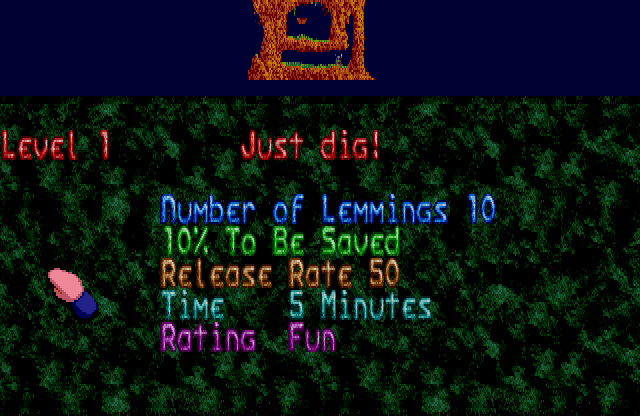
Our Emu198x capture of Lemmings, DMA Design/Psygnosis, 1991, Amiga. The first briefing asks us to save just one of ten lemmings, leaving plenty of room to experiment.
The opening briefing gives us ten lemmings and asks us to save 10%: just one. 1 That is a generous invitation to try something. We can get a first success before we have learnt to manage a whole crowd.
The level does not always require every creature to reach the exit. Its target permits some losses; other challenges demand much more. 2
That gives the designer room to accept different solutions. A route which loses one pioneer may still be successful. Another player may spend much longer finding a way to save that pioneer too.
The arithmetic is approachable. In an invented level with 50 lemmings and an 80% target, 40 must reach the exit. Ten can be lost without failing that requirement. But knowing the allowance does not tell us whether we are happy to use it.
That gap between the formal goal and the goal we choose is part of the pleasure. A success screen can say we have done enough while we decide to try again for something better.
The characters make that choice feel surprisingly personal. They are tiny and interchangeable in many of their rules, but a builder at the edge of a long staircase can become our builder. We have watched it work, planned around it and remembered to return before the bricks ran out.
The game also makes dark jokes of disaster, with explosions, traps and the option to end a hopeless attempt. It is possible to enjoy the slapstick and still care about saving them. Neither response needs to become a theory about what all players are like.
When the plan is right and the click is wrong
The mouse is a wonderfully direct way to point at a creature, until several creatures occupy almost the same place. Then the task changes from choosing a good action to selecting the intended individual.
The original interface helps by identifying what lies beneath the cursor. The minimap shows where the visible window sits within the larger level, and the panel keeps skill counts and rescue progress nearby. 2 Those are working instruments, not extra decoration.
Even so, a level can be difficult for reasons which are hard to distinguish. Did we misunderstand the route? Choose the wrong skill? Click a walker facing the wrong way? Miss a brief opportunity? Learning from failure depends on being able to answer.
That is worth taking seriously when we praise the game’s difficulty. The challenge of discovering a solution and the challenge of entering it accurately can support one another, but they can also pull apart. A brilliant plan can be buried beneath repeated fiddly execution.
Later community tools would revisit that relationship. We do not have to declare the original mistaken to ask what happens when a player can replay a solution, step through events or undo an input. Different tools let us keep different kinds of challenge.
The level designers had to learn how to teach
The original Amiga game presents 120 single-player levels in four groups, Fun, Tricky, Taxing and Mayhem. Terrain can reappear with a different allowance of skills, making a familiar shape into a new problem. 3
An abundance of tools can let us improvise a generous solution. Remove most of those tools and the same geography asks us to find an economical one. The picture need not change for the problem to change.
Mike Dailly’s retrospective account describes Gary Timmons making simpler introductory levels and grading the sequence. 4 That is a substantial design task. After months of building puzzles, their creators know far more than someone picking up the mouse for the first time.
The opening has to teach the reader of this visual language, not celebrate how fluent the designers have become. A level such as Just Dig offers a quick success with an explanation embedded in the action. Later levels can trust that earlier learning.
There is a useful caution here for our own curriculum. Once we know the solution, a task can seem obvious. That feeling tells us about our knowledge, not necessarily about the quality of the explanation. Watching someone else attempt the task reveals steps we have stopped noticing.
A small animation in Dundee
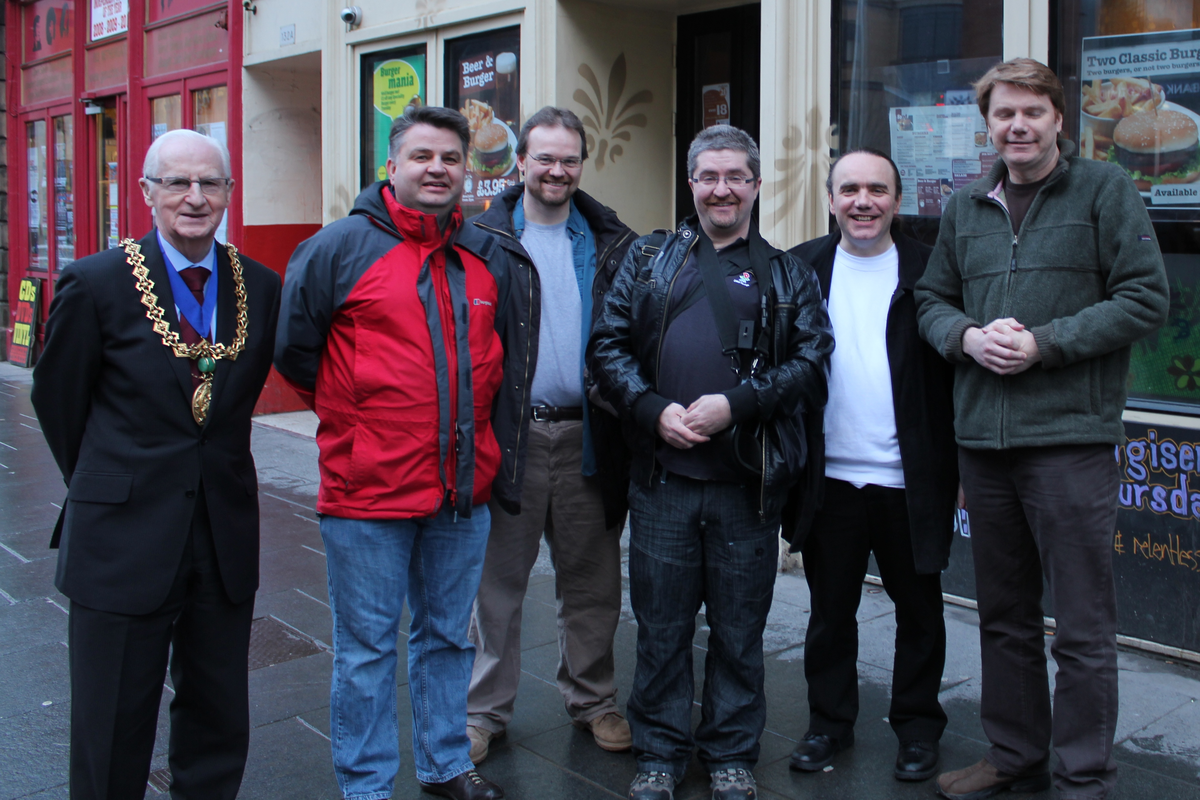
Twenty years later, a shared achievement. At the 2011 Dundee anniversary event, left to right: John Letford, Russell Kay, Mike Dailly, Steve Hammond, Gary Timmons and Dave Jones. Photograph credited to Steve Hammond, CC BY-SA 2.0; resized, no crop.
Photograph source and credit · CC BY-SA 2.0.

Lemmings began within DMA Design’s working life in Dundee, with friends and colleagues experimenting on available machines. Steve Hammond traces the studio’s roots through the Kingsway Amateur Computer Club; it was a local network before it became a famous name. 5
Dailly’s account places an animation experiment alongside work on Walker. He wanted to demonstrate how small a recognisable moving figure could be; Gary Timmons developed the character further. The creatures were funny before there was a finished game for them to inhabit. 4
This is a wonderfully practical origin. A promising bit of animation can suggest a game, rather than merely illustrate a game already designed. Watching small figures move invites a question: what could we ask a player to do with them?
The shift towards rescue is what makes the answer distinctive. A crowd can supply targets in a shooting game, scenery in a city or units in a battle. Here its inability to look after itself gives the player a job.
The name draws on the familiar image of lemmings following one another into danger. It is a cartoon premise, not a lesson in animal behaviour. Real lemmings are rodents, and the popular story of deliberate mass suicide is false. 6 The game only needs us to understand what these fictional walkers do.
Painting, animation and the world outside games
The art tells us what the creatures are doing. The green hair and blue bodies separate a very small figure into recognisable parts. A builder’s labour, a basher’s fists and an umbrella opening have to read while other creatures are moving nearby.
A bigger character might show more detail, but it would occupy more of the landscape and change the scale of the puzzles. Smallness helps make a crowd possible. Expressive animation stops the crowd becoming an anonymous moving texture.
Dailly also reproduces Gary Timmons’s character sketches, made after development had begun to show Psygnosis what the tiny figures were meant to look like. 4 A publisher needed characters it could put on a box; a handful of moving pixels left plenty for the artist to decide.
The team used Deluxe Paint, and its familiar interface helped shape the level-making tools. 4 That links the game to the working habits of Amiga artists as much as to other games. A tool which makes it easy to try something can influence what people are willing to attempt.
The environments also brought Psygnosis’s other games into view. Special levels used imagery associated with Menace, Awesome and Shadow of the Beast. Contemporary reviewers recognised those borrowings. 3 A publisher’s catalogue could become a shared imaginative landscape rather than a list of unrelated boxes.
Other references are smaller: a level title can recall television, a film or a joke familiar to its maker. We should explain a reference when it improves our understanding of the level, without making knowledge of that programme the price of understanding the puzzle.
A voice, a tune and a picture on the box
A lemming’s cry can make an event legible before we have looked back at it. The music keeps a long bout of planning company; brief vocal reactions give individual actions punctuation. The sound belongs to the experience of managing the crowd.
Contemporary and later accounts credit Brian Johnston’s early sound work and Tim Wright’s music. Wright recalled being called in to replace material based on familiar screen themes. 7 The eventual mixture of recognisable tunes and game music is part of the game’s character, while the change also shows that the soundtrack had production and permission constraints.
Outside the running game, the characters had to work at another scale. Dailly credits Adrian Powell with box art, promotional material and the logo. 4 Packaging could promise an expressive little person where the screen supplied only a few moving pixels.
That is not necessarily a dishonest promise. Players routinely supply imagined detail between the picture on a box and the picture a machine can draw. The animation has to give that imagination enough evidence to work with. A tiny figure pausing on its staircase can suggest effort more effectively than a larger still image.
More than one person making the puzzle
The familiar DMA story can too easily become a single name attached to a hit. The credits and contemporary reporting instead reveal connected jobs: Dave Jones, Mike Dailly and Russell Kay in programming and development; Timmons in character animation; Scott Johnston in environments; further work across machines, music and tools. 38
Psygnosis contributed testing, publishing and the route to buyers. Dailly describes level feedback returning from the publisher with timings and difficulty judgements. 4 A level which its author can solve quickly may need someone outside the room to reveal where it confuses or exhausts a newcomer.
That gives production a visible role in the design. Test reports are useful when they lead to a better order, a clearer introduction or a changed puzzle. Marketing is useful when the game reaches people who would enjoy it. Neither task is automatically secondary because the program runs without it.
The different origin accounts do not agree on every moment or attribution. 8 We can preserve that uncertainty without losing the main point: the animation, character, tools, rules and levels were collaborative work. Lemmings became a game through many decisions after someone first noticed a funny moving figure.
Getting the small creatures onto the shelf
Psygnosis had a striking visual identity, but a box could not demonstrate the pleasure of a plan working. Screenshots, demonstrations and reviews had to help a potential buyer imagine what those tiny figures were doing.
The One gave the Amiga game 96% and listed a price of £24.99. 3 That was a substantial purchase, and the offer included a large sequence of puzzles rather than a brief novelty. The level passwords mattered to that offer: after solving a difficult room, we could record a way back without having to repeat everything on our next visit. 2
The product could therefore offer both a quick experiment and a long undertaking. Someone might enjoy learning the first tools while someone else spent weeks pursuing the hardest puzzles. That range helps explain why the introduction and the later level design deserve equal attention. A hundred difficult rooms are little consolation if the opening persuades a newcomer to stop.
The reviews were enthusiastic, but enthusiasm does not make a sales figure reliable. Later accounts offer different totals across different periods and versions. The Vault entry keeps those claims together rather than turning the largest number into an unquestioned lifetime total. 8
More useful than a contest over the total is what the success allowed people to do next: commission new levels, adapt the game for other machines and bring the characters back in new products. Each step created work for further programmers, artists, designers, publishers and testers. The little crowd on the screen had become something a much larger crowd of people could work on.
A second mouse changes the question
The Amiga version also has two-player play, using a second mouse. Each player has an exit and can rescue lemmings from either side. 2
That changes the meaning of a safe route. We may both want creatures to survive, but we want them to survive through different doors. A useful bridge for one player can become an opportunity for the other; a tunnel can redirect work that someone else has prepared.
The shared rules acquire social uncertainty. Against a fixed level, we can eventually learn what will happen. Against another person, the landscape can carry someone else’s response to our plan.
Dailly names Populous and Stunt Car Racer among the games the team were playing when they experimented with multiplayer connections. 4 That is a documented influence on a particular part of the work, not a reason to describe every Lemmings rule as descended from those games.
It also reminds us to name versions. The manual says the PC edition lacks two-player mode. A game reaching many machines does not mean every audience received the same possibilities. 2
What travels, and what changes
The Spectrum version reduced the original’s level count; consoles asked players to select and command with different controls; the PC accommodated different graphics and sound hardware. The focused Lemmings Vault entry follows those conversions and their source trail. 8
A successful adaptation needs to preserve the parts which carry the experience. If selecting a lemming becomes slow, that is a design change even when the landscape looks familiar. If a screen shows less of the level, looking ahead and returning to a worker become different tasks.
That makes conversions useful studies of judgement rather than a ranking by colour count. An artist may simplify a character to keep its action readable. A programmer may reduce the crowd to keep the game responsive. A designer may change a level which no longer works comfortably with the new controls.
We can ask what each choice costs without assuming the smaller machine’s version must be worthless. Different players first met Lemmings through different compromises, and those meetings belong to its history.
More levels, or a different game?
Oh No! More Lemmings followed in 1991 with another set of challenges. Its attraction was partly that the vocabulary already made sense: players could get on with finding new combinations instead of learning an entirely new way to play. Seasonal Lemmings releases made another use of the familiar characters and machinery. 8
Lemmings 2: The Tribes arrived in 1993 with twelve themed groups and a much wider selection of skills. 9 That offers a different kind of abundance. More tools can create delightful surprises, but they also ask the player to learn more before making a confident plan.
The difference is useful. The first game’s depth often comes from extracting another solution from eight familiar jobs. A sequel can deepen that vocabulary, enlarge it or change the situation around it. None guarantees a better puzzle merely by increasing the number on the box.
The series also tried three dimensions, action and other forms: 3D Lemmings, Lemmings Paintball, The Adventures of Lomax and Lemmings Revolution. 8 Some keep the challenge of guiding creatures; others carry characters into a different kind of play. A brand’s history and a design idea’s history can diverge.
From a shared machine to a pocket screen
Team17’s PSP Lemmings in 2006 returned to the familiar rescue structure and offered an editor and ways to share levels. Sony’s announcement made creation part of the product’s appeal. 10
That changes the audience’s role. People who understand the tools well enough to solve a puzzle may start arranging those tools and obstacles for someone else. Designing a fair, surprising level asks questions that completing one does not.
Sad Puppy’s 2018 mobile game adapted the experience around a portrait screen and touch controls, with in-app purchases. Its launch account explicitly describes removing camera control to suit the device. 11 This is a design and business change, not merely the old Amiga game shrunk onto a phone.
The useful historical question is what survives those changes. A player is still looking at a vulnerable group and trying to prepare a route. But the space available, the input method, the session and the way the product is funded can all shape how that responsibility feels.
We should follow those later games without treating their existence as proof that every original feature remained, or that every audience wanted the same thing.
A community rethinks the act of trying again
The community has also built tools and engines around creating and solving new puzzles. NeoLemmix describes its origins in Lemmix, whose aims included reproducing the DOS game’s behaviour while adding facilities such as frame stepping and saved replays. NeoLemmix then took its own route towards friendlier tools and new features. 12
That is a continuation through criticism as well as affection. If a player can inspect an event more carefully or repeat a sequence reliably, they can spend less effort re-entering actions and more on understanding the puzzle.
Something changes in exchange. The tension of performing several tasks in real time need not remain identical. A good study can recognise the value of both experiences rather than assume that convenience always leaves the game untouched.
The creative conversation carries on because the original question remains so fertile. A group is coming. The route is not ready. We have a few tools and a little time.
We could build a deliberately limited original example from that: walkers, a gap and one way to change the ground. Then watch how a single useful action becomes a route for everyone. The technical parts are interesting, but the reason to make them is already visible. We want to get these little people home.
Sources and further reading
- Lemmings, DMA Design/Psygnosis, Amiga, 1991: selected execution attempts and manual comparison. Evidence and limits distinguish observed play, manual rules and our invented examples.
- Psygnosis, Lemmings / Oh No! More Lemmings combined manual, copyright 1991, English section pp.11–17; illustrated skills pp.4–10. Preserved scan. This later combined manual includes data-disk instructions; it is not silently presented as the first retail manual.
- The One 28, January 1991, pp.46–50, review and “The Art of Rodent Design”; Amiga Format 20, March 1991, pp.62–63; ZZAP! 72, April 1991, p.75. Contemporary accounts retained and qualified in the Lemmings Vault source trail, including level groups, introductions, art and two-player play.
- Mike Dailly, The Complete History of Lemmings, revision 17, copyright 2006: a participant’s retrospective account of animation, tools, level making, collaborators and multiplayer experiments. Interpretations, uncertain memories and sales estimates are not independent audits.
- Steve Hammond, About DMA Design: participant account of the club, people and studio’s development.
- Alaska Department of Fish and Game, Lemming Suicide Myth: real animal behaviour and the false popular story. No claim that the DMA team watched a particular wildlife film.
- Tim Wright’s recollection in Arcade 2, January 1999, p.174, and original credits, documented in the Vault’s music source trail. The study does not adopt unverified legal-dispute or public-domain claims about particular tunes.
- Lemmings Vault entry, with contemporary and retrospective sources for credits, differing origin accounts, conversions and later releases. This study adds an account of play; it does not replace the reference article’s detailed coverage.
- ST NEWS 8.2, contemporary Lemmings 2 account, 1993: twelve tribes and the expanded design. See the Vault source trail for the Amiga release context.
- Sony Computer Entertainment America, PSP announcement, 20 March 2006: Team17, editor and sharing features. Its announced May date is North American, not a worldwide first-release date.
- Serkan Hassan, Sad Puppy, Lemmings Comes to Mobile Devices Today, PlayStation Blog, 20 December 2018: portrait orientation, touch redesign, camera decisions and in-app purchases. Dated launch description, not a current availability or pricing promise.
- NeoLemmix project, its own account of Lemmix/NeoLemmix and their differing goals. Community tools do not confer rights in Psygnosis’s original art or levels.
This study has not yet been fact-checked. Selected early encounters were observed; a complete playthrough is not claimed. Original documents and source analysis support the wider account.
Lemmings · DMA Design · Psygnosis · Amiga · 1991. Own screenshots illustrate criticism and review. Rights in the game remain with their owners. The header and explanatory diagrams are original illustrations. Photographs and advertising carry their own credits and rights records alongside each image.
Canonical study · Evidence and capture credits · More game studies