

There is nowhere for the danger to hide. The platforms, the moving guardian, the flashing objects and the exit are all on the screen. Miner Willy stands at the edge of Central Cavern, and the air is already running out.
You can see the problem. That does not mean you can solve it.
A jump which looked comfortable from the other side of the keyboard turns out to need a better starting point. Waiting for an enemy to pass costs air. A useful floor may not survive another visit. Before long, the room you first saw as a picture becomes a sequence of decisions: cross here, wait there, collect that, then get out.
Matthew Smith’s Manic Miner, published by Bug-Byte for the ZX Spectrum in 1983, makes an extraordinarily rich game from that exchange between seeing and doing. Twenty caverns share a small set of controls, but finding a way through them asks for observation, planning and practice. The mutant telephones help too. A mine this unreasonable deserves unreasonable inhabitants. 12
Everything you need, almost within reach
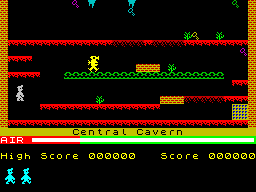
Our capture of Manic Miner, Matthew Smith/Bug-Byte, 1983, ZX Spectrum. Central Cavern shows the immediate problem whole: objects to reach, hazards to avoid and an exit that is not ready yet.
The basic task is easy to explain. Collect the flashing objects in the cavern. Once they are all gone, the portal becomes available; reach it before the air runs out. Touch a deadly creature or hazard and lose a life. Then try again. 12
That second part of the task matters. Collecting the last object is not the finish. You still have a body in a place, and that place may be a long way from the exit. A route which efficiently gathers everything can leave a dreadful final journey.
Look at the opening room. The platforms are not a stack of interchangeable shelves. Their lengths, gaps and heights determine where Willy can go. The guardian’s path gives one area a moving danger. The items give us reasons to visit different parts of the room. The portal makes those visits into a round trip rather than a shopping list.
We can begin to plan before pressing anything. Perhaps a ledge will give us a safe place to wait. Perhaps collecting a particular object on the way back will save crossing a hazard twice. But the plan has to fit the way Willy moves. Drawing an imaginary line across the screen is the easy part.
This is one reason the single screen is so effective. It gives the player enough information to form an intention, then makes carrying out that intention interesting. We are rarely wondering what exists beyond the edge of the camera. We are wondering how to get to something we can already see.
A jump is a commitment
Willy can move left, move right and jump. Three actions sound like a small vocabulary until you have to choose the exact place and moment to use them.
His jump has a set rise and fall. It does not become a higher leap because you desperately need another few pixels. The original routine advances through a sequence of vertical changes; the horizontal movement chosen for a moving jump continues during it, rather than offering modern free steering in mid-air. 3
That makes the take-off point part of the decision. Start too early and the descending part of the arc may meet the gap. Start too late and the ascent may meet something overhead. A gap is a relationship between the floor you leave, the floor you hope to reach and the space between them.

An original schematic, not a measured reconstruction of Willy's trajectory. A safe landing needs both enough reach and a clear place to arrive.
Now put a patrolling enemy on the far platform. The distance has not changed, but the question has. We must arrive when the landing space is clear. Watching where the enemy is now is not enough; we need a rough idea of where it will be when Willy comes down.
That is prediction on a small, visible scale. We do it by watching the movement repeat, recognising a useful moment and trying a jump. Failure can improve the next attempt: a little earlier, a different take-off point, or a pause on the previous ledge.
The Game Feel material can take that further. How quickly should movement respond? What should happen when we release a control? How much correction should a jump allow? Manic Miner gives us a particular answer, shaped around deliberate commitment. It is useful to understand that answer before deciding whether we would want it in our own game.
The floor joins in
A solid ledge is a promise that a piece of the route will still be there when we return. A crumbling ledge weakens that promise.
Willy can stand on some surfaces only briefly before they give way. Conveyors move him along, changing the relationship between pressing a direction and getting where we intend. Static hazards make apparently open space dangerous. The underlying cavern description distinguishes these materials, so changing the arrangement changes what the room asks us to do. 3
Consider an imagined room with a collectable beyond a strip of crumbling floor. Going straight across may be easy. Coming back may be impossible because we have used up our return route. The mistake happened before we fell: we treated the outward journey as though it had no effect on the inward one.
That is a different kind of challenge from a narrower gap. We need to think about the state we leave behind. A floor can be part of the level’s memory.
A conveyor produces another question. If it carries Willy towards a hazard, waiting is not neutral. We may have to move simply to remain safe. Two rooms with the same jump distances can feel very different when one lets us stop and the other keeps applying pressure.
Try replacing a solid ledge with a conveyor. The route may still be possible, but the chance to stand still has gone. A new floor texture becomes meaningful when the player can learn what it does. Attractive scenery and information have to work together: a ledge should look enough like a ledge to invite a plan, while the dangerous exception needs a way to become recognisable.
Twenty rooms, different problems
Manic Miner keeps the action local but does not make every cavern the same exercise. The Cold Room, Eugene’s Lair, the Kong Beast caverns and Solar Power Generator give familiar movement different circumstances. 23
In Eugene’s Lair, collecting the final object changes Eugene’s behaviour around the exit. The collection order therefore matters for more than distance. The thing which appears to complete the shopping list changes the conditions for leaving. 3
That is a lovely piece of mischief. We learn the general rule—collect everything, then exit—and discover that knowing the rule is not the same as having a good plan for this room.
The Kong caverns bring switches and a conspicuous giant creature into the arrangement. Solar Power Generator makes a beam and its route through the room part of the danger. These changes give individual caverns identities without requiring a new control scheme every few minutes. 3
The titles contribute too. Attack of the Mutant Telephones does not need a page of explanation. Ordinary objects have become enemies, and their absurdity makes the screen easier to remember. We can talk about the telephone room or Eugene’s room rather than a bare level number.
A sequence of rooms can therefore teach a shared language while finding new things to say with it. Repetition helps us become competent. Variation stops competence becoming routine.
Air makes waiting a decision
The air bar puts a limit on each attempt. It decreases while we play; remaining air becomes a bonus when we finish a cavern. The game therefore gives time two jobs: it threatens our survival and rewards an efficient solution. 13
Without that pressure, a player could wait indefinitely for a guardian to reach an especially comfortable position. With it, waiting is a purchase. We buy a safer opportunity with some of the time available to finish.
That does not make the fastest route automatically the best one. A risky shortcut which repeatedly kills Willy may be worse for us than a slower route we can carry out reliably. The game leaves room for the difference between a route we can describe and a route we can actually perform.

An original invented-room comparison. Neither route is a solution to an actual Manic Miner cavern; the diagram shows why distance alone cannot tell us which route to choose.
Lives extend that calculation beyond a single screen. Reaching a later cavern can mean protecting the successful work which came before it. Familiar rooms become a journey back to the new problem. For some players that repetition turns awkward jumps into satisfying skill. For others it is an admission charge they no longer want to pay.
Both responses are worth understanding. A game can be memorable, carefully made and still shut some players out. Being able to finish all twenty caverns is not a condition for enjoying their jokes or learning from their design.
A tiny theatre, with a tune that will not leave
The Spectrum’s pictures are small, but Manic Miner rarely feels short of character. Willy’s hat, his walking animation and the guardians’ shapes give motion something to belong to. A familiar household object in the wrong place can do more imaginative work than a complicated invented monster.
The room names and theatrical hazards invite us to accept a world which operates by dream logic. We need consistency from the movement and collisions; we do not need a sensible explanation for the toilets.
The music helps make that world recognisable. The title screen animates a piano keyboard to Strauss’s The Blue Danube. During play, Grieg’s In the Hall of the Mountain King repeats beneath the action. Period reviewers repeatedly noticed the achievement of keeping music going while the game ran; the disassembly shows how sound and game updates share the processor. 23
The Spectrum has no separate music processor to keep that tune playing while the Z80 gets on with everything else. Its beeper needs carefully timed changes from the CPU. Producing sound therefore shares a resource with moving Willy, checking hazards and drawing the screen. The beeper music entry explains that wider technique.
That technical work has an immediate effect on play. The tune makes another attempt feel like a return to the same peculiar place. Its repetition can also become wearing; the contemporary review noted the option to switch it off. 2 Sound can give a game identity while still needing an escape hatch.
Recognisable classical melodies also connect the game to music older than the computer. Their use is part of the game’s presentation, not evidence that every player could name the composers. You can recognise a tune long before you know where it came from.
Before Willy: arcades, a Tandy and another miner
Manic Miner did not appear because no one had thought of platforms before. Smith had played arcade games and wanted their pleasures at home. In a 2005 on-stage interview with Paul Drury, he specifically recalled putting some Donkey Kong into his game, and identified Bill Hogue’s move from TRS-80 games to the Atari 800 as an important inspiration. Miner 2049er is the earlier mining platform game at that point in the story. 45
The comparison is revealing without making the games interchangeable. Miner 2049er asks its character to cover the platforms of each area. Manic Miner directs us towards particular objects and a portal. A shared vocabulary of jumps, hazards and mining becomes a different set of reasons to travel. 5
Smith’s earlier machine was a TRS-80. He remembered children congregating in a Liverpool Tandy shop, learning the machines and sometimes doing small software jobs for customers. That is a more useful picture of his beginnings than a teenager materialising alone with a completed hit. Shops, friends, accessible machines and a publisher all helped make the work possible. 4
His route also crossed hardware. He developed Z80 code on a Tandy system and transferred it to the Spectrum, rather than requiring the computer which ran the game to supply every development tool. 2 That distinction still matters whenever we build for a machine with fewer resources than our everyday computer.
We can trace earlier platform games outwards from here without turning the study into a contest for a single inventor. What matters locally is the choice Smith made with the ideas available: a full room on screen, an exacting little figure and twenty increasingly strange places to put him.
Designing the rooms, making the product

Matthew Smith at Screenplay, Nottingham, 2005: the interview discussed below comes from this festival. Photograph by Jontintinjordan, CC BY-SA 3.0; converted to PNG, no crop.
Photograph source and credit · CC BY-SA 3.0.

In the 2005 interview, Smith recalled drawing Manic Miner’s screens in a red notebook. 4 Paper is a useful place to begin a game whose geography can be seen all at once. A platform can be moved without waiting for the program to run.
But a drawing cannot settle how a room feels. The same arrangement must work with a particular jump, a particular guardian speed and the time allowed. Moving a ledge a small distance can turn an apparent route into an impossible one. Making the player repeat it reveals costs that are easy to miss on paper.
There are two closely connected kinds of authorship here. One is writing the rules which let Willy walk, jump and collide. The other is arranging situations in which those rules become enjoyable—or wonderfully infuriating. A room editor can change the latter without requiring someone to rewrite the former.
That separation helps explain the game’s later creative life. The machinery supports many rooms, and the rooms give that machinery something worth playing. Our own projects can use the same distinction without borrowing Willy, the caverns or their artwork.
The commercial product was more than its running code. A buyer needed a tape that loaded, an inlay that explained the task, a name that stood out and a reason to choose it among other games. The game went on sale at £5.95; contemporary coverage establishes it was available during summer 1983. 2 The focused Vault entry keeps the conflicting magazine notices and their dates together.
A review could describe the amount of detail, praise the music and tell readers why this particular tape deserved their money. The customer’s experience then had to make that recommendation credible. Twenty screens sound generous on an advertisement; getting beyond the first few determines how much of that promise a player can reach.
Success does not explain a whole life
Smith moved from Bug-Byte to Software Projects, founded with Alan and Soo Maton, and Manic Miner was reissued there. Contemporary reporting distinguished the publishing licence from copyright; the game could move because those were not the same thing. 26
That is an important part of the history of a game made by a young programmer. Writing the program, owning it, publishing it and getting paid for it are separate matters. Success makes those relationships more consequential, not automatically simpler.
The sequel also brought pressure. Smith later described the difference between the pleasure of making Manic Miner and the strain of following it with Jet Set Willy. 4 We do not need to turn that into a diagnosis or repeat every story told about his subsequent absence from the industry. His account is enough to show why a chart success does not guarantee a comfortable working life.
The energetic figure people meet through Willy is a character. The person who created him had work, friendships, business arrangements and a life beyond the machine. Keeping those separate makes the history more human, not less interesting.
From a cavern sequence to a place to explore
Jet Set Willy followed in 1984. Willy’s fortune has bought a mansion, and his housekeeper will not let him go to bed until he clears away the remains of a party. Familiar movement now serves a connected place, with rooms we can visit in different orders. 6
That changes the use of memory. In Manic Miner, we practise a succession of self-contained challenges. In Jet Set Willy, we also remember how rooms join, where an object remains and which journey we want to make next. The mansion turns platform skill towards exploration.
A recognisable room can be useful even before we can solve it. We can leave, find another way around and return with a better picture of the house. The Jet Set Willy entry examines that game in its own right; the link is an invitation to follow a changed experience, not assume that the sequel is merely more screens.
Its release problems belong to the account too. Contemporary readers documented faults and circulated corrections. 7 A player blocked by a software error is in a different position from a player who has not yet found the route. When a game asks us to trust that persistence will reveal a solution, an impossible situation damages that trust.
Jet Set Willy II enlarged the journey again. Derrick Rowson and Steve Wetherill’s accounts describe its development from the expanded Amstrad version and the work involved in fitting more rooms into the Spectrum. 8 The family was already becoming the work of further programmers, not an indefinitely repeated solo achievement.
When the audience starts making rooms
The later heritage includes conversions, remakes and a community which kept composing new challenges with the old games’ machinery. JSW Central documents complete games and variants, while Richard Dymond’s SkoolKit disassemblies make the original routines and room data inspectable. 39
Those are different kinds of continuation. A conversion asks how the experience survives another machine’s display, sound and controls. A newly designed cavern asks what else the existing movement can support. A disassembly lets us investigate a behaviour which previously had to be learnt by falling into it.
The trail is clearest where people tell us what they borrowed, or deliberately return to the old machinery to make something new. A later game containing ledges might have arrived there by an entirely different route. The wider genre is full of other paths.
Manic Miner’s lasting usefulness is unusually easy to demonstrate. Put a collectable on the far side of a gap. Choose a jump the player can learn. Add a moving hazard. Now ask where we should stand, when we should leave and whether we can get home afterwards.
Those questions can support a tiny original teaching example. A full recreation is unnecessary. What we would borrow is the care with which a room turns movement into intention—and the confidence that a few bright shapes can become somewhere people remember for decades.
Sources and further reading
- Manic Miner, Matthew Smith/Bug-Byte, ZX Spectrum, 1983: selected own execution and Central Cavern capture. See evidence and capture scope; no game media distributed.
- Contemporary source trail in the Manic Miner Vault entry: Personal Computer News, 11–17 August 1983, p.48; Personal Computer Games’ 1983–84 review/interview; Sinclair User’s reporting on the reissue. Used here for product, music, development and publishing context; exact notices and qualifications remain in the reference entry.
- Matthew Smith, original program, annotated by Richard Dymond in SkoolKit’s Manic Miner disassembly: movement routines 35515 and 35805; cavern-specific routines and data. An inspected technical interpretation of the original program, not an original author commentary or a licence to republish the game.
- Matthew Smith interviewed by Paul Drury, Screenplay, Nottingham, February 2005; Mark Green’s live-feed transcript. Retrospective testimony; the transcript contains uncertain spellings, interruptions and interviewer assertions which are not adopted wholesale.
- Bill Hogue, Atari Compendium interview; Nintendo’s Donkey Kong history. Context for the earlier games, alongside Smith’s own influence testimony.
- CRASH 4, May 1984, Jet Set Willy review, and CRASH 1, February 1984, news: the sequel’s premise and the publisher’s plans.
- CRASH 9, October 1984, readers’ correspondence: specific completion faults and corrections, rather than treating every problem as one indistinguishable Attic bug.
- Derrick P. Rowson and Steve Wetherill, comments collected by Julian D. A. Wiseman, Jet Set Willy II: the programmers speak: retrospective accounts of development. No map reproduced here.
- JSW Central, community catalogue and contributor accounts: continued creation with Manic Miner/Jet Set Willy engines. Community participation, not a claim that all listed games have cleared third-party rights.
This study has not yet been fact-checked. Selected early encounters were observed; a complete playthrough is not claimed. Original documents and source analysis support the wider account.
Manic Miner · Matthew Smith · Bug-Byte · ZX Spectrum · 1983. Own screenshots illustrate criticism and review. Rights in the game remain with their owners. The header and explanatory diagrams are original illustrations. Photographs and advertising carry their own credits and rights records alongside each image.
Canonical study · Evidence and capture credits · More game studies