
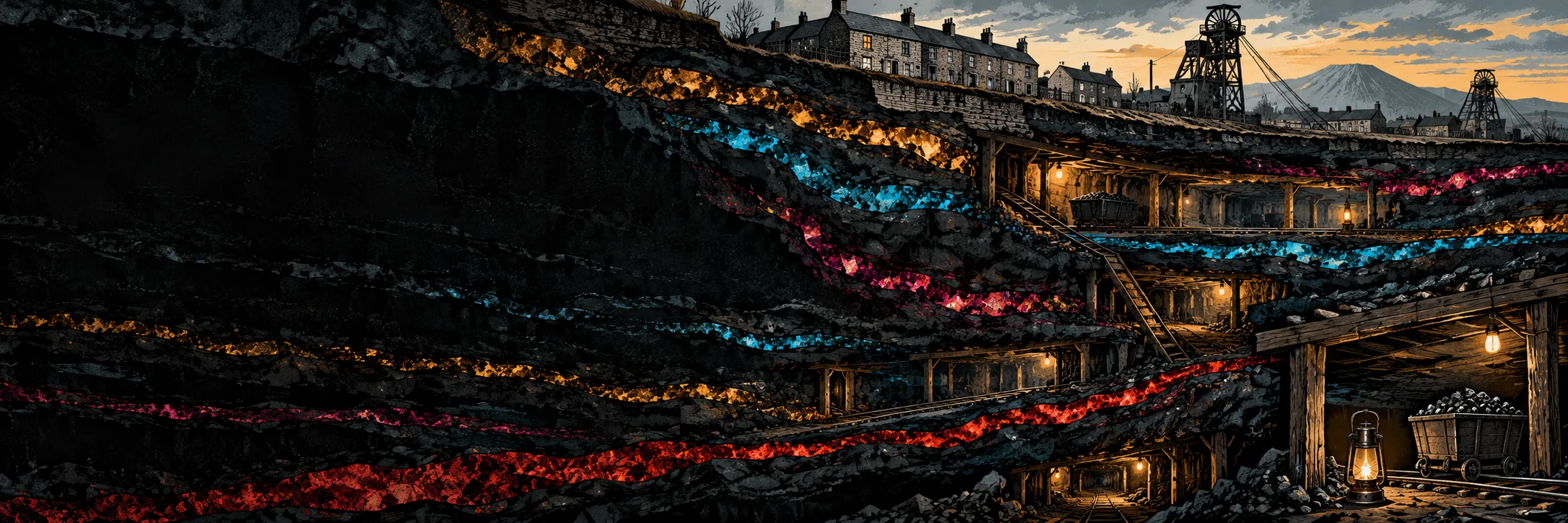
A bucket of coal, a very bad idea, and one of the Spectrum’s most likeable troublemakers.
Monty needs coal. Unfortunately, the place that has it is full of machinery apparently designed to flatten moles.
On the surface, things look almost welcoming. There is a house, a tree, a little bridge and a pit winding tower. Monty himself is small, round and splendidly unsuited to heroic posturing. He looks like someone who would rather get the job done and go home.
Then an acorn drops, a gap interrupts the bridge, and you begin to suspect that getting home will take a while.
Wanted: Monty Mole, published by Gremlin Graphics in 1984, turns a very ordinary need—keeping warm—into an extraordinary obstacle course. It is a platform game, so much of your time goes into moving, jumping and avoiding things. But the journey also depends on finding objects and discovering what they change. Knowing where to jump is only part of knowing what to do.
This study follows Peter Harrap’s ZX Spectrum game. Its coal mine, humour and difficulty make more sense when we also meet the family and Sheffield business behind it. They belong in the same story.
Before the mine
Look at the opening screen before moving. The bucket is on the left. Monty begins towards the right. Between them lies a crossing with a conspicuous gap. Above, the tree adds a moving danger to a landscape you might otherwise have mistaken for safety.
That is already quite a lot to ask of a new player. We need to discover how far Monty moves while a key is held, how a jump rises and falls, and when it is safe to cross. The screen gives us somewhere recognisable to try these things; it does not provide a protected tutorial enclosure.
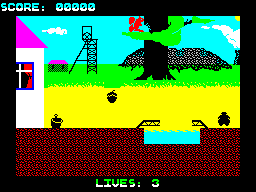
The journey starts above ground. The bucket and broken crossing give the first screen a job beyond setting the scene. Own capture of Wanted: Monty Mole, Gremlin Graphics, 1984, ZX Spectrum; active display cropped from emulator output.
The instructions put left and right on O and P, climbing on Q and A, and jumping on any key from B through Space. You do not need a keyboard full of commands. The difficulty lies in getting a few actions right while several things are happening around you. 1
There is a useful distinction here. A control scheme can be short without making a game easy. The small number of actions helps us remember what our hands should do. It does not tell us when to do it.
The bucket makes a second demand. It is essential to collecting coal: the original instructions tell you to take it before going underground. That makes it a prerequisite, an earlier action which enables a later one. A player who races towards the mine has missed something important before the main journey even begins. 1
There is a lovely economy to that idea. A bucket is an understandable tool for carrying coal. The game can use that familiar relationship without explaining a complicated inventory system. It also risks leaving an impatient player puzzled. A rule that feels obvious after discovering it can be surprisingly easy to overlook beforehand.
Getting to know a jump
A platform game quickly teaches you to look at empty space differently.
At first a gap is a gap. Soon you see a take-off point, the distance to a landing place, room for Monty’s head, and the hazard that may meet him there. You stop asking only whether he can reach the other side. You begin asking when he should leave.
A jump has a shape over time. Monty rises, reaches the top of his leap and comes down. Horizontal movement carries him across the room while that happens. A landing which looks possible from a still picture may fail because he is still too high when he passes the ledge, or already too low by the time he reaches it.

An original schematic, not a traced Monty jump. Reaching a ledge and arriving at a safe moment are separate problems. The exact arc and timing belong to each game.
That is why repeated attempts can change the way a room feels. The first jump may be an experiment. After several tries, the same movement becomes a little performance: move here, wait, jump now. What was uncertain becomes something your hands can repeat.
We should not mistake familiarity for a generous design. A narrow safe interval can remain awkward after you understand it. If a collision is hard to read, practice may teach you to stay farther away rather than reveal a satisfying boundary. The question is whether each attempt gives you enough information to improve.
Monty’s animation helps give these attempts a personality. You are directing a busy little animal, with a recognisable gait and a body that seems to belong in this strange world. A few changing pixels can make a missed jump feel like something that happened to a character, rather than a coordinate moving into the wrong rectangle.
That is a good route into The Craft: movement, animation and collision need to agree closely enough that a player can trust what they see. A beautiful walking cycle cannot compensate for an unreadable edge, but it can make a well-understood movement a pleasure to perform.
A room is a problem you can see
Underground, the screen becomes a compact arrangement of ledges, ropes, machinery and moving creatures. Much of the room is visible at once. That gives you a chance to look before acting, even if the hazards are not willing to wait indefinitely.
The first mine room is a good example. Its ropes suggest vertical travel. Platforms break that travel into stages. The crusher occupies space above a route you might otherwise treat as open. An exit can be visible without the way to it being immediately clear.
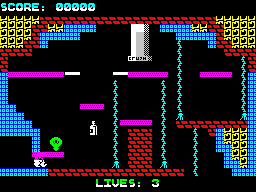
The first mine room makes a route out of height, openings and moving machinery. The crusher’s space matters even when the crusher is raised. Own capture of Wanted: Monty Mole, Gremlin Graphics, 1984, ZX Spectrum.
A still picture shows the arrangement. Play supplies the missing dimension: time.
A moving platform is a place to stand which will not stay where you found it. A descending crusher makes a temporarily open route lethal. A creature can turn a comfortable landing into an emergency. We have to combine the fixed shape of the room with what its moving parts are doing now.
It helps to separate two questions. Where could I go? is about the room’s layout. When can I get there? is about movement and danger. Good rooms let these questions complicate one another without becoming impossible to read.
The ropes make that especially clear. Horizontal movement and vertical travel have different jobs. You may have to reach a rope, decide where to leave it, then time a jump from a new height. A rope is more than scenery: it changes which parts of the room can be connected by your movements.
We can think about this without reducing the mine to a diagram of every route. Stand in one safe place and consider the next reachable place. Is there a ledge? Can a rope take you higher? Does a hazard make the direct route unwise? One room becomes a handful of decisions, each small enough to try.
The room changes when you learn something
The original game has 21 screens, but collecting things is not just a matter of sweeping every screen clean. Objects have uses, and some become available only after another object has been collected. The mine asks you to discover dependencies as well as destinations. Contemporary reviewers recognised that distinction from a straightforward collect-everything platform challenge. 2
That means there are two kinds of progress. Monty can move farther through the mine. You can also understand the mine better.
Suppose you have seen an object you cannot yet use or reach. Later you find something that changes what is possible. The earlier room acquires a new purpose. You have a reason to remember it and return, rather than treating every screen as a disposable obstacle.
This is where a platform game starts to feel adventurous. The actions remain immediate—walk, climb, jump—but the question stretches beyond the next hazard. What have I overlooked? What did that object change? Is the route blocked by my timing, my position, or something I still need?
Those questions can produce very different kinds of failure. Missing a landing tells you something about movement. Being unable to collect an object may tell you nothing until you discover its prerequisite. If both failures are presented without a useful clue, a player can spend a long time practising the wrong solution.
We met a related problem in Adventure. A closed route can depend on world state rather than better execution. Monty brings that question into a moving, dangerous picture. You must work out what the game wants while keeping the little fellow alive.
The crusher problem
There is an inviting kind of danger in a machine which rises and falls. Watch a cycle, spot an opening, dash through. It looks as though observation will turn terror into a timetable.
Monty’s crushers are less comforting. CRASH’s original review explicitly identified luck in getting past them. One reviewer thought that added excitement and nerves, even while recognising that it reduced the part played by skill. That is useful contemporary disagreement with the idea that every good platform hazard must be perfectly predictable. 2
We do not need to settle that argument by declaring the game fair or unfair as a whole. A better question is what the uncertainty does to this journey.
If you can judge a gap reliably, waiting and moving at the right moment can feel excellent. If a crusher can defeat an apparently sound attempt, the same passage can make you hesitate. The player may be frightened because the rule is dangerous, or frustrated because it is difficult to discover a dependable answer.
Both reactions can coexist. The relief of getting through may be real even when the attempt did not feel entirely under your control. The cost grows when a lost life also means repeating earlier rooms.
This is one of the reasons old games deserve close attention rather than automatic praise for being difficult. A remembered challenge may have been exciting, capricious, learnable, exhausting—or some mixture of all four. We learn more by asking which decisions the game lets us make than by admiring the number of times it can kill us.
Three lives make the familiar valuable
You begin with three lives. 1 That makes an early mistake matter beyond the few seconds it takes to recover.
A room you have learned becomes something you want to preserve. Getting through it cleanly leaves more chances for the unfamiliar room ahead. You are gradually assembling a journey out of sections you can manage with growing confidence.
There is satisfaction in that. The mine becomes less mysterious, and a route that once seemed impossible can become your reliable opening. Improvement is visible in what you can do, not only in a score.
There is also a cost. Repetition spends the player’s time as well as the character’s lives. If the familiar sections are still enjoyable, revisiting them can feel like gathering momentum. If they have become chores, the game is charging an entrance fee before every new experiment.
That distinction matters when we design difficulty today. Limited lives do not create stakes by themselves. They create a particular relationship between learning, repetition and loss. A short, satisfying repeat can sharpen the next attempt; a long, opaque one can discourage it.
Monty makes us feel that relationship because his mine is a place to learn, not just a set of disconnected challenges. The more we understand, the more we have invested in getting farther.
Colour, character and a very strange workplace
The mine is bright. Cyan ropes and magenta platforms sit beside red and yellow brickwork. Against black, those colours make the room’s parts stand out. It is a cartoon mine with an extravagant supply of things that should not be there.
That matters to how we read the danger. We can take the need for coal seriously without mistaking the game for a working model of mining. A recognisable pit, a mole with a bucket and outlandish hazards can sit together because the game establishes its comic world so quickly.
The Spectrum’s limited colour system also makes the choice of large coloured areas important. A screen has to communicate where Monty can move, which shapes are solid, and which objects are alive or useful. Decorative detail competes with that work. The frame above shows how much a few repeated textures can do: brickwork feels solid, ropes feel narrow, and black leaves room for movement.
Sound belongs to this first game on its own terms. It is easy to remember the later series through Rob Hubbard’s celebrated C64 music for Monty on the Run. That is a different game. Importing that soundtrack into our memory of this one gives the original an atmosphere it did not have.
The Monty on the Run entry follows that later development. Here, Monty’s movement, the screen’s changing hazards and the small scale of his predicament carry much of the character.
Coal was not an abstract collectible
For someone arriving without knowledge of Britain in 1984, the premise needs a little explanation.
The miners’ strike of 1984–85 centred on pit closures, jobs and the future of mining communities. Support differed between coalfields; arguments about a national ballot and picketing were part of the dispute. A “flying picket” was a striker travelling to another area to support or extend picketing. It was not originally a flying monster. Arthur Scargill led the National Union of Mineworkers. These were people and arguments in the news, not names invented for the game. 3
That knowledge changes the opening. Coal is something a household needs. A South Yorkshire pit places the cartoon adventure inside a recognisable local economy. The game’s jokes take familiar news language and make it absurdly literal.
Peter Harrap later described a direct family connection: his father was on strike, money was scarce, and coal was needed to heat the house. He remembered putting those frustrations into a game about a mole digging for things. That is his account of a particular circumstance and creative response. We do not need to invent further motives to make it matter. 4
The inlay pushes the satire further. Its adventure eventually takes Monty to Arthur’s castle, with ballot papers and a vote-casting scroll among its comic business. 1 That is Gremlin’s fictional framing of a conflict, not a neutral account of the strike or a reliable guide to Harrap’s political views.
A game can grow out of hardship and still be funny. It can also turn a complicated public dispute into a much simpler set of villains, obstacles and jokes. Looking at both gives us a fuller understanding than calling it a topical game and moving on.
A shop, a programmer and a publisher
Monty also belongs to Sheffield’s growing games business.
In Roger Kean’s 1985 visit to Gremlin, Ian Stewart described how the company grew from the Just Micro shop he ran with Kevin Norburn. Harrap’s repeated visits over a damaged Spectrum helped turn a customer relationship into a friendship and then a game proposal. Stewart recalled suggesting a mole and a platform game, with the mine setting drawing on Harrap’s father’s work. As the strike developed, topical details entered the game. 5
The account is wonderfully concrete. A shop supplied a meeting place. A programmer had skills and ideas. Other people could help shape, distribute and sell the result. The finished cassette came from those relationships as well as from code.
It is tempting to flatten this into a solitary young genius story because one programmer’s name is such a strong credit. Harrap’s authorship matters. So do the people and arrangements which helped a game reach buyers.
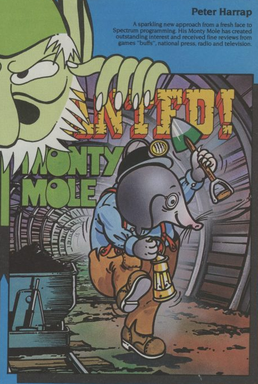
Gremlin sold the creator as well as the character. Detail from its two-game launch advertisement, Computer & Video Games 35, September 1984, page 25: Harrap’s name appears above Monty. Illustrator uncredited on the inspected page. Cropped and reduced for criticism/review; artwork remains with its owners.
Original advertisement · Excerpt provenance and credit research.
The advertisement places the new programmer beside his character and pairs Monty with Tony Crowther’s Potty Pigeon. A new publisher could offer two games while giving each a recognisable author. The cartoon sells a comic adventure before a buyer sees how the game actually looks on a television. 7
Stewart was equally clear about publicity. The Scargill caricature gave Gremlin a news hook, and getting the game into newspapers, radio and television took deliberate work. Attention did not arrive merely because the subject was topical. 5
That explains something a screenshot cannot: how a small publisher could put a new character in front of people who were not reading game reviews. The same subject could interest a player as a challenge, a journalist as a news item, and a publisher as a way to establish a name.
What the player was buying
CRASH reviewed the Spectrum game at £6.95 and awarded it 92%. Its reviewers praised the animation, colour, responsive controls and absorbing challenge, while noticing similarities to Manic Miner and Jet Set Willy. 2
Those comparisons tell us what a buyer might already have understood. Screens of platforms, a jumping character and lethal contact were familiar. Monty offered a new character, a connected mine, object questions and topical humour within that recognisable form.
The inlay had work to do before the tape reached the computer. It supplied a reason to enter the mine, explained the bucket, named hazards and promised a journey beyond coal collecting. A player’s idea of the adventure could be much larger than the visible screen because the packaging had already supplied a home, a winter and a story. 1
We should keep sales claims distinct from reviews and publicity. A high score tells us what a magazine’s reviewers thought. News coverage tells us the game escaped the specialist press. Neither, by itself, tells us how every buyer felt or supplies an audited sales total.
A year later, CRASH returned to the game and still valued its object-dependent changes to the route. That helps explain why the memory could last beyond the topical joke. The mine offered something to work out as well as something to survive. 6
What carries beyond Monty
Take away the coal and the cartoon, and several useful questions remain—but it would be a shame to take them away too quickly. They are what make these questions worth asking here.
A jump needs a shape you can learn. A moving danger needs enough information for you to judge it. A room needs routes you can read, then reasons to reconsider them. An object can change what is possible without adding another button. Repeated failure can teach, but it can also waste the patience you hoped to earn.
The game also shows how a small character can carry a large amount of meaning. Monty needs a bucket because he needs coal; coal belongs to a household; the household belongs to a place and a difficult moment. The game never has to stop and explain all of that for it to be present.
For a small original game of our own, we could investigate one gap, one moving obstacle and one object which opens a route. We would need to make each action readable before building a larger world around it. That is a possible teaching direction, not a commission to reproduce Monty’s art, rooms or name.
The original’s value is broader than a template. It lets us examine movement, humour, frustration, local experience and commercial judgement together. All of them helped turn a bucket of coal into an adventure.
Sources and further reading
- Gremlin Graphics, Wanted: Monty Mole, original Spectrum inlay instructions, 1984, preserved transcription. Premise, objectives, controls and lives; promotional claims remain promotional.
- CRASH 9, October 1984, “Wanted: Monty Mole”. Contemporary review, credits, £6.95 price, 92% rating, objects and the reviewers’ assessment of crushers.
- Bob Dinn, People’s History Museum, “Miners’ Strike 1984 to 1985”, 31 January 2024. Historical context, regional differences, ballots and flying pickets; not evidence of a programmer’s private beliefs.
- Peter Harrap, interview by Peter Ward, Retro Gamesmaster. Retrospective first-person account of the mine setting and family circumstances. The page misspells Harrap’s surname in its title; its other questions contain credit errors, so they are not used as corroboration.
- Roger Kean, CRASH 18, July 1985, “A Gremlin in the Works”. Contemporary interview with Ian Stewart and visit to Gremlin: shop, collaboration and publicity.
- CRASH 21, October 1985, “CRASHBack”, Monty section. Contemporary reassessment of object changes and route-finding.
The screenshots illustrate selected early encounters; they do not establish a complete playthrough. Evidence, capture credits and limits records what was actually observed. The header and jump diagram are original editorial illustrations. All rights in the underlying game remain with their owners; no game media, audio, complete map or walkthrough is distributed.
- Gremlin Graphics, launch advertisement for Potty Pigeon and Wanted! Monty Mole, Computer & Video Games 35, September 1984, p.25. Preserved page. Inspected for developer naming, paired launch presentation and character illustration; artist not credited on this page.
This study has not yet been fact-checked. Selected early encounters were observed; a complete playthrough is not claimed. Original documents and source analysis support the wider account.
Wanted: Monty Mole · Peter Harrap · Gremlin Graphics · ZX Spectrum · 1984. Own screenshots illustrate criticism and review. Rights in the game remain with their owners. The header and explanatory diagrams are original illustrations. Photographs and advertising carry their own credits and rights records alongside each image.
Canonical study · Evidence and capture credits · More game studies