
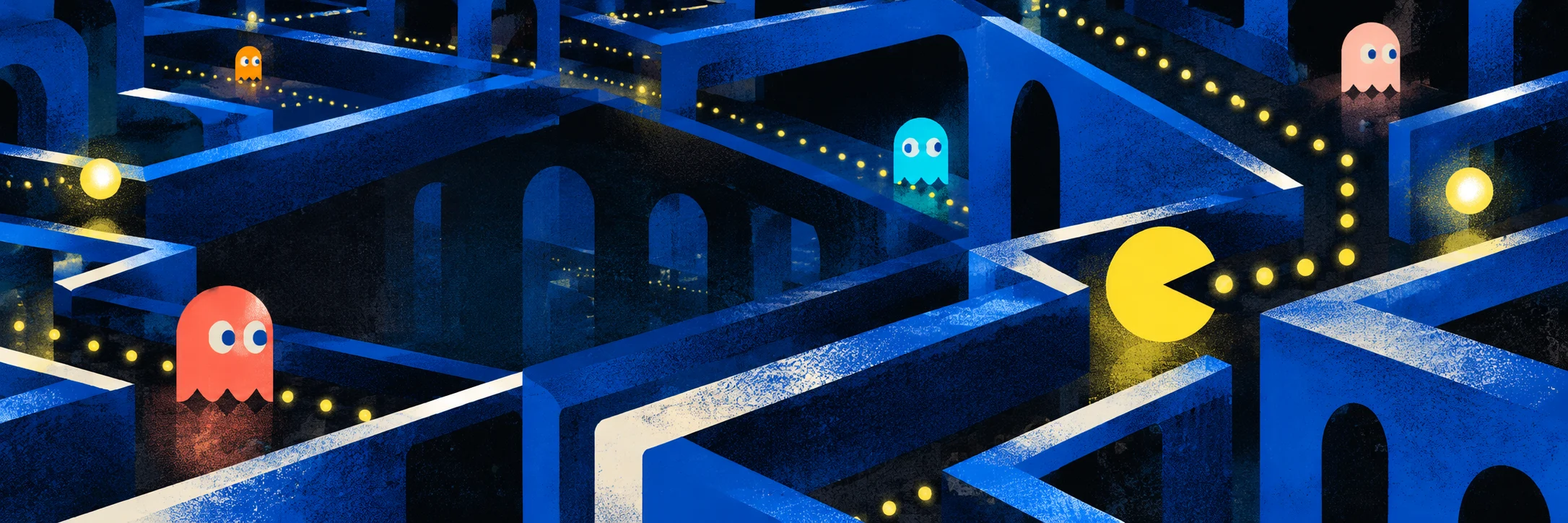
There are only a few dots left in that corridor. The red ghost is coming up behind us, but we can reach the junction first. Turn left, clear the corner, then get back to the middle.
Except the pink ghost is already coming the other way.
Pac-Man makes a wonderfully small promise: eat everything in the maze without getting caught. Then it gives us enough information to keep making plans, and enough trouble to keep revising them. A familiar route can become dangerous in seconds. One large dot can turn a retreat into a chase.
Namco released the game in 1980, with Toru Iwatani planning its design, Shigeo Funaki programming it and Toshio Kai composing its music. The company’s history distinguishes the May location test from the Japanese public release in July. 1
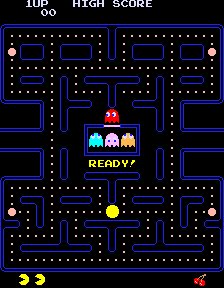
Our MAME capture of the Midway arcade version of Pac-Man, Namco / Midway, 1980. The whole playing space is visible before the chase begins. This is game output, separate from the imagined header illustration.
A whole job, visible at once
Look at that screen. Almost everything we need to do is already there.
The little dots show the unfinished work: 240 ordinary dots and four power pellets. Clearing them starts another round. 2 The blue walls show the routes. Four larger dots mark the places where we can change the terms of an encounter. We can see where the ghosts are, where a junction lies, and how much room remains between us.
Seeing the whole maze does not make the game easy. It makes a bad decision understandable. We can watch a route close and know why we are in trouble. A ghost may surprise us, but the corridor it enters was not hidden off-screen.
Eating makes a second kind of map. A cleared passage looks different from a passage we still need to visit. We leave a visible record of our own work behind us. There is no separate list of tasks to open while four ghosts wait politely.
That changes the journey back through a safe-looking area. A corridor with no dots may still be the best escape route, but travelling through it does nothing towards clearing the board. Safety and progress can point in different directions.
The maze also keeps the job finite. We can see an end to the round. The awkward handful of dots left behind can become more troublesome than the great sweep we cleared at the start.
One joystick, plenty to do
During play, the arcade game asks for four directions. There is no attack button to remember or aiming control to learn. The choice is where to go and when to turn.
That makes the junction the important meeting point between hand and program. A direction that is useful in the next corridor may be impossible in the corridor we are currently crossing. Pressing towards a wall should not mean wandering through it.
In the captured opening below, we travel left from the starting position, then request an upward turn. The yellow character follows the passages; the cleared dots and rising score make the journey visible.
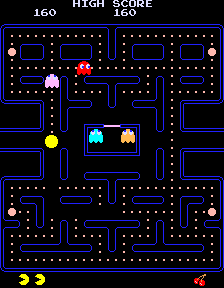
Our own arcade capture after directional input. The route is partly eaten, the score has risen, and the ghosts have moved away from their starting positions.
A responsive turn matters because the decision is already demanding enough. We are reading several moving threats while trying to remember what remains. If the control requires an unnecessarily exact instant, a missed turn becomes a dispute with the joystick instead of a mistake we can learn from.
Pac-Man accepts an early request to turn. 2 The control helps us express an intention while attention is elsewhere. The Game Feel controls sequence explores that wider question through original movement experiments.
The physical stick matters too. The operator manual gives the control assembly its own parts drawings and service instructions. The cabinet is a thing people repeatedly push, pull and repair, not merely a screen with a program attached. 3
A dot that changes the argument
A power pellet lets us do something the rest of the maze makes dangerous: move towards a ghost.
The change is easy to read. The ghosts become blue, so four differently coloured pursuers now share one visible condition. The maze is familiar, but its opportunities have changed.
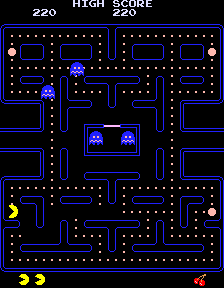
Our own capture after steering to the lower-left power pellet. Compare the blue ghosts with their normal colours in the opening frame.
We can spend that interval escaping, clearing an awkward stretch, or trying to catch ghosts. Those choices can conflict. A tempting blue ghost may lead us away from the dots we actually need, or deep into a corridor from which we will soon want to retreat.
The pellet is therefore more than a health pickup. It changes who wants to approach whom. Even a player who cannot name the rule can understand the reversal when the pursuers start getting eaten.
It also gives us a reason to leave something uneaten. Taking a pellet immediately is progress; keeping it for a more difficult encounter preserves an option. The same object can be a score item, an escape opportunity and a way to arrange a later chase.
There are only four on the board. Once used, that particular opportunity is gone until a new maze begins. The ordinary act of eating has become a decision about timing.
Four ghosts with different jobs
During chase, Blinky, the red ghost, targets Pac-Man’s tile. Pinky aims four tiles ahead; Inky extends the vector from Blinky through a point two tiles ahead. Clyde chases from a distance, switching towards a corner when closer than eight tiles. 16
There is also an upward-facing overflow quirk: Pinky’s target shifts left, and Inky’s intermediate point has a related offset. 2
Those rules explain why treating every ghost as the same pursuer is a poor plan. A rule aimed ahead can threaten an exit. A rule involving another ghost’s position can change its target even when Pac-Man has not moved very far.
The names and colours help us attach an expectation to each moving shape. We can start by recognising that the red one is persistent and the pink one often seems to be in the way. Understanding every calculation is not a condition of enjoying the chase.
We can split the job in two: choose a target, then choose the next move. The first decides what a ghost is trying to approach. The second decides what movement it can make next. Different targets can produce different behaviour even when the movement procedure is shared.

Our explanatory diagram, using invented coordinates rather than a copied maze or a reconstructed game encounter. Changing the target changes the pressure a pursuer creates.
In our example, columns increase to the right and rows downwards. The player is at column 7, row 3 and faces right. A direct pursuer aims at (7, 3). Looking four cells ahead gives (11, 3).
For the vector example, put the reference pursuer at (3, 5). Two cells ahead of the player is (9, 3). From the reference point to that point, the change is six columns right and two rows up. Extend by the same amount again and the target becomes (15, 1).
Nothing in that arithmetic says that a ghost has understood our intentions. We have supplied a position, a direction and a rule. The interesting encounter comes from those rules operating while we keep changing the situation.
A decision at the next junction
A ghost does not need to solve the whole maze to make our next turn uncomfortable.
At ordinary junctions ghosts exclude walls and reversal, compare nearby tiles’ straight-line distances, and break ties up, left, down, right. Some junctions have extra restrictions. This is no complete-route search. 2
We can work through that idea with a tiny invented example. Put a pursuer at (2, 2), facing right, and a target at (6, 1). Suppose up, right and down are all open.
Moving up reaches (2, 1): four columns from the target and zero rows away. Moving right reaches (3, 2): three columns and one row away. Moving down reaches (2, 3): four columns and two rows away.
To compare these distances, square the column and row differences and add them:
| Candidate | Calculation | Squared distance |
|---|---|---|
| Up | 4 × 4 + 0 × 0 | 16 |
| Right | 3 × 3 + 1 × 1 | 10 |
| Down | 4 × 4 + 2 × 2 | 20 |
Right wins this comparison. We can compare the squared distances without calculating square roots; the ordering is the same.

Our original worked example. The blue arrow is the chosen local move. A wall farther along could still make the complete journey longer; this calculation has not explored that journey.
This is a useful limit to understand. A distance to a target ignores the route around walls. Choosing a nearby square is cheap and repeatable, but does not guarantee a shortest path through an entire maze.
That limitation is part of what a player can learn to use. A convincing enemy need not always choose the move that a perfect planner would choose. It needs rules which create an interesting encounter and give us some chance to understand what happened.
A chase with breathing space
The ghosts alternate between corner targets (scatter) and individual targets (chase); frightened movement differs. Changes can force reversal. Blinky can speed up as dots run out and continue chasing during scatter. 2
The immediate lesson is visible even before we understand the schedule: pressure can ease and return. Moving away from us is not the same thing as becoming harmless. A ghost crossing a useful route can still catch us while heading somewhere else.
A fixed maze can therefore have several different rhythms. There is the rhythm of reaching junctions, the rhythm of a ghost entering a passage, and the longer rhythm of the group changing its behaviour.
The player has a timing problem inside all of them. Wait too long to finish an awkward corner and the next wave may arrive. Rush out of a safe loop without looking and two separate journeys can become an ambush.
Frightened intervals become less generous in later rounds. 2 The first easy reversal is an introduction, not a lasting guarantee.
Points tempt us to stay
Clearing dots gives the round a goal. Scoring offers reasons to take risks on the way.
A dot earns 10 points; a pellet earns 50. Successive ghost captures under one pellet earn 200, 400, 800, then 1,600. 2 The doubling makes the fourth capture much more tempting than the first.
A player pursuing the last ghost is making a different journey from a player trying to finish the remaining dots. The score system can persuade us to stay in danger after the useful part of a power pellet has already been spent.
There is a small piece of arithmetic behind that temptation. The four captures add up to 3,000 points. Stopping after two earns 600; catching the other two would add 2,400 more. The reward is concentrated at the end, just where the remaining time can make the chase most uncomfortable.
That does not make chasing all four the right choice in every encounter. A scoring opportunity can be good design precisely because it asks the player to decide how much risk is worthwhile.
High scores also let the same board support different ambitions. One player wants to survive a little longer. Another wants a clean route through the first maze. Another starts arranging the ghosts to extract more from a pellet.
The operator can alter coinage, starting lives and the score threshold for a bonus life. 3 A cabinet’s settings therefore affect the terms under which those ambitions are pursued.
Making a character out of very little
The yellow mouth tells us which way Pac-Man faces. The ghosts’ eyes suggest where they are looking. A blue body announces vulnerability; returning eyes communicate a different condition again.
These are small pictures doing several jobs. They identify a character, show a state and help us anticipate movement. The dot-eating animation also gives the movement a purpose: we are watching a creature eat a path through the board.
The screen does not need the large expressive face seen on packaging to make this work. A character can have a simple in-game form and a more elaborate promotional form, each serving its own conditions.
Iwatani told Susan Lammers that he began with the idea of eating and wanted a comical alternative to the fighting and shooting games around him. His pizza story describes the mouth shape, but the larger design began with an activity and the audience he wanted to reach. 4
His recollections about attracting women describe a designer’s aims and assumptions in that period. They do not establish what all women enjoy, or imply that women had been absent from games before Pac-Man.
The result offers an inviting first action without removing the possibility of demanding play. Knowing how to move the stick is enough to begin. Reading four changing threats while clearing the last few dots is another matter.
Cartoons, music and the people behind the cabinet
The game did not come from Iwatani alone. Funaki wrote the program. Shigeichi Ishimura designed the board; Sho Osugi worked on the cabinet; Tadashi Yamashita shaped the illustrated character and logo; Hiroshi Ono worked on cabinet and marquee art. Toshio Kai supplied the opening and intermission music. 5
Iwatani later connected the ghosts with Obake no Q-Taro and their comic relationship with Pac-Man to Tom and Jerry. He cited Popeye’s spinach when discussing the power reversal. These are his reported influences, not a claim that every resemblance proves a direct connection. 5
The little intermissions let the characters perform outside the maze. We get a joke and a pause before resuming the work. A player can also want to reach another scene, so the break can become a reason to keep playing.
Kai recalled drawing musical inspiration from Gábor Szabó, after initially thinking about the Allman Brothers Band that Iwatani liked. 5 A short arcade tune can carry a history of listening which is much larger than its few seconds on screen.
There is a practical production story behind the glow as well. Ishimura recalled designing a board suitable for reliable mass production; Haraguchi handled semiconductor procurement. 5 A game has to survive being built repeatedly before it can become a familiar cabinet in thousands of locations.
Finding room for something different
A game can be obvious to the person playing it and puzzling to the person deciding whether to buy a cabinet.
In the team’s later interviews, Akiyoshi Sarukawa remembered a muted response at an early business showing and a slower start in Japan, followed by steadier sales. Katsutoshi Endo described seeing women playing alone in coffeehouses as evidence that the intended audience was finding it. 6
Those recollections place Pac-Man in a social setting. A game installed in a coffeehouse meets a different audience and pattern of use from a game bought to take home. The setting affects who notices it and whether they feel comfortable trying it.
Publicity reached beyond the cabinet too. Namco’s official history records a display of the game on Shinjuku ALTA’s large screen before the Japanese public release. 1 The moving screen could advertise the experience before someone had touched the joystick.
Overseas demand created manufacturing pressure. Haraguchi recalled orders outgrowing the supply of a custom gate-array component; Ishimura described replacing that part of the design with general-purpose components. 6
That is another kind of constraint shaping a game. A design which can be manufactured only in small quantities cannot meet a sudden rush of buyers just because the software is finished.
A mouth on the radio
Pac-Man Fever, by Buckner & Garcia, reached the American top ten, while a television cartoon brought the character into another part of the day. 6 People could encounter the name, imagery and sounds without first learning a route through the maze.
The music connection is especially apt. The game already makes repeated movement and eating recognisable through sound. A record could carry that recognition away from the machine and give it a new setting.
That does not mean the song explains the success of the game. It shows how a successful game can become material for another kind of entertainment, which can then bring more people to the name.
The same distinction matters when looking at later merchandise. A character can remain familiar to someone who has never cleared the original maze. The commercial life of an image and the experience of playing its game can travel together without becoming the same thing.
The maze goes home
A home conversion has to decide which parts of the experience matter most when the hardware and surroundings change.
The Atari 2600 version arrived in 1982. Its manual describes maze wafers, power pills, ghosts and joystick movement, but the visible layout and presentation differ from the arcade game. 7 The separate Atari 2600 Vault entry examines that conversion and its reception.
The numbers change too. The 2600 manual awards one point for a wafer and five for a power pill, and gives an extra life for clearing the wafers. Its eight game variations offer different movement speeds; the manual recommends two of them for younger children. 7
Those options matter in a living room. Players sharing a cartridge can choose a gentler chase without needing a different cabinet. Completing the board also replenishes a life, so finishing the immediate job changes how much room remains for the next mistake.
Calling any conversion a smaller copy misses the decisions involved. A different maze changes the routes available to both player and pursuers. Different colours or flicker change how clearly a player can follow an encounter. A different controller changes what a turn feels like.
Other home versions and maze-chase games provided their own answers. Acornsoft’s Snapper belongs in that wider history, for example, with its own account of adaptation rather than a place in a list of supposedly identical games. 8
Follow a single chase in each version. A different turn, a harder-to-read ghost or an altered escape route tells us more than a familiar name on the box.
Keeping the chase, changing the game
Ms. Pac-Man grew from General Computer’s Crazy Otto enhancement work, which Midway licensed. Steve Golson’s account preserves that route from an alteration of an existing arcade game to a successor. 9 A sequel’s history can involve a new team and a different commercial arrangement as well as new mazes.
Later games took different parts of the original in different directions. Pac-Man Championship Edition put a timed scoring challenge at the centre of its 2007 release; Championship Edition DX followed in 2010. 1011
A fixed-duration challenge changes what a good attempt means. The player is building a score inside an interval, rather than asking only how long a stock of lives will last. That can make a new route or a quicker chain of actions worth trying even after basic survival feels comfortable.
Pac-Man 256 turned the original game’s infamous 256th-board problem into an advancing threat in an endless maze. 12 A historical fault became a source for a new rule. That is a much more specific connection than saying a later game is merely nostalgic.
The character also travelled into platform games. Pac-Man World appeared in 1999; World Re-Pac later revisited it, and World 2 Re-Pac arrived in 2025. 1314 These games give the character actions and spaces which the original joystick-and-maze design did not need.
Shadow Labyrinth, released in 2025, offers a darker action-platforming variation built around exploration and consuming enemies. 15 It is an explicit later interpretation of the heritage, rather than evidence that the original was secretly trying to be that kind of game.
Some descendants preserve a maze and change its pace. Others keep the character, or the reversal between eating and being eaten, while replacing much of the surrounding experience. Following those choices makes the decades between them worth exploring.
Reading the next turn
Return to the original screen. There is still a little yellow mouth, a maze full of work and four things we would rather avoid for the moment.
Now the details offer more to notice. An empty corridor records where we have been. A pellet preserves a choice we have not yet used. Different targets make pursuers spread out. A visible change of state can turn an escape route into an invitation to chase.
The first pleasure is still getting around that corner before the ghost does.
Sources and further reading
-
Bandai Namco, official Pac-Man history, 1980 and later chronology. Credits, May location test, July Japanese release and Shinjuku ALTA display. Anniversary dates and public release are distinguished.
-
Jamey Pittman, The Pac-Man Dossier, 23 February 2009, gameplay, maze logic and ghost behaviour. Primary reverse engineering and controlled observation; the technical account is distinguished from its broader historical anecdotes. Worked coordinate examples here are ours.
-
Midway Manufacturing, Pac-Man Parts and Operating Manual, game numbers 932, 933 and 934, December 1980, printed pp. 1–3, 9 and 18–21. Operator settings, controls and serviceable cabinet assemblies.
-
Susan Lammers, Toru Iwatani interview excerpts, interview conducted in 1985 for Programmers at Work, first published 1986. Author’s current excerpt, not a claim to have inspected an unseen complete edition.
-
Jin Sugiyama, Untold Stories of the Creation of Pac-Man, part 1, Bandai Namco, English publication 17 June 2021; conversations recorded November 2020. Team roles, cultural and musical influences, board and cabinet development. Recollections are attributed; no interview photographs or sketches reproduced.
-
Jin Sugiyama, Untold Stories of the Creation of Pac-Man, part 2, same interview series and publication date. Sales, locations, production response and wider popular culture; retrospective testimony, not independently audited sales accounts.
-
Atari, Pac-Man Game Program Instructions, CX2646, copyright 1981. The cartridge’s 1982 release is separately identified in Atari’s later product history.
-
Acornsoft, game advertisement in Personal Computer World, March 1983, describes Snapper’s maze, dots, fruit and pursuers. The Acornsoft account supplies wider context; no Snapper play observation is claimed here.
-
Steve Golson, Classic Game Postmortem: Ms. Pac-Man, GDC 2016, and presentation. A participant’s account of General Computer, Crazy Otto and Midway.
-
Microsoft and Namco Bandai, Pac-Man Championship Edition announcement, 5 June 2007. Timed challenge and release context; its introductory 1981 date for the original is not adopted.
-
Bandai Namco, Championship Edition 2 announcement, 20 July 2016. Confirms the 2007 Championship Edition and 2010 DX sequence.
-
Bandai Namco, Pac-Man 256 console and PC release, 2016. Endless maze, advancing glitch and relation to the original’s 256th board; no complete original-game run was performed here.
-
Bandai Namco, Pac-Man World Re-Pac. Identifies the original World as a 1999 release and describes the later platform-game remaster.
-
Bandai Namco, World 2 Re-Pac release announcement, 26 September 2025. Later heritage, not a review or play claim.
-
Bandai Namco, Shadow Labyrinth and maze reveal, 22 May 2025. Publisher’s explicit Pac-Man connection; later interpretation kept distinct from original intent.
-
Chris Lomont, Pac-Man Emulation, version 0.1, October 2008, printed pp. 25–26 and disassembly figure. Supports individual target calculations; its rough gather/scatter timing description is not adopted over Pittman’s more precise analysis.
This study has not yet been fact-checked. Selected early encounters were observed; a complete playthrough is not claimed. Original documents and source analysis support the wider account.
Pac-Man · Namco · Midway · Arcade · 1980. Own screenshots illustrate criticism and review. Rights in the game remain with their owners. The header and explanatory diagrams are original illustrations. Photographs and advertising carry their own credits and rights records alongside each image.
Canonical study · Evidence and capture credits · More game studies