
The Atari 7800 joined two different generations of Atari hardware. Its newer graphics environment used MARIA, a chip that fetched instructions and picture data from memory. It retained TIA, the chip familiar from the Atari 2600, for sound and input functions, and offered a separate mode for 2600 cartridges.
The machine was shown at the June 1984 Consumer Electronics Show; COMPUTE! reported the showing that August. Retail availability followed in 1986. The July Computer Entertainer reported readers finding machines in Toys R Us from early June, followed by a distributor report on 20 June. A 1984 announcement should not be silently converted into two years of general retail availability. (1984 report; July 1986 issue.)
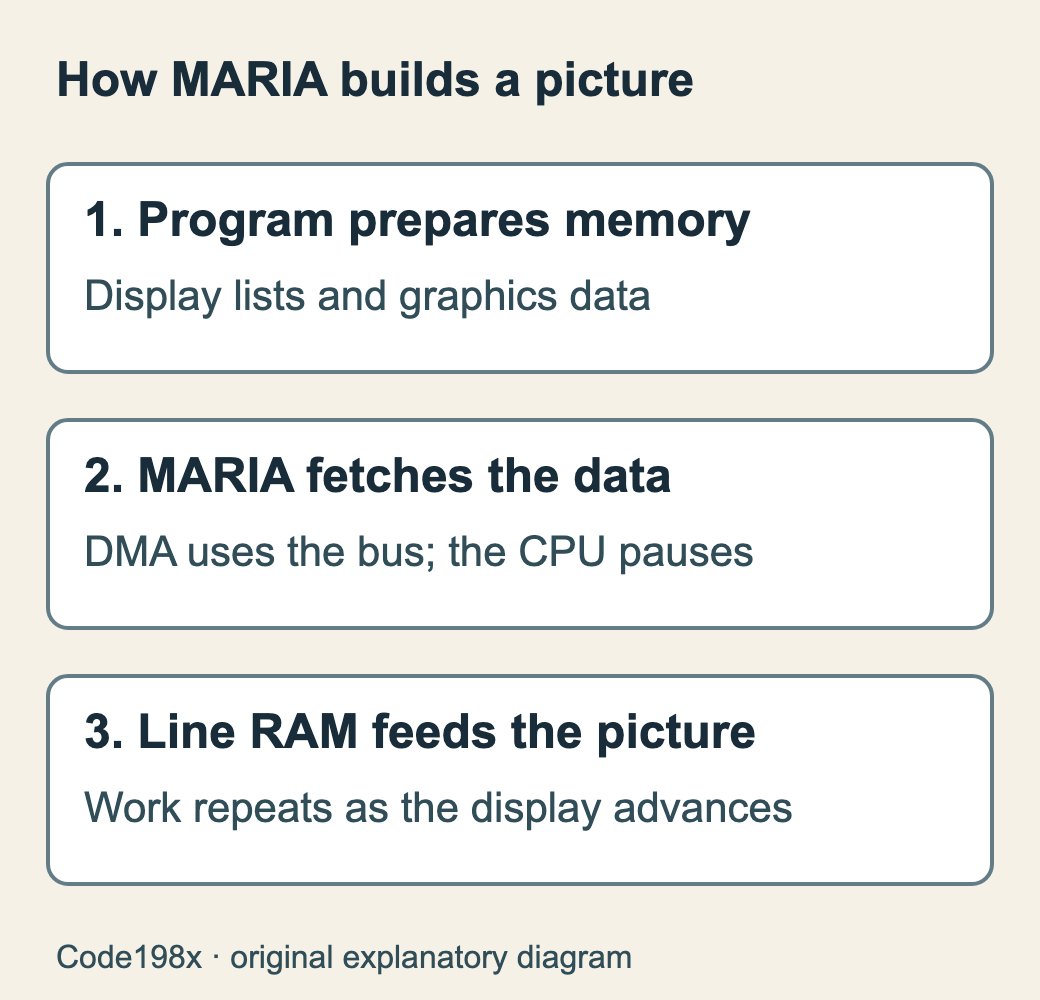
A list describes the screen
The developer guide describes a hierarchy of instructions for MARIA. A display list specifies graphics objects and their horizontal positions. A list of display lists selects the material for successive vertical regions. MARIA reads those instructions, fetches the graphic bytes and builds a line of the picture in internal line RAM.
The CPU therefore prepares data that the display hardware will interpret. This differs from a 2600 program’s close involvement in timing the construction of each scanline. It is a useful example of display lists: a compact description connects program memory to a picture without being the picture itself. (7800 software guide.)
Graphics still consume time
MARIA’s direct memory access, or DMA, needs the memory bus. During those fetches the SALLY processor is halted. More graphics work can therefore reduce the CPU time available to the game. Offloading display work changes the scheduling problem; it does not remove memory bandwidth or make the number of objects unlimited.
TIA remained part of the newer machine rather than disappearing behind MARIA. A programmer choosing graphics modes still had to account for the sound and input hardware separately. A new display chip was not a complete replacement for every part of the earlier architecture.
Playing older cartridges
The 2600 mode provided a reason for an existing Atari owner to consider the newer console. It is still useful to distinguish that mode from native 7800 software: the older cartridge did not acquire MARIA graphics because it was plugged into a newer case.
The Atari 5200 had taken another route, drawing on Atari’s computer-chip family. Comparing the two successors shows why a console’s relationship to an older machine needs to be explained in terms of hardware and software, rather than the order of the model numbers.
Sources
- Atari/GCC, 7800 Software Guide. Preserved developer guide; MARIA display lists, line RAM, DMA, SALLY and TIA. Read source.
- Software Power, COMPUTE! (1984-08). Issue 51, p.32; June 1984 CES showing and announced price. Read source.
- Computer Entertainer, volume 5 number 4 (1986-07). July 1986, p.12, They’re Here!: reader reports of Toys R Us stock from early June and a distributor report on 20 June. Distinguish 1984 announcement from 1986 retail availability. Read source.