
GLQuake is the OpenGL-rendered version of Quake. It keeps the game’s three-dimensional world while changing the machinery that turns that world into pixels. The renderer can send drawing work through OpenGL to supported graphics hardware.
Shape, surface and light
Quake’s world contains more than its polygon shapes. A stone wall needs its surface texture, and it also needs lighting that makes the space readable. GLQuake’s released surface code keeps those contributions distinct.
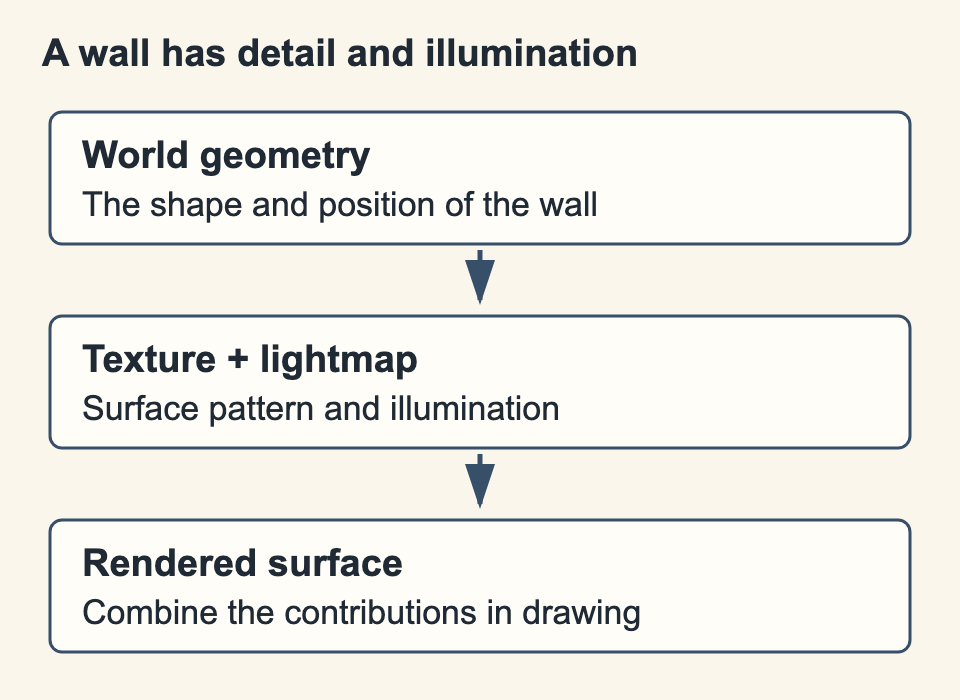
A texture supplies the repeated detail of the wall. A lightmap supplies a lower-resolution pattern of illumination across its surface. The renderer combines them, and its code also accounts for changing lights. The result can retain the same stone pattern while brightness varies across the room.
The related OpenGL QuakeWorld release notes describe drawing world textures and lightmaps in separate passes, then supporting hardware able to combine them with multitexturing. That later change illustrates why the number of passes depended on the renderer and hardware in use.
One branch among several
QuakeWorld changes the networking side of Quake. GLQuake changes its drawing side. The released source includes versions combining those developments, so an OpenGL client need not imply a particular network model.
John Carmack’s source-release notes identify all four preserved branches: WinQuake, GLQuake, QuakeWorld and GLQuakeWorld. They also distinguish engine source from the original game’s data. Releasing the machinery did not turn every map, sound and texture into freely redistributable material.
For a reader following texture mapping, GLQuake makes the next question concrete: once the world and its surfaces are described, which work does the CPU perform, and which work can the graphics hardware take over?
Sources
- id Software, GLQuake surface renderer: Original WinQuake/gl_rsurf.c; texture polygons, lightmaps, dynamic lights and drawing passes.
- John Carmack, Quake source-release notes: Identifies the released WinQuake, GLQuake, QuakeWorld and GLQuakeWorld sources and the distinction between code and game data.
- id Software, QuakeWorld release notes: v2.30 archive of earlier changes; GL client texture/lightmap passes, multitexture support and hardware-dependent behaviour.