
HyperCard turns a stack of cards into something a reader can explore and an author can change. A card can contain a picture, text fields and buttons. Buttons can lead elsewhere or run a script, making the stack an application rather than a fixed sequence of pages.
Bill Atkinson created HyperCard at Apple. It was introduced for the Macintosh in 1987. Its uses extended beyond games to reference works, teaching materials, personal records and small tools.
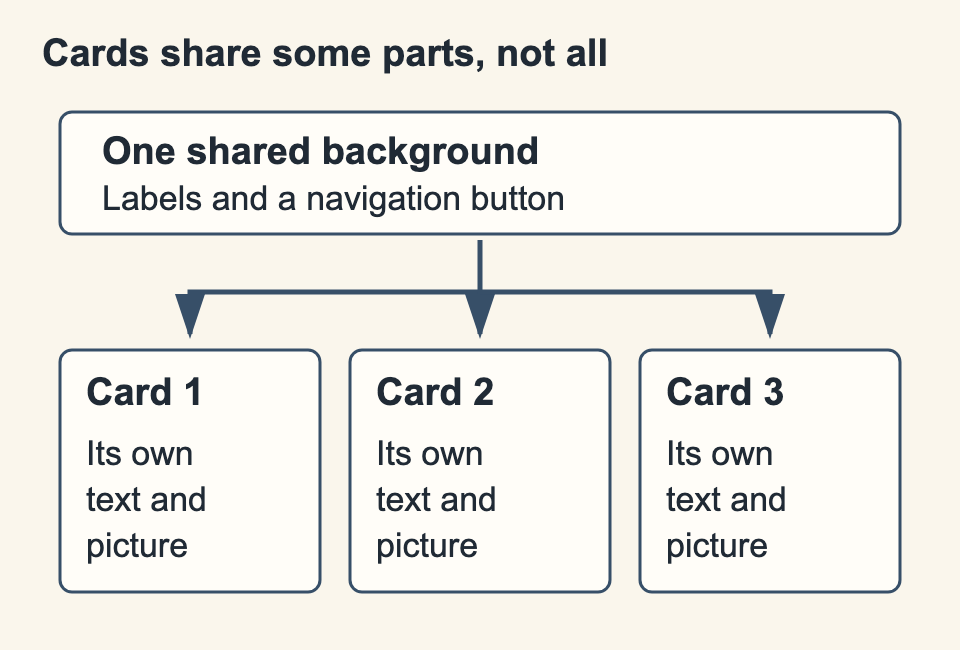
Cards can share a background
Apple’s original user guide distinguishes a card’s own material from a background shared by several cards. An address stack, for example, can reuse the same arrangement of labels and fields while showing different entries. Altering the shared background changes what those cards have in common.
The same idea supports interactive work. A reader sees a particular screen; the author can decide which parts belong to that card and which should stay consistent across a group. HyperCard’s drawing, field and button tools put those decisions directly on screen.
Add behaviour with HyperTalk
Scripts written in HyperTalk respond to events and perform actions. A button can do more than point at the next card: it can examine text, change values or choose a destination. Visual authoring and programming therefore sit next to each other.
The boundary between author and player changed across editions. Paul Foraker’s contemporary MacTech review of HyperCard 2.2 distinguishes the full application from HyperCard Player, which cannot be used for scripting. It also describes the newer ability to build standalone applications. Those later facilities should not be assumed for the original 1987 package.
From small stacks to game worlds
Cyan used HyperCard in its early work and in Myst. In a later interview, Robyn Miller described receiving HyperCard from Rand and credited Richard Watson with helping on Myst’s HyperCard scripts. Linked views offered a way to explore a place through pictures and actions. Making a compelling world still depended on the authors’ images, sounds, puzzles and decisions about what each interaction meant.
Garry Kitchen’s GameMaker gathered game-specific editors into one package. HyperCard offered a broader card-and-script environment which authors could turn towards games among many other uses.
Sources
- Apple Computer, HyperCard User’s Guide, 1987: Original 1987 Macintosh guide; chapters 1–2 and 4–6 cover cards, shared backgrounds, fields, buttons and scripting controls.
- Paul Foraker, HyperCard 2.2, MacTech 10:3: Contemporary review, volume 10 issue 3; full application versus Player and version 2.2’s standalone applications.
- Science Museum Group, Apple Hypercard software, 1987: Museum object catalogue, 2014-127; attribution to Bill Atkinson and initial release in 1987.
- Damien McFerran, Robyn Miller interview, The Making of Myst: Nintendo Life, 17 November 2012, reprinting the earlier Retro Gamer interview; Miller recalls receiving HyperCard and credits Richard Watson’s Myst scripting work.