
iMUSE is LucasArts’ interactive music system, created by Michael Land and Peter McConnell. It connects what happens in a game to the timing and structure of its score. Music can respond to a player entering a room without abandoning the phrase already under way.
The system is closely associated with Monkey Island 2, part of the Monkey Island series. It helps an adventure’s soundtrack follow a player who can pause, explore or leave at an unpredictable moment.
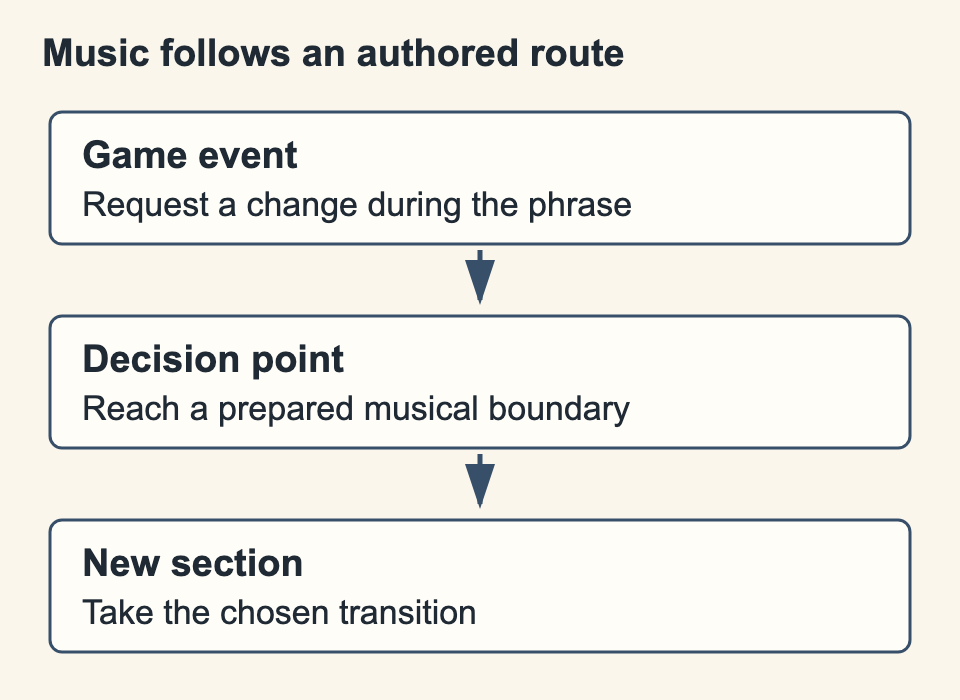
A request and a musical answer
Land and McConnell’s patent describes prepared decision points, markers and commands. The composer supplies material and ways to move through it. The game selects what should happen, and the music system carries out that request at a suitable point.
That separation solves a practical problem. A story event happens on the player’s schedule, while a tune has its own rhythm. Cutting immediately to a different piece may sound abrupt. Waiting for an authored transition can acknowledge the event and still make musical sense.
Several kinds of machinery
The original MIDI approach works with musical performance information: notes, instruments and timing. Later digital iMUSE systems work with recorded audio. ScummVM preserves separate implementations of these systems, making their different responsibilities visible.
They share a goal, but the machinery differs. Rearranging a sequence of note events and moving between streams of recorded sound present different problems of timing and continuity.
SCUMM supplies the surrounding adventure logic, while INSANE addresses another part of LucasArts’ presentation: keeping interactive animation moving. Together they show why game engines often grew as cooperating systems, each handling a particular kind of time.
Sources
-
Michael Z. Land and Peter N. McConnell, Method and apparatus for dynamically composing music and sound effects: US5315057A; filed 25 November 1991, published 24 May 1994. Original patent describes decision points, markers, hooks and queued commands.
-
ScummVM, iMUSE implementation: Independent reimplementation of the MIDI system; players, parts, sequencer and instrument handling.
-
ScummVM, digital iMUSE implementation: Independent reimplementation of the later digital-audio system; transitions and streamed sound management.
-
LucasArts, Monkey Island 2 credits: Original game credits transcribed by The SCUMM Bar; iMUSE Music System credits Michael Land and Peter McConnell.