
Pucrunch puts the hard work on the computer preparing a program. Pasi Ojala, also known as Albert, wrote its compressor in portable C and its small-machine decompressor in assembly. A host can spend memory and time searching for savings; a C64 need only restore the result.
Ojala’s design page dates the first version to March 1997, with a rewrite that December and a major update in October 1998. He also explained the work in C=Hacking.
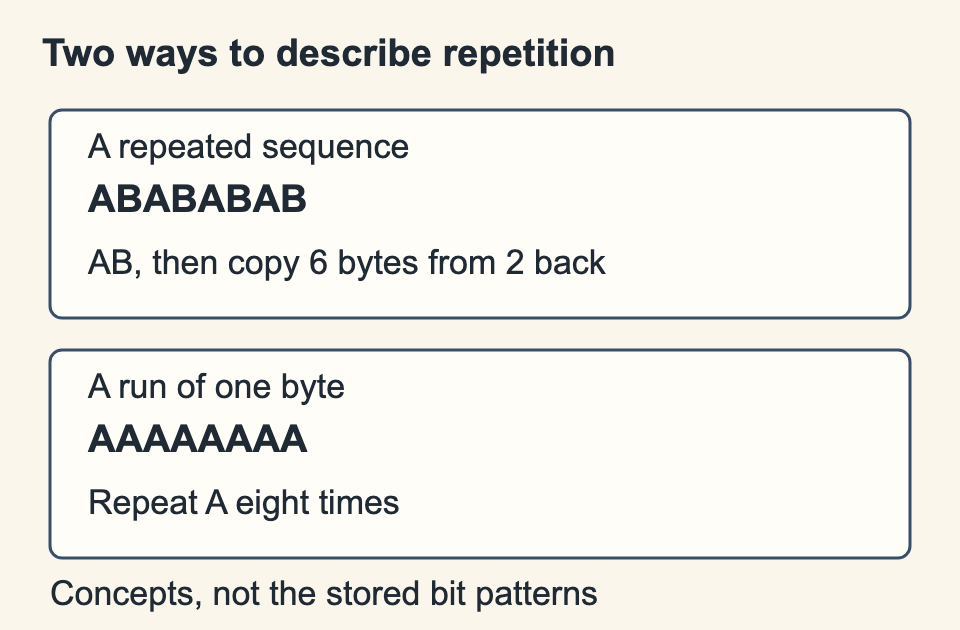
Two kinds of repetition
Pucrunch combines LZ77-style copies with run-length encoding. A copy refers to an earlier sequence in the output. A run describes several repetitions of one byte. Both save space when their descriptions are shorter than the data they replace.
The distinction matters. A repeated phrase and a long area filled with one value are different opportunities. Ojala explains that a dedicated run representation can describe longer runs than the copy lengths allowed by his LZ encoding. Lengths use variable-length codes, so small and large values need not occupy equal amounts of space.
The decoder shapes the format
Ojala’s Compression Basics explains why a small computer’s needs change the design. The decompressor must be short, use little working storage and avoid arithmetic that is expensive on an 8-bit processor. A format that compresses well on a large machine is not automatically cheap to decode on a small one.
His implementation also allows packed and expanded data to share part of memory, provided unread input remains safe. That is a loading arrangement with constraints, rather than a promise that any two addresses will work.
The same decisions recur in Exomizer and ByteBoozer. File size is one part of the comparison; decoder bytes, workspace and unpacking time also belong in the budget.
Sources
- Pasi Ojala, An Optimizing Hybrid LZ77 RLE Data Compression Program: Author’s original design account and dated revision history; host/target split, encoding and decoder constraints.
- Pasi Ojala, Compression Basics: Original explanation of sequence references, repeated runs and low-resource decoding.
- Pasi Ojala, Compression Basics, C=Hacking 16: April 1998 period publication of the author’s explanation.