
Repton Infinity lets players alter the rules behind a game, as well as its screens. David Lawrence and David Acton made the package for the BBC Micro and Acorn Electron, extending the construction ideas in the Repton series.
Superior Software’s manual credits Matthew Atkinson with game screens. It introduces four supplied games: Repton 3 – Take 2, Repton 4, Robbo and Trakker. They show different uses of the same creation system, rather than four sets of maps with identical rules.
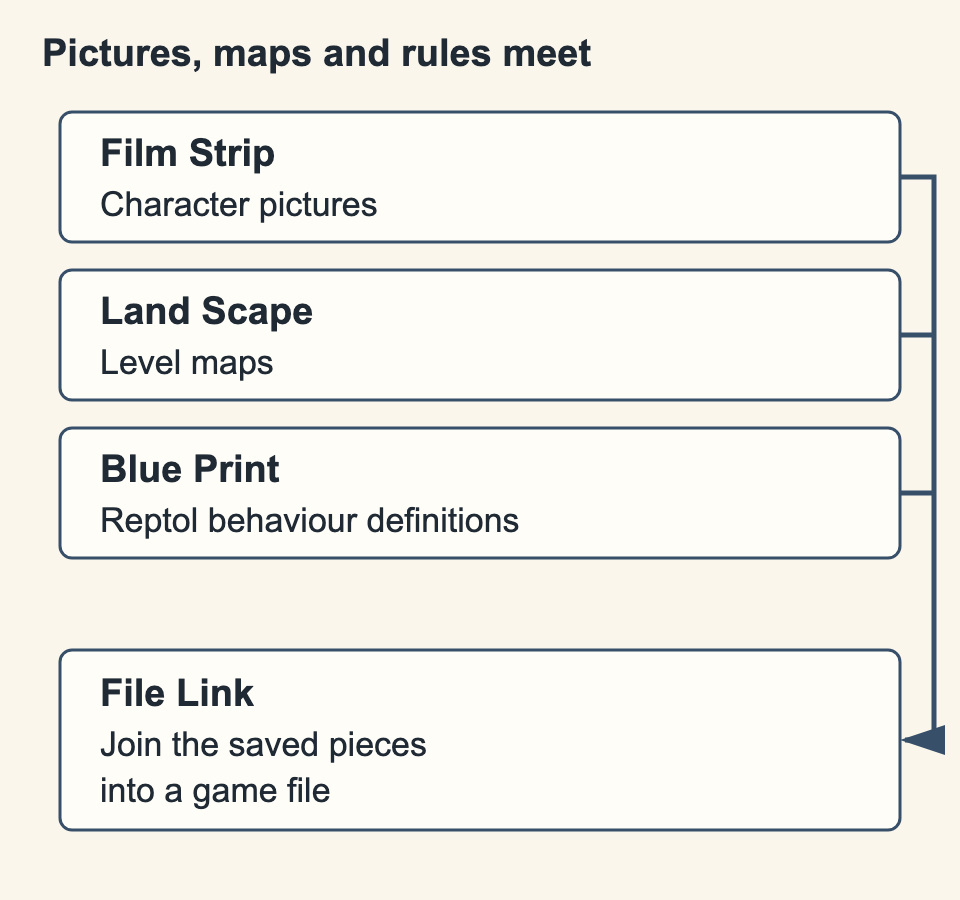
Four tools divide the work
Land Scape designs the levels. Film Strip edits the character graphics. Blue Print defines behaviour in the Reptol language and turns it into the form the game engine uses. File Link gathers the saved pieces into a game file.
That division matters. Replacing a creature’s picture changes its appearance. Rewriting its Reptol definition can change what it does when it meets another object or when the player acts. The map, the pictures and the behaviour are related, but separately editable.
Rules belong to objects
The manual teaches Reptol through object definitions, conditions and commands. Instructions can test circumstances, move an object, change it into another kind or alter the score. An author can make a new interaction while keeping the engine’s existing work of displaying and running the world.
The supplied games make the distinction concrete. Robbo puts a robot into a different set of puzzles; Trakker changes the character and its interactions again. Their instructions provide something playable before the author starts learning how those effects were built.
Reviewing the Electron version in March 1989, Roland Waddilove described the four games alongside the creation utilities. He found Reptol approachable, but said learning to use it well would take effort. (Electron User, pp. 16–17.)
More than a level editor
A new map can be a substantial design project in its own right. Repton Infinity adds another layer: the pieces placed on it can have new meanings and behaviours. Its editors let a player move gradually from rearranging a world to defining how it works.
Garry Kitchen’s GameMaker and MegaZeux approached that opportunity through different interfaces and machines. All made some of a game’s authorship available inside the package used to play it.
Sources
- David Lawrence and David Acton, Repton Infinity instruction manual: Original Superior Software manual, later printing; credits and sections 2–6 cover editors, Reptol and linking.
- Repton Infinity manual, alternative 8BS download: Alternative 8BS copy of the same instruction manual, listed under Electron.
- Superior Software, Repton Infinity game instructions: Original game instructions preserved by Acorn Electron World; four supplied games and controls.
- Roland Waddilove, The ultimate Repton?, Electron User, March 1989: Original contemporary review, pp. 16–17, preserved in indexed OCR; editor roles and the effort of learning Reptol.