Reflex
The screen flashes white at a moment you can't predict — how fast can you hit a key? Meet the C64's jiffy clock, learn GET for an instant keypress, and turn raw timing into a verdict on the player's speed.
In Oracle the machine decided. Here it measures. Reflex is a reaction tester: the screen sits black, then flashes white at a moment you can’t see coming — and the C64 counts, to the sixtieth of a second, how long you take to hit a key. The trick at its heart is tension: the wait is random, so you can never anticipate it, only react.
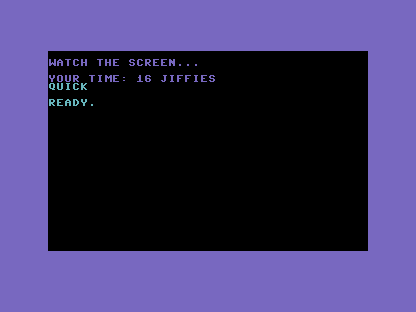
This is your first program that times the player. You’ll meet TI, the C64’s built-in
clock, ticking sixty times a second whether you watch it or not; GET, which catches a single
keypress the instant it lands; and RND again, this time to make the wait unpredictable. By
the end the machine doesn’t just measure — it judges.
What you’ll build:
- A screen that flashes white on a fixed beat, by writing to one register
- A wait you can’t predict, randomised with
RND - The gap between flash and keypress, measured with the jiffy clock
TI - An instant keypress with
GET— noRETURN, no waiting - Jiffies turned into seconds, the unit a human understands
- A verdict — LIGHTNING, QUICK, OK, SLOW — and a cheat caught in the act
6 units. About 5–6 hours. This follows Oracle and builds on Meet C64 BASIC.
Unit roadmap
The signal
A screen that flashes white — first on a fixed beat, then on one you can't predict
Measuring the moment
The C64's clock times the gap between the flash and your key
A verdict
Jiffies become seconds, a rating judges the time, and a cheat gets caught