
Code status: executed in the original AMOS runtime. These are language-native integer arrays and Gosub routines, independently qualified from the assembly and Blitz routes.
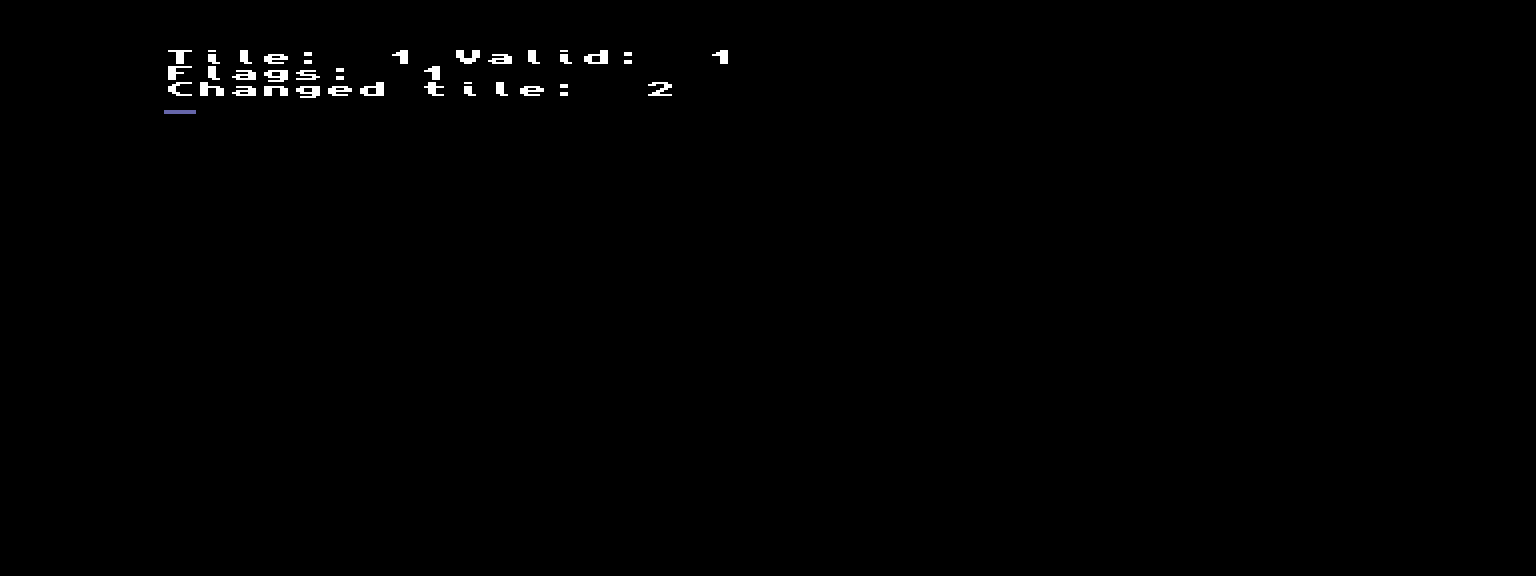
Read a cell, change it and look up its properties without tying your map data to the screen. caller.amos supplies a small 7×5 map; the maintained helper labels live in routines.amos. Run make, import build/demo.asc as ASCII into AMOS Professional 2.00, syntax-check with F2 and run with F1. It prints the queried tile/flags and then the changed tile; Q returns to the editor. These are original ASCII modules, not tokenised AMOS save files.
A small project caller: read, property, write and convert
Hide : Palette $000,$FFF : Paper 0 : Pen 1 : Cls 0
Rem Reusable small caller: a 7 by 5 map in a flat AMOS integer array.
Dim PL_TM_MAP(34),PL_TM_PROPS(3)
PL_TM_W=7 : PL_TM_H=5 : PL_TM_CAP=35 : PL_TM_MAX=3 : PL_TM_PC=4
For PL_TM_I=0 To 34 : PL_TM_MAP(PL_TM_I)=PL_TM_I mod 4 : Next PL_TM_I
PL_TM_PROPS(0)=0 : PL_TM_PROPS(1)=1 : PL_TM_PROPS(2)=2 : PL_TM_PROPS(3)=3
PL_TM_X=3 : PL_TM_Y=2 : Gosub PL_TM_GET
Print "Tile: ";PL_TM_TILE;" Valid: ";PL_TM_VALID
Gosub PL_TM_PROPERTY : Print "Flags: ";PL_TM_PROP
PL_TM_TILE=2 : Gosub PL_TM_SET
PL_TM_WX=24 : PL_TM_WY=16 : Gosub PL_TM_PIXEL8
Print "Changed tile: ";PL_TM_TILE
Repeat : Wait Vbl : Until Inkey$="q"
Show
End
Include, allocate and call
Paste/import the caller followed by the helper once. Keep the caller’s End before the labels so execution cannot fall through into a subroutine. Merge the helper labels into an existing project and rename the PL_TM prefix if it conflicts with its variables. Every shared value here is a normal AMOS integer; string, floating-point and assembly-pointer contracts are not transplanted into this route.
The caller allocates PL_TM_MAP(last-index) and PL_TM_PROPS(last-index). AMOS DIM’s final value is an inclusive upper index: DIM PL_TM_MAP(34) provides 35 elements, indexed 0–34. Set PL_TM_W/H to 1–255 cells, PL_TM_CAP to the actual allocated element count, PL_TM_MAX to the highest tile ID (0–255), and PL_TM_PC to the property element count (at least MAX+1). Map order is rows of W cells: row*W+column. Initialise all used map cells and properties before calling. Capacity values are caller promises; these routines cannot discover or repair a falsely declared DIM allocation.
- PL_TM_GET: set X/Y; Gosub the label; check VALID immediately. It returns TILE and clears PROP. Failure returns VALID=0, TILE=0, PROP=0. Zero tile alone is not success. A stored tile outside 0–MAX is rejected too.
- PL_TM_SET: set X/Y/TILE; call; check VALID. Invalid dimensions, declared capacity, coordinates or tile IDs cannot change the map. TILE remains the supplied value; PROP is cleared. It does not draw.
- PL_TM_PROPERTY: set TILE; call; check VALID before PROP. It checks the highest ID and property capacity independently of map dimensions. Failure returns PROP=0 and leaves TILE unchanged. Property bits are your game’s meaning, not renderer commands.
- PL_TM_PIXEL8: set WX/WY to whole world coordinates 0–65535. Call, check VALID, then use X/Y/TILE. It divides by eight with Int and uses the checked read. Negative/out-of-range world inputs return zero outputs; a positive converted cell outside the map is rejected. WX/WY survive. Other cell sizes need another conversion; a negative world needs an explicit origin policy.
The routines own their PL_TM state and index scratch, and use the normal Gosub stack. They do not allocate arrays, reserve banks, wait, draw, read input or touch a global clock. Do not recursively share one context or let another caller change its inputs before consuming the result. The small caller’s output and the qualification bank are not helper requirements.
The maintained checked map routines
Rem Checked row-major map context. Arrays and capacities belong to the caller.
PL_TM_CHECK:
PL_TM_VALID=0 : PL_TM_PROP=0
If PL_TM_W<1 or PL_TM_W>255 or PL_TM_H<1 or PL_TM_H>255 : Return : End If
If PL_TM_CAP<PL_TM_W*PL_TM_H : Return : End If
If PL_TM_MAX<0 or PL_TM_MAX>255 : Return : End If
If PL_TM_X<0 or PL_TM_X>=PL_TM_W or PL_TM_Y<0 or PL_TM_Y>=PL_TM_H : Return : End If
PL_TM_INDEX=PL_TM_Y*PL_TM_W+PL_TM_X
PL_TM_VALID=1
Return
PL_TM_GET:
PL_TM_TILE=0 : Gosub PL_TM_CHECK
If PL_TM_VALID=0 : Return : End If
PL_TM_TILE=PL_TM_MAP(PL_TM_INDEX)
If PL_TM_TILE<0 or PL_TM_TILE>PL_TM_MAX
   PL_TM_TILE=0 : PL_TM_VALID=0
End If
Return
PL_TM_SET:
Gosub PL_TM_CHECK
If PL_TM_VALID=0 : Return : End If
If PL_TM_TILE<0 or PL_TM_TILE>PL_TM_MAX : PL_TM_VALID=0 : Return : End If
PL_TM_MAP(PL_TM_INDEX)=PL_TM_TILE
Return
PL_TM_PROPERTY:
PL_TM_VALID=0 : PL_TM_PROP=0
If PL_TM_MAX<0 or PL_TM_MAX>255 or PL_TM_PC<PL_TM_MAX+1 : Return : End If
If PL_TM_TILE<0 or PL_TM_TILE>PL_TM_MAX : Return : End If
PL_TM_PROP=PL_TM_PROPS(PL_TM_TILE) : PL_TM_VALID=1
Return
PL_TM_PIXEL8:
PL_TM_X=0 : PL_TM_Y=0 : PL_TM_TILE=0 : PL_TM_PROP=0 : PL_TM_VALID=0
If PL_TM_WX<0 or PL_TM_WY<0 or PL_TM_WX>65535 or PL_TM_WY>65535 : Return : End If
PL_TM_X=Int(PL_TM_WX/8) : PL_TM_Y=Int(PL_TM_WY/8)
Gosub PL_TM_GET
Return
Make it your own
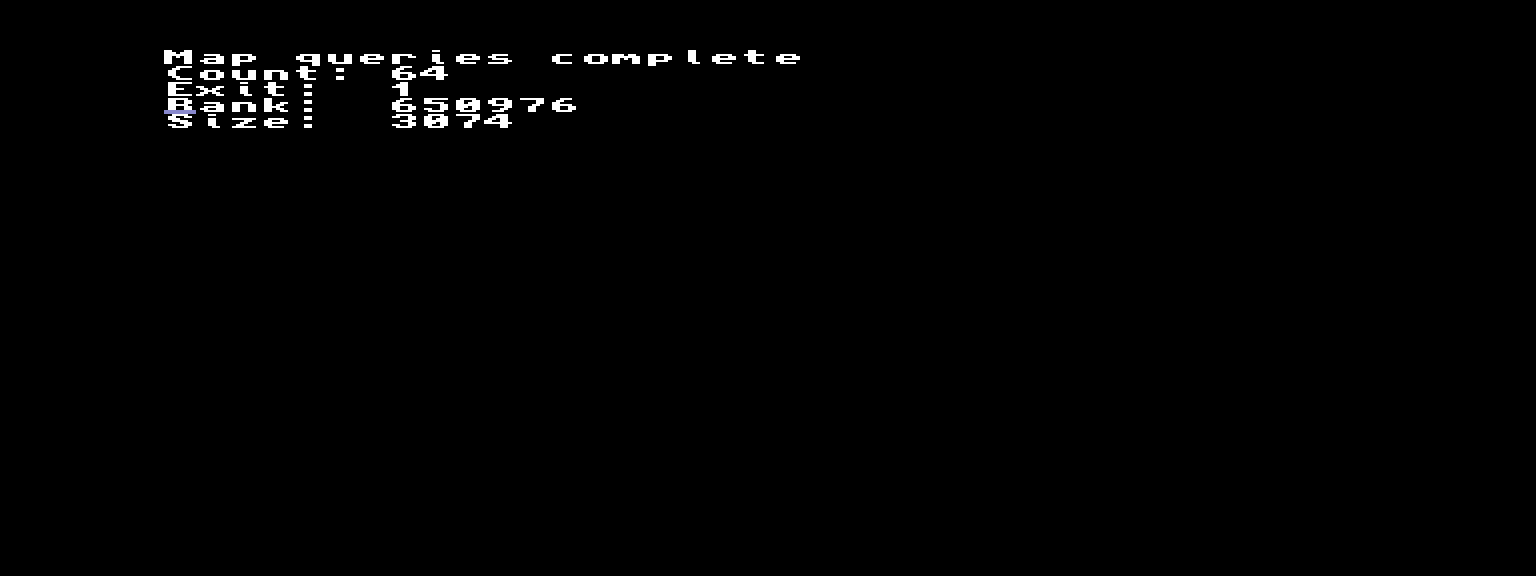
The qualification map uses four tile IDs and a four-element property table. Bit 0 means solid and bit 1 means exit only by this caller’s convention. custom changes the exit tile’s property from 2 to 1; every property query must then return that new value, and the native display shows Exit: 1 instead of 2. Allocation, helper code and map dimensions remain unchanged. A game decides whether a solid exit makes sense; the lookup merely returns the data.
Map data can be larger than a screen, and a renderer can draw only the visible region. This library layer deliberately does no region drawing. More IDs need a larger property allocation and matching MAX/PC values. Wider maps, a different world origin, row-offset tables, packed storage or compressed rooms need their own contract/qualification. The 255-cell dimensions are a chosen small-map interface, not a limit of Amiga hardware.
Common error: multiply by height
The labelled wrong build replaces rowW+column with rowH+column. It still stays within this bounded allocation and completes all observations, so a clean exit cannot detect the error. On the non-square 7×5 map, reading column 0, row 1 returns tile 1 instead of 3. The same fault can alter a different cell during a valid write. Restore W in the stride expression. repaired imports exactly the original working source and passes the full oracle again.
Deliberate fault applied by the qualification builder
    if name == "wrong":
        helper = helper.replace("PL_TM_Y*PL_TM_W+PL_TM_X", "PL_TM_Y*PL_TM_H+PL_TM_X")
The captured native trace records every operation and the full map after it; result values are not injected by the observer. Every invalid write must leave all 35 map elements and the following guard unchanged. A square map would hide this stride mistake, which is why the independent caller is non-square.
Costs and execution evidence
The small example allocates 35 map integers and four property integers, plus named scalar state and the runtime’s array/variable metadata. This does not claim a total compiled or interpreter RAM footprint. Row-major lookup uses an interpreted multiplication and indexed access. A row-offset table would spend more storage to avoid repeated multiplication; no speedup or cycle count is measured here.
The qualification caller adds one guard element and a 3,074-byte work bank: 64 records of 48 bytes plus a final marker. That bank is instrumentation, not a game requirement. Its 64 cases cover every cell, negative/outside reads, invalid writes/IDs, a successful write/read, properties, eight-unit conversion and invalid dimensions/capacity. The map after each operation is checked against an independent row-major host oracle. The small reader-facing caller also runs independently and displays Tile: 1, Flags: 1 and Changed tile: 2. Working, custom, wrong, repaired and boundary runs execute separately in the original runtime. The boundary run repeats the supplied-value caller rather than claiming another algorithm.
Emu198x 0.44.2, A1200 PAL, 2 MiB chip/no fast RAM, recorded Kickstart and AMOS Professional 2.00 media, and Build198x-ADF 0.2.13 are the named configuration. A fresh original-runtime cold boot and blank editor precede ASCII import and F2/F1. Source-fixture, source/tool/firmware/runtime identities, native work-bank bytes, complete markers and numeric capture recognition are retained under verification. Private runtime/media/snapshots are not distributed. This is not host-interpreter or original-hardware timing proof.
Run python3 scripts/check-amos-map-queries.py and python3 -m unittest discover -s scripts -p test_amos_map_queries.py -v from the samples root. verify-amos-map-queries.py accepts explicit original runtime/firmware, emulator, disk-builder and fresh private-directory paths for replay. Corruptions must fail before publication. After capture, Q exits the diagnostic and releases its bank; the retained quit image is an observation, not an automatic proof of all editor cleanup behaviour.
Coordinates, array indexing, integer division and flag sets connect naturally to Maths for Games. This routine returns data; collision, movement and drawing callers decide what it means.
See the original runtime
Pinned routines and complete importable callers · Native configuration and records. Maths for Games develops indexing, division and flag sets; the map-query explanation describes the shared row-major conventions.