
Code status: executed in the original Blitz runtime. These are language-native integer arrays and Gosub routines, independently qualified from the assembly and AMOS routes.
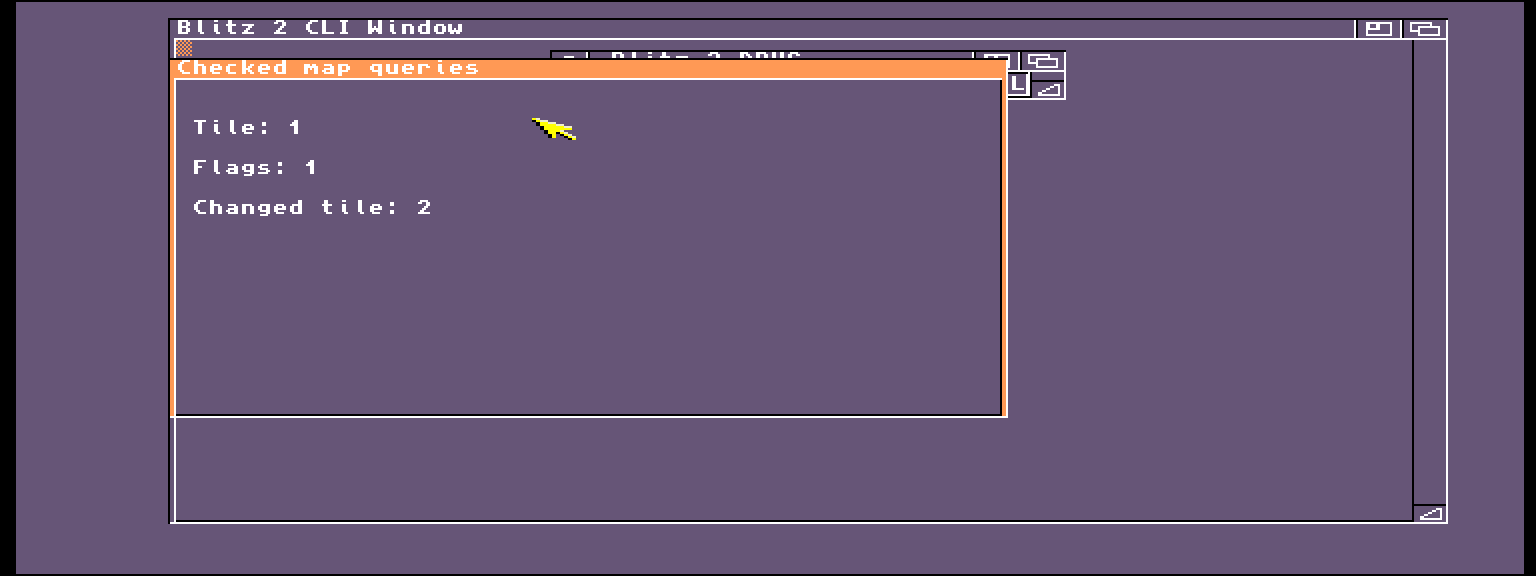
A map is game data first: read a cell, change it and ask what its tile means without involving the display. caller.bb2 is a small complete project caller; append routines.bb2 after its End, or import build/demo.asc from make through Ted’s ASCII Insert command. Compile/run with Right-Amiga+X. It displays Tile: 1, Flags: 1 and Changed tile: 2; Q closes its window. The qualification uses original Blitz BASIC 2.10/Ted 1.1 in Amiga mode, independently of the AMOS and assembly routes.
A small project caller: read, property, write and convert
; Blitz BASIC 2.10 Amiga-mode long arrays; append routines after End.
WbToScreen 0
Window 0,0,20,420,180,$1000,"Checked map queries",1,0
Dim PL_TM_MAP.l(34),PL_TM_PROPS.l(3)
PL_TM_W.l=7 : PL_TM_H.l=5 : PL_TM_CAP.l=35 : PL_TM_MAX.l=3 : PL_TM_PC.l=4
For PL_TM_I.l=0 To 34 : PL_TM_MAP.l(PL_TM_I.l)=PL_TM_I.l MOD 4 : Next
PL_TM_PROPS.l(0)=0 : PL_TM_PROPS.l(1)=1 : PL_TM_PROPS.l(2)=2 : PL_TM_PROPS.l(3)=3
PL_TM_X.l=3 : PL_TM_Y.l=2 : Gosub PL_TM_GET
WLocate 8,20 : Print "Tile: ",PL_TM_TILE.l
Gosub PL_TM_PROPERTY : WLocate 8,40 : Print "Flags: ",PL_TM_PROP.l
PL_TM_TILE.l=2 : Gosub PL_TM_SET
PL_TM_WX.l=24 : PL_TM_WY.l=16 : Gosub PL_TM_PIXEL8
WLocate 8,60 : Print "Changed tile: ",PL_TM_TILE.l
Repeat : VWait : Until Inkey$="q"
DefaultInput : DefaultOutput
Free Window 0
End
Allocate and call
Use typed long arrays and scalars, as the maintained code does. Dim PL_TM_MAP.l(34) gives 35 elements, indexed 0–34; the final DIM index is inclusive. Dim PL_TM_PROPS.l(3) gives four property entries. Set W/H to 1–255 cells, CAP to the actual allocated map element count, MAX to the highest valid tile ID (0–255), and PC to the property element count (at least MAX+1). Initialise every used element. The capacity fields are caller promises; the helper cannot discover or repair a falsely declared allocation.
The map is flat and row-major: row*W+column. These .l arrays store long values even though this interface limits tile IDs to byte range. They are not raw packed assembly maps. Keep the PL_TM prefix free or rename it consistently. One shared context is not recursive or re-entrant.
- PL_TM_GET: supply X/Y, Gosub the label, then check VALID before TILE. It clears PROP. Invalid dimensions/capacity/coordinates or a stored out-of-range ID return VALID=0 and TILE=0. A zero tile alone is not success.
- PL_TM_SET: supply X/Y/TILE, call, check VALID. Invalid dimensions, capacity, cell or tile cannot alter the map. TILE remains the input and PROP is cleared. This routine does not draw.
- PL_TM_PROPERTY: supply TILE, call, check VALID before PROP. It checks MAX and property capacity independently of map dimensions. Failure returns PROP=0 and leaves TILE unchanged. The game assigns meanings to those flags.
- PL_TM_PIXEL8: supply WX/WY as nonnegative long world coordinates up to 65535. It divides by eight into long X/Y and uses the checked read. Division discards the nonnegative fraction, giving the containing cell. Negative/too-large world coordinates return zero outputs; positive converted cells outside the map are rejected. WX/WY survive. A different cell size or signed world needs a corresponding conversion and origin policy.
Routines change their PL_TM output/state/index scratch and use the normal Gosub stack. They do not allocate, reserve banks, wait, draw, install interrupts or change a clock. The small caller separately owns its window/output route and frees the window on Q. Keep another routine from changing this context’s inputs before the result is consumed.
The maintained checked map routines
; Checked row-major map context. Arrays and capacities belong to the caller.
.PL_TM_CHECK
PL_TM_VALID.l=0 : PL_TM_PROP.l=0
If PL_TM_W.l<1 or PL_TM_W.l>255 or PL_TM_H.l<1 or PL_TM_H.l>255
Return
EndIf
If PL_TM_CAP.l<PL_TM_W.l*PL_TM_H.l
Return
EndIf
If PL_TM_MAX.l<0 or PL_TM_MAX.l>255
Return
EndIf
If PL_TM_X.l<0 or PL_TM_X.l>=PL_TM_W.l or PL_TM_Y.l<0 or PL_TM_Y.l>=PL_TM_H.l
Return
EndIf
PL_TM_INDEX.l=PL_TM_Y.l*PL_TM_W.l+PL_TM_X.l
PL_TM_VALID.l=1
Return
.PL_TM_GET
PL_TM_TILE.l=0 : Gosub PL_TM_CHECK
If PL_TM_VALID.l=0
Return
EndIf
PL_TM_TILE.l=PL_TM_MAP.l(PL_TM_INDEX.l)
If PL_TM_TILE.l<0 or PL_TM_TILE.l>PL_TM_MAX.l
   PL_TM_TILE.l=0 : PL_TM_VALID.l=0
EndIf
Return
.PL_TM_SET
Gosub PL_TM_CHECK
If PL_TM_VALID.l=0
Return
EndIf
If PL_TM_TILE.l<0 or PL_TM_TILE.l>PL_TM_MAX.l
PL_TM_VALID.l=0
Return
EndIf
PL_TM_MAP.l(PL_TM_INDEX.l)=PL_TM_TILE.l
Return
.PL_TM_PROPERTY
PL_TM_VALID.l=0 : PL_TM_PROP.l=0
If PL_TM_MAX.l<0 or PL_TM_MAX.l>255 or PL_TM_PC.l<PL_TM_MAX.l+1
Return
EndIf
If PL_TM_TILE.l<0 or PL_TM_TILE.l>PL_TM_MAX.l
Return
EndIf
PL_TM_PROP.l=PL_TM_PROPS.l(PL_TM_TILE.l) : PL_TM_VALID.l=1
Return
.PL_TM_PIXEL8
PL_TM_X.l=0 : PL_TM_Y.l=0 : PL_TM_TILE.l=0 : PL_TM_PROP.l=0 : PL_TM_VALID.l=0
If PL_TM_WX.l<0 or PL_TM_WY.l<0 or PL_TM_WX.l>65535 or PL_TM_WY.l>65535
Return
EndIf
PL_TM_X.l=PL_TM_WX.l/8 : PL_TM_Y.l=PL_TM_WY.l/8
Gosub PL_TM_GET
Return
Make it your own
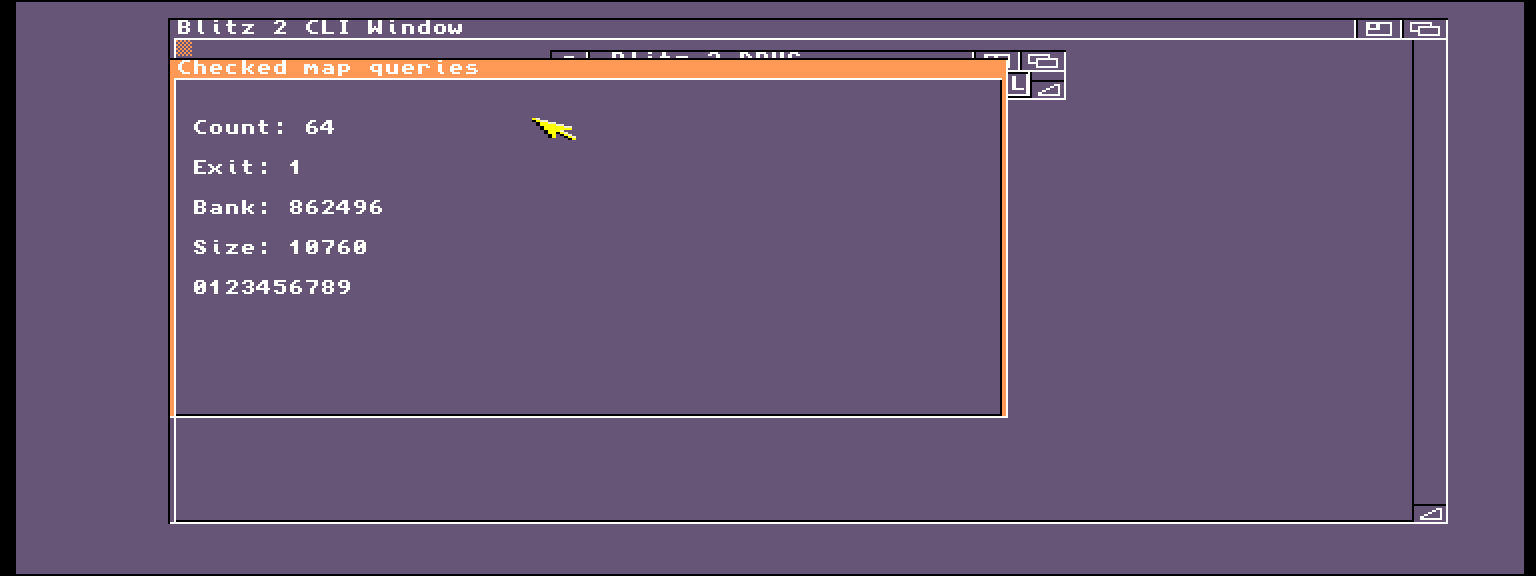
In this caller’s property convention, bit 0 means solid and bit 1 means exit. The native customisation changes tile 2’s property from 2 to 1; the compiled caller then displays Exit: 1 instead of 2 and property queries return the new value. The helper, map dimensions and allocations stay unchanged. A game decides what a solid exit should do; the lookup only returns data.
A map can be larger than the visible region. This component deliberately does no region drawing. More IDs need a larger property array and matching MAX/PC values. Wider dimensions, row offsets, packed byte arrays, compressed rooms or streamed chunks need their own contracts and checks. The 255-cell dimensions are a selected small-map interface, not an Amiga hardware limit.
Common error: use height as the stride
The labelled wrong build substitutes rowH+column for rowW+column. It stays inside this bounded allocation and completes all 64 operations, yet column 0, row 1 of the 7×5 map returns tile 1 instead of 3. A valid write can alter the wrong cell too. Restore W in the stride expression. The repaired run compiles exactly the original working source and passes the whole map oracle.
Deliberate fault applied by the qualification builder
    if name == "wrong":
        helper = helper.replace(
            "PL_TM_Y.l*PL_TM_W.l+PL_TM_X.l", "PL_TM_Y.l*PL_TM_H.l+PL_TM_X.l"
        )
The native trace records the result and all map elements after every operation. Invalid writes must leave all 35 cells and their following guard unchanged. A square map would hide this stride error; a successful compile or clean exit does not detect it.
Costs and independent verification
The small example allocates 35 map longs and four property longs: 156 bytes of numeric element payload, plus array metadata, named long scalar state and compiled code/runtime support. No total compiled or runtime footprint is claimed. Row addressing performs multiplication and indexed access; a row-offset table would spend storage to avoid repeated multiplication. No cycle count, speedup or frame budget is measured here.
The qualification caller adds a guard element and a 10,760-byte bank: 64 records of 168 bytes plus eight final guard bytes. That bank is observation storage, not a map-helper requirement. Each record contains outputs and the complete long-element map. Cases cover every cell, negative/outside reads, invalid writes/IDs, a valid change/readback, properties, world conversion and invalid dimensions/capacity. A separate host row-major oracle checks the observations without being treated as native execution.
The small reader-facing caller runs separately. Working, custom, wrong, repaired and boundary runs each compile in original Ted and execute their supplied-value caller; the boundary run repeats that caller rather than claiming another algorithm. The original runtime cold boot, blank editor and ASCII requester phases precede imports. Explicit source-file selection and bounded import/compile windows are checked. Positive per-operation/final markers distinguish successful completion from an editor or failed compile. Native bank bytes, source-fixture/program/tool/firmware/runtime identities, numeric PNG recognition and rejected corruptions are retained under verification.
Selected configuration: Emu198x 0.44.2, A1200 PAL with 2 MiB chip/no fast RAM and three drives, recorded Kickstart and original Blitz BASIC 2.10 system/libraries media, Build198x-ADF 0.2.13. Private runtime media and snapshots are not distributed. This is compiled original-runtime execution, not a claim about every Blitz revision, original-hardware timing or an exported standalone executable. Quit captures are observations, not complete proofs of all editor cleanup behaviour.
Run python3 scripts/check-blitz-map-queries.py and python3 -m unittest discover -s scripts -p test_blitz_map_queries.py -v from the samples root. The native verifier takes explicit emulator/firmware/runtime/builder and fresh private-directory paths. Coordinate indexing, integer division and flag sets connect to Maths for Games; collision, movement and drawing callers decide how to use the data.
See the original runtime
Pinned routines and complete importable callers · Native configuration and records. Maths for Games develops indexing, division and flag sets; the map-query explanation describes the shared row-major conventions.