Counting the Faces
Six counters and a chain of IFs turn a hundred rolls into a tally — the accumulation pattern at the heart of the simulation.
Rolling a hundred dice takes one change — the loop to 1 TO 100. The new idea is remembering
what came up. To see whether a die is fair, you need to count how many times each face
appears. That means six running totals, nudged up one at a time as the dice land.
  10 BORDER 0: PAPER 0: INK 7: CLS
  20 RANDOMIZE
  60 CLS
  70 LET t1 = 0: LET t2 = 0: LET t3 = 0
  80 LET t4 = 0: LET t5 = 0: LET t6 = 0
  90 PRINT "Rolling 100 dice..."
 100 PRINT
 110 FOR i = 1 TO 100
 120 LET d = INT (RND * 6) + 1
 130 IF d = 1 THEN LET t1 = t1 + 1
 140 IF d = 2 THEN LET t2 = t2 + 1
 150 IF d = 3 THEN LET t3 = t3 + 1
 160 IF d = 4 THEN LET t4 = t4 + 1
 170 IF d = 5 THEN LET t5 = t5 + 1
 180 IF d = 6 THEN LET t6 = t6 + 1
 250 NEXT i
 260 PRINT "1: "; t1; "  2: "; t2; "  3: "; t3
 270 PRINT "4: "; t4; "  5: "; t5; "  6: "; t6
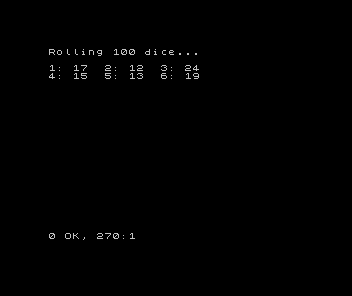
The accumulation pattern
Lines 70–80 set up six counters, t1 to t6, all starting at zero. Inside the loop, lines
130–180 are a chain of IFs: whichever face came up, that counter gains one — IF d = 1 THEN LET t1 = t1 + 1, and so on. LET t1 = t1 + 1 reads as “make t1 one bigger than it is now”;
the counter remembers its value between rolls and grows across the whole run.
That is accumulation — a value that builds up over many passes of a loop. You met it as a single counter in Reflex’s reaction timer; here it is six counters working in parallel, one per outcome. It is the pattern behind every score, every total, every statistic a program keeps.
A hundred is not enough either
The totals come out close to even — around 16 or 17 each — but not exact, and the gaps look large. Is face 3 truly better than face 2, or is a hundred rolls just too few to tell? You already suspect the answer: roll more. But staring at the screen while a thousand dice land, then reading six final numbers, is a poor way to watch. The totals deserve to be seen as they climb.
Next: a dashboard that updates as each die lands.