
Every fortune-teller does the same two things: it takes your question, and it gives you an answer. That’s the whole shape of Oracle, and you can build it in four lines. The answer won’t be wise yet — it’s always YES — but the ceremony is what matters first.
10 PRINT CHR$(147)
20 INPUT "SPEAK, MORTAL";Q$
30 PRINT
40 PRINT "THE ORACLE SAYS... YES"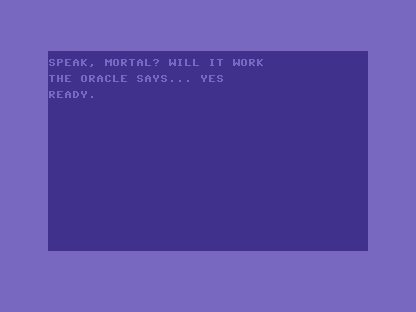
INPUT "SPEAK, MORTAL";Q$ does the asking: it prints the prompt, waits for the player to
type, and stores whatever they type in the string variable Q$. (The Oracle never reads the
question — but the ritual of typing it is half the fun.) Then PRINT gives the answer.
The prompt is doing real work, too. INPUT "SPEAK, MORTAL" has more menace than INPUT "TYPE YOUR QUESTION" — same code, different character. The Oracle’s voice starts here.
Try this
- Change its voice. Rewrite the prompt — “WHAT TROUBLES YOU?”, “ASK, AND BE ANSWERED” — and feel how the personality shifts.
- A grander answer. Swap
YESforIT SHALL BE SO. The Oracle should never sound like a person.
What’s next
An Oracle that always says YES is no Oracle at all. In Unit 2 it learns to choose —
RND picks between two answers, and the player stops knowing what’s coming.
Run it here
This unit's program, built for you.
- Program
- ask.prg
- Machine
- Commodore 64 (PAL Breadbin)