
Switch a 48K Spectrum on and it shows almost nothing: a pale grey screen with a single line of copyright along the bottom. That is a fair introduction to a machine which did nothing at all until it was told to.
What it says for itself

One line, bottom left. That’s the whole of what the machine says for itself before you give it something to do.
The announcement
Sinclair Research presented the ZX Spectrum in London on 23 April 1982. There were two models: £125 with 16K of RAM and £175 with 48K. At first there was no shop to buy one from. You sent your order to Sinclair by post, and the company promised to fill it within 28 days.
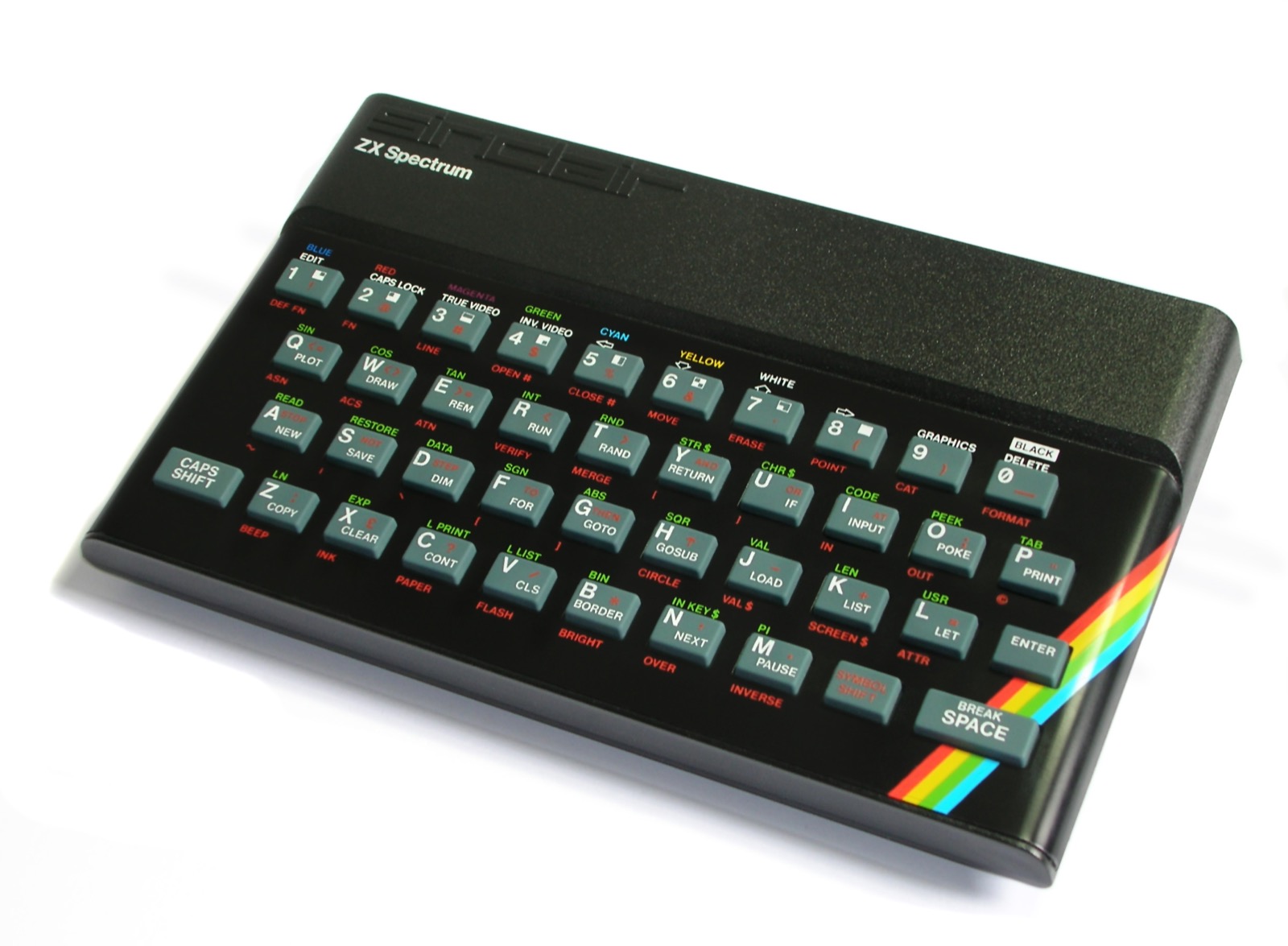
That promise was hard to keep. Most of the first machines had a fault in the ULA — the single custom chip that drew the screen, read the keyboard and made the sound. A logic error in how it shared the machine with the processor garbled input and output, and the keyboard misbehaved. Sinclair’s engineers repaired it by adding a small extra chip to the circuit board, mounted upside down and soon nicknamed the “dead cockroach”. Repaired machines were not ready until early June.
You’ll meet the ULA properly later. For now it’s enough to know that the part which made the machine cheap was also the part that made it late.
Why there were so many
£125 was the point. It was not the best home computer you could buy in 1982, and nobody claimed it was. It was the one a family could afford, which meant it went into hundreds of thousands of houses where a computer had never been.
That matters for a reason beyond history. A machine that sells in those numbers gets written for — by teenagers in bedrooms as much as by studios — and the software written for it had to work within the same limits you’re about to meet.
Why it’s worth your time now
The Spectrum is small enough to understand completely. Not “well enough to get by” — completely. One CPU, one custom chip, 48K of memory, and a manual that fits in your hands.
Almost nothing you use today is like that. That’s the reason to spend time here: not nostalgia, but the rare chance to hold a whole machine in your head at once.
A machine that arrived at £125, aimed at people who could not previously afford a computer, and sold in the numbers that decision bought.
Sources
Chris Smith, The ZX Spectrum ULA: How to Design a Microcomputer (ZX Design and Media), chapter 6, p. 72: the 23 April 1982 launch date; chapter 24, p. 250: the first ULA’s contention logic error, the erratic keyboard it caused and the “dead cockroach” repair. Alessandro Grussu, Spectrumpedia, volume 1 (English edition), p. 25: the 23 April 1982 presentation and the £125 and £175 prices; pp. 28–29: mail-order sales, the 28-day promise, the ULA fault and the first repaired machines in early June; p. 37: about five million Spectrums sold between 1982 and 1985.