
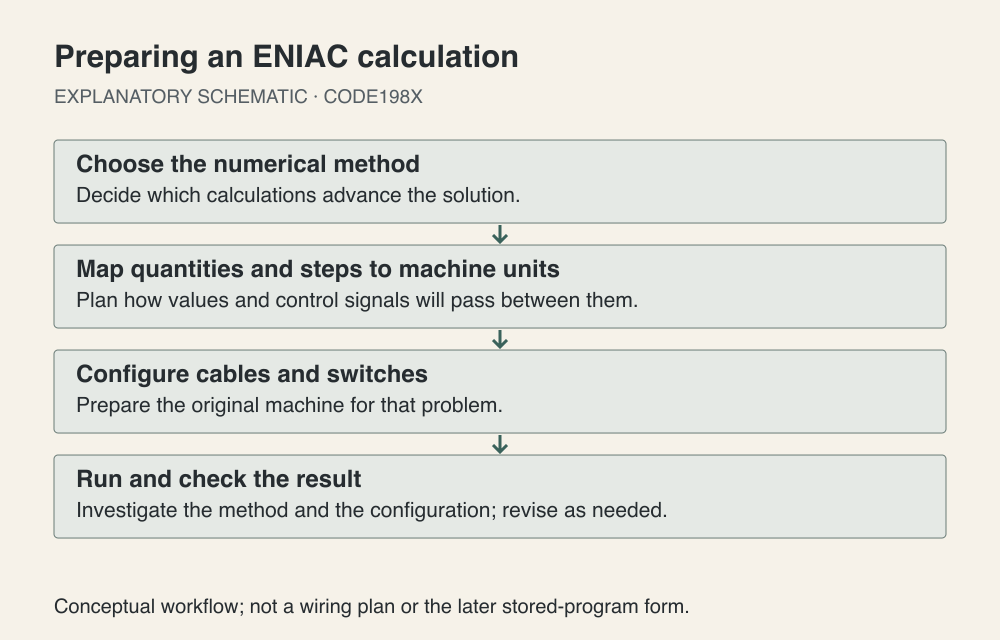
Programming ENIAC originally meant arranging cables, setting switches and deciding how its units would pass numbers and control signals. Six women selected from the human computing workforce learned that machinery well enough to make it perform calculations. The work required understanding the numerical method and how the hardware could carry it out.
They are often named by the surnames they acquired later: Kathleen McNulty Mauchly Antonelli, Jean Jennings Bartik, Betty Snyder Holberton, Marlyn Wescoff Meltzer, Frances Bilas Spence and Ruth Lichterman Teitelbaum. Their earlier names appear in the wartime records and accounts. (IEEE Computer Society; W. Barkley Fritz, The Women of ENIAC.)
From trajectories to configurations
The US Army needed firing tables describing the paths of projectiles. Human computers worked through numerical calculations using desk calculators; the Moore School at the University of Pennsylvania also operated a differential analyser, an analogue calculating machine. ENIAC, designed under John Mauchly and J. Presper Eckert, offered electronic calculation at a much greater speed. Preparing a problem remained substantial work. (Computer History Museum, “ENIAC”; Fritz.)
A programmer had to allocate quantities to units, connect the paths between them and arrange the sequence of operations. A wrong answer could require tracing both the mathematics and the configuration. The later stored-program form of ENIAC changed this arrangement; it should not be read back into the original setup. (CHM.)
Kathleen McNulty Mauchly Antonelli
McNulty graduated in mathematics from Chestnut Hill College in 1942. She and Frances Bilas applied together for computing work. In her account, learning numerical integration involved practical instruction as well as reading: they needed to understand how each calculated step advanced a trajectory. Work on the differential analyser preceded ENIAC. After the war she continued computing work with John Mauchly. (Fritz, McNulty account; IEEE career summary.)
Jean Jennings Bartik
Jennings arrived after graduating in mathematics in 1945. She and Betty Snyder worked closely on the demonstration calculations. Bartik later helped adapt ENIAC for stored-program operation and contributed to BINAC and UNIVAC. Her career therefore spans more than the machine’s unveiling: it includes changes to how instructions were represented and used. (CHM, “Jean Jennings Bartik”.)
Betty Snyder Holberton
Snyder brought experience of calculation and punched-card equipment to the group. Bartik’s account describes their partnership in checking the demonstration setup. Holberton later developed a sort-merge generator for UNIVAC and contributed to language-standard work. Those tools reduced repetitive programming tasks; they connect her ENIAC work with Grace Hopper’s work on reusable routines and business languages. (Fritz; Hopper’s IEEE career history.)
Marlyn Wescoff Meltzer
Wescoff graduated from Temple University in 1942. Her own account describes an education in social studies, English and business, followed by calculator work at the Moore School. She moved from weather calculations into ballistics and then ENIAC. She left the group in December 1946, before its move to Aberdeen. Her route into the team differed from those of the mathematics graduates. (Fritz, Meltzer account.)
Frances Bilas Spence
Bilas graduated from Chestnut Hill in 1942 with mathematics and physics studies. Alongside McNulty, she learned the differential analyser before joining the ENIAC group. Her account records continuing at Aberdeen and resigning in 1948 before the birth of her first child. The early team did not all leave at the same time or follow the same later career. (Fritz, Spence and McNulty accounts; IEEE.)
Ruth Lichterman Teitelbaum
Lichterman studied mathematics at Hunter College before working on ballistic calculations and ENIAC. She went with the machine to the Ballistic Research Laboratory at Aberdeen and helped the continuing operation there. Fritz’s account, drawing on Bartik’s recollections, identifies her as the last of the original six to leave ENIAC. Her role extends the story beyond the Philadelphia demonstration. (IEEE; Fritz, Teitelbaum passage.)
A demonstration and further development
ENIAC ran a major Los Alamos calculation in December 1945. Its formal dedication followed on 15 February 1946. Preparing the demonstration required working configurations and checks before visitors arrived. These events are separate from the later conversion for stored-program operation, developed through further collaboration. (APS’s account of the December service log; Martin H. Weik; CHM.)
Other women also contributed. Adele Goldstine wrote ENIAC documentation and participated in its later development; she was a separate contributor, not one of the original six. The six programmers themselves worked alongside engineers, maintenance staff and a larger computing workforce. (Fritz.)
Later oral histories helped recover what particular people had done. Fritz’s 1996 article includes participant accounts recorded decades after the work, and notes differences in recollection. The surviving machine records, individual testimony and later institutional histories answer different questions. Women’s contributions to computing connects this team to other workplaces and forms of programming.
Sources
- W. Barkley Fritz, “The Women of ENIAC”, IEEE Annals of the History of Computing 18(3), 1996, pp. 13–28. Primary participant testimony collected within a retrospective history. Named sections preserve accounts from McNulty, Bartik, Holberton, Meltzer and Spence; the Teitelbaum passage draws on Bartik.
- IEEE Computer Society, “About Women of ENIAC”. Institutional identification of all six and career summaries. The individual testimony supplies Meltzer’s particular education and the differing departure dates.
- Computer History Museum, “ENIAC”, Revolution. Museum account of calculation, units and original programming.
- Computer History Museum, “Jean Jennings Bartik”, 2008 Fellow. Career account: education, ENIAC conversion, BINAC and UNIVAC.
- IEEE Computer Society, “Grace Brewster Murray Hopper”. Identifies Holberton’s sort-merge generator and its connection to Hopper’s automatic-programming work.
- Tess Joosse, APS, “December 1945: The ENIAC Computer Runs Its First, Top-Secret Program”, 10 November 2022. Secondary account citing the service log. Martin H. Weik, The ENIAC Story, 1961, records the formal dedication on 15 February 1946.