
A photograph of a computer can leave out most of the work needed to use it. Someone chose a method, prepared the data, wrote or configured a program, and checked the answer. In other settings, someone designed the language, the processor or the game. Women did all of these kinds of work. Following particular tasks makes their contributions easier to understand than a list of famous names alone.
The histories below take us through American research laboratories, British computer development and games made in the United States and Japan. Their institutions and opportunities differed. A mathematician employed to calculate, an electronic-computer programmer and a game composer were doing distinct jobs, even when their careers crossed those boundaries.
When a computer was a person
Before the word usually meant an electronic machine, a computer could be a person employed to calculate. Research laboratories organised teams to work through numerical problems, often with mechanical calculating equipment. Women formed important computing groups at particular institutions; that does not mean every human computer was a woman.
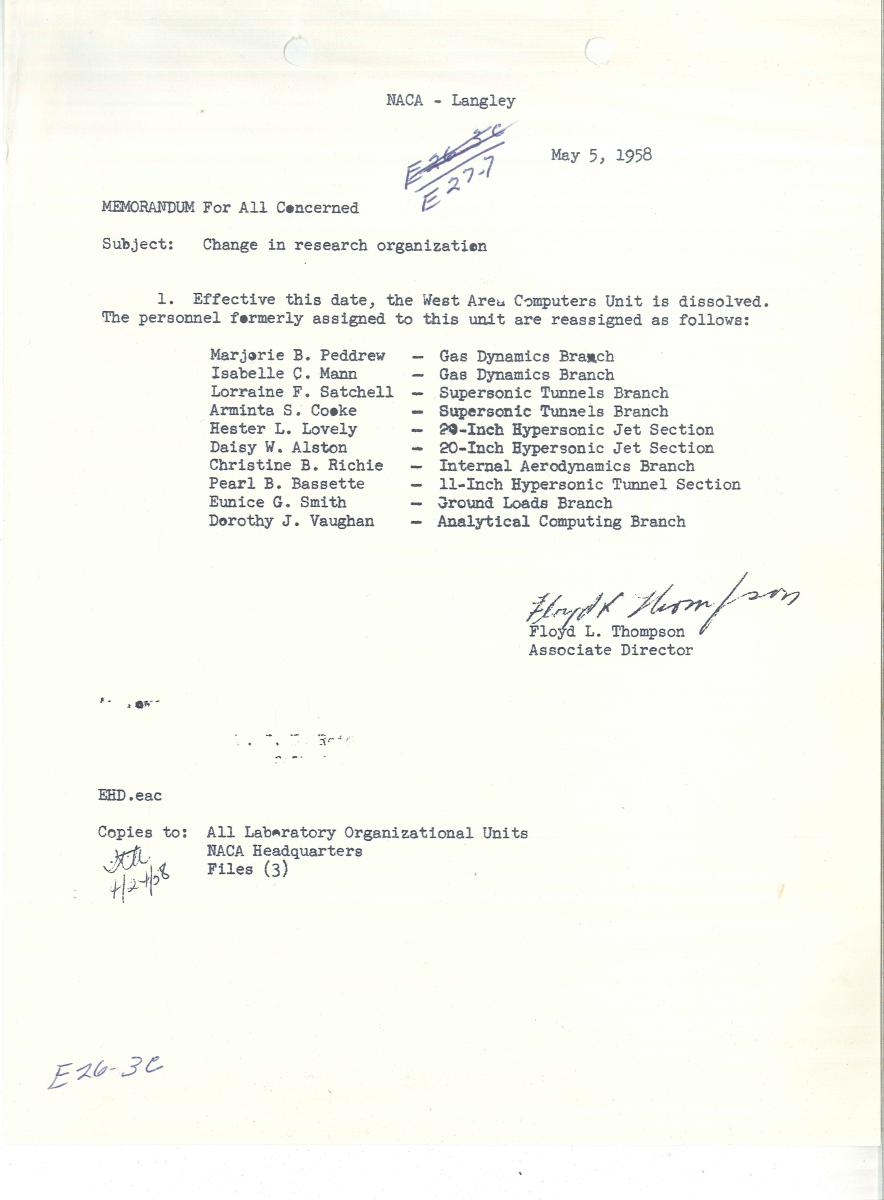
At the United States’ Langley laboratory, Dorothy Vaughan joined the National Advisory Committee for Aeronautics in 1943. She led its West Area Computing group from 1949. Black women worked in a segregated unit and were required to use separate dining and bathroom facilities. These restrictions shaped where qualified mathematicians worked and how their careers developed. (Margot Lee Shetterly’s NASA biography; National Archives account.)
A memo dated 5 May 1958 formally dissolved the unit. It lists ten women and the branches to which each was reassigned; Vaughan went to the Analytical Computing Branch. The document records an organisational change affecting named workers. Their expertise continued to be needed. Vaughan became an expert in FORTRAN, a programming language used for scientific calculations, according to NASA’s biography.
Programming an electronic machine
The original ENIAC programming group had also worked as human computers. Its six members were Kathleen McNulty Mauchly Antonelli, Jean Jennings Bartik, Betty Snyder Holberton, Marlyn Wescoff Meltzer, Frances Bilas Spence and Ruth Lichterman Teitelbaum. Their task required understanding how a mathematical problem could pass through ENIAC’s electronic units. (University of Pennsylvania; Computer History Museum.)
On the machine’s original configuration, programming involved cables and switches. There was no familiar text editor in which to type and run a stored program. Preparing the connections and settings was part of programming, and finding an incorrect result required investigating the setup as well as the mathematics. The engineers who designed the hardware and the programmers who made it solve a problem contributed different kinds of expertise. (CHM, “ENIAC”.)
ENIAC ran a major Los Alamos calculation in December 1945, before its formal dedication on 15 February 1946. The date a machine first worked, its public demonstration and its later operation are separate events. A history that starts and ends with the unveiling can miss the preparation that made the demonstration possible. (Tess Joosse, APS history; Martin H. Weik, The ENIAC Story, 1961.)
Languages and processors in Britain
Sophie Wilson worked on several layers of Acorn’s computers. She designed the System 1, wrote BASIC interpreters for Acorn machines and designed ARM’s instruction set. Steve Furber’s and the wider Acorn team’s work connected that instruction set to a physical processor and working computer.
On the BBC Micro, a programmer could use named BASIC procedures and an integrated assembler. The interpreter and its tools affected what an owner could make without purchasing another language system. ARM’s instruction set, in turn, defined the operations available to machine-code programmers and compiler writers. Wilson’s biography follows the work and its collaborators; the BCS career account traces its development.
Other British computing careers survive less visibly. Historian Mar Hicks describes finding many photographs of women workers whose names were missing. Tracking down Cathy Gillespie led to interviews with both Gillespie and her former colleague Ann Sayce. A remembered 1965 recruitment advertisement became another piece of evidence: Hicks eventually found a copy in a different newspaper from the one first consulted. That account shows why photographs, job advertisements and interviews can answer different questions about a working life. (Hicks, “What Makes a History Hidden?”, 2019.)
Making games was technical and creative work
Carol Shaw designed and programmed games, including the Atari 2600 River Raid. Dona Bailey programmed Centipede with Ed Logg. Their work belonged within Atari’s and Activision’s game development, with the same need to fit programs, pictures and behaviour into limited hardware. It was central to the games people played.
The jobs within a game team also need distinguishing. In her 1990 START interview, Roberta Williams described designing Mystery House and drawing its pictures while Ken Williams programmed it. For later games, more programmers and artists joined the work. Crediting the design does not require assigning the whole implementation to the designer. (Tom Byron, “Roberta’s Bequest”.)
In Japan, Manami Matsumae’s work on Mega Man included both music and sound effects. In an interview with Mohammed Taher, translated by Alex Aniel, she explained how her piano training helped with writing several simultaneous musical parts. She also described the practical problem of sound effects interrupting music, and shortening effects to reduce those interruptions. Musical judgement and the behaviour of a limited sound system met in the same task. (Brave Wave interview.)
Opportunities and experiences differed
Barriers should be described where the evidence places them. Segregation at Langley was an institutional restriction. Bailey’s accounts of being the only woman in Atari’s coin-op engineering group describe a particular workplace. In a 2007 interview, she recalled colleagues dismissing her contribution to Centipede. Shaw’s 2011 account of her own career was different: she said that she did not recall discrimination or harassment at Tandem, where she worked with other women engineers. Those recollections concern different teams and periods; neither stands for every woman’s experience. (Bailey interviewed by Leigh Alexander; Shaw interviewed by Benj Edwards.)
Recognition could also occur at the time. Activision’s River Raid instructions named Shaw and included her advice to players. The later preservation of her papers at The Strong adds source listings and design documents to that public credit. An overlooked career, an anonymous photograph and a credited designer whose records are later archived are different historical situations.
Useful questions to carry into another entry are concrete: what work did this person perform, who worked with them, what could they access, and which records support the account? The answers can recover a name, correct a credit or explain how a familiar machine or game was made.
Further computing histories
Katherine Johnson and Mary Jackson follow different work at Langley: orbital mathematics and experimental aerodynamics. Annie Easley follows scientific programming at the Cleveland laboratory. Margaret Hamilton examines the organisation and recovery of Apollo flight software.
Ada Lovelace explains a proposed nineteenth-century machine through its operations and quantities. Grace Hopper follows reusable routines, business languages and standards on electronic computers. Barbara Liskov examines data abstraction, while Karen Spärck Jones asks how words can help retrieve useful documents. Each entry follows the particular method and the records behind it.
Sources
- Margot Lee Shetterly, “Dorothy Vaughan”, NASA, originally published November 2016. Secondary institutional history: computing work, segregation, leadership and subsequent FORTRAN programming.
- NACA Langley, Floyd L. Thompson, “Change in research organization”, 5 May 1958, National Archives identifier 81215360. Primary memorandum: ten named reassignments, including Vaughan’s Analytical Computing Branch. The archive’s surrounding explanation supplies institutional context.
- University of Pennsylvania, “The world’s first general purpose computer turns 75”, 2021. Secondary institutional history: the six original programmers and manual configuration.
- Computer History Museum, “ENIAC”, Revolution. Museum account and collection objects: mathematicians, machine units and original programming methods.
- Tess Joosse, “December 1945: The ENIAC Computer Runs Its First, Top-Secret Program”, APS, 10 November 2022. Secondary history citing the December service log. Martin H. Weik, The ENIAC Story, Ballistic Research Laboratories, 1961, corroborates the February 1946 dedication date.
- BCS, “Sophie Wilson”, Distinguished Fellowship 2020. Institutional career account. Wilson’s linked biography gives the original manuals and oral history behind the technical examples.
- Mar Hicks, “What Makes a History Hidden?”, MIT Press, 29 March 2019. The historian’s own account of researching British workers. The research account concerns Cathy Gillespie, Ann Sayce and a 1965 recruitment advertisement.
- Tom Byron, “Roberta’s Bequest”, START, vol. 4 no. 8, March 1990. Primary participant interview, read in the Atari Magazines transcription.
- Mohammed Taher, “A Conversation with Manami Matsumae”, Brave Wave, translated by Alex Aniel. Primary interview: training, composition and sound effects. The transcript is translated participant testimony.
- Leigh Alexander, interview with Dona Bailey, Gamasutra, 27 August 2007. Primary retrospective testimony, now hosted by Game Developer. The account of colleagues’ comments is attributed to Bailey.
- Benj Edwards, interview with Carol Shaw, 12 October 2011. Conducted May 2011; primary retrospective testimony about her own workplace experience.
- Activision, River Raid: Plan of Operation, 1982, and The Strong, Carol Shaw Papers finding aid, revised 2022. Contemporary named credit and surviving archival material.