
To pass over a chosen place on Earth, a satellite must account for the ground moving beneath it. Katherine Johnson and T. H. Skopinski worked through that problem in a 1960 NASA report. It gives us a specific example of Johnson’s mathematics alongside the better-known story of her checking calculations for John Glenn’s orbital flight.
From school to Langley
Johnson was born in White Sulphur Springs, West Virginia, in 1918. She graduated from West Virginia State College in 1937, studying mathematics and French. Her career at Langley began in 1953, when the laboratory belonged to the National Advisory Committee for Aeronautics, or NACA. NASA took over in 1958. (NASA Science’s biography; Margot Lee Shetterly’s Nature obituary.)
She entered the segregated West Area Computing section led by Dorothy Vaughan, then worked with flight researchers. Moving from a pool of human computers into research work involved both mathematical ability and access to the people discussing the problems. Shetterly’s account places Johnson’s career within those institutional restrictions rather than treating her achievements as the absence of barriers.
A published problem
Skopinski and Johnson’s Determination of Azimuth Angle at Burnout for Placing a Satellite Over a Selected Earth Position asks which direction a spacecraft should be travelling when its final-stage engine stops. “Azimuth” here means a direction measured around the horizon, relative to north. The chosen direction affects the orbital plane and therefore where the spacecraft can pass.
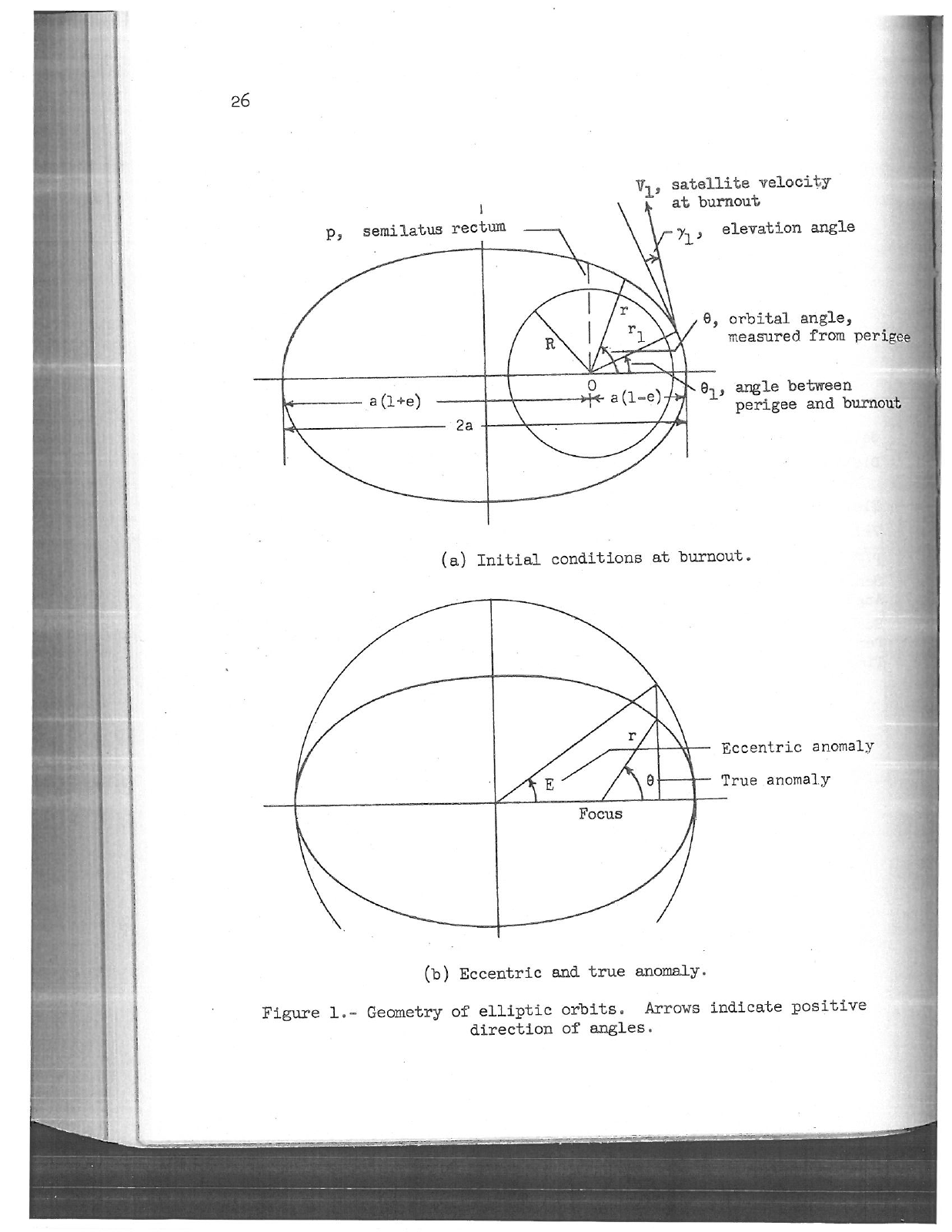
Their method first treats Earth as a sphere, then allows for its slightly flattened shape. The report works through examples involving a selected position after three orbits and compares results with machine calculations. We can follow its assumptions, intermediate quantities and corrections. It preserves a method that another analyst could examine, rather than only a claim that a calculation was correct. (TN D-233, summary, analysis and worked examples.)
Checking a flight and continuing the work
For Glenn’s 1962 mission, Johnson independently checked the electronic computer’s trajectory calculations. NASA also records her work on Alan Shepard’s earlier flight and on Apollo and Space Shuttle problems. The Glenn episode matters as a check within a larger engineering process; it was one assignment in a career that continued until retirement in 1986. She died in 2020. (NASA Science; Shetterly.)
Johnson’s orbital analysis and Margaret Hamilton’s onboard software work contributed to spaceflight in different ways. A mathematical model, a numerical check and a program running during flight each answer different questions. Mary Jackson’s wind-tunnel research offers another view of Langley: experimental measurements rather than orbital geometry.
Sources
- T. H. Skopinski and Katherine G. Johnson, NASA TN D-233, 1960. Primary technical report: summary, orbital relationships, worked examples and Figure 1 on printed p. 26 (PDF p. 28).
- NASA Science, “Katherine Johnson”. Institutional account of education, flight work, retirement and life dates.
- Margot Lee Shetterly, “Katherine Johnson (1918–2020)”, Nature, 12 March 2020. Historian’s obituary: training, segregation, research career and independent checking.