
Air flowing over a cone can change from smooth layers to a turbulent mixture. Where that happens matters to aerodynamic research. Mary Jackson and Kazimierz Czarnecki studied that transition in a supersonic wind tunnel, comparing differently shaped models. Their 1958 report preserves the apparatus, measurements and limits of a particular experiment.
Getting into engineering
Jackson was born in Hampton, Virginia, in 1921 and graduated from Hampton Institute in 1942 with qualifications in mathematics and physical science. She taught and held other jobs before joining NACA Langley in 1951. There she worked in the segregated West Area Computing group under Dorothy Vaughan. (NASA’s biography.)
In 1953 she moved to work with Czarnecki in Langley’s four-foot supersonic pressure tunnel. Advancing into engineering required additional courses. They were offered through the University of Virginia at Hampton High School, a segregated school, so she needed permission from the city to attend. After completing the training she became an engineer in 1958. NASA identifies her as its first Black woman engineer; her career crossed the transition from NACA to NASA that year. (NASA biography and 2022 agency history.)
What the cones tell us
Czarnecki and Jackson’s Effects of Nose Angle and Mach Number on Transition on Cones at Supersonic Speeds appeared as NACA Technical Note 4388 in September 1958. Both names are on the title page. They tested smooth, sharp-nosed cones at Mach numbers from 1.61 to 2.20: speeds well above the speed of sound.
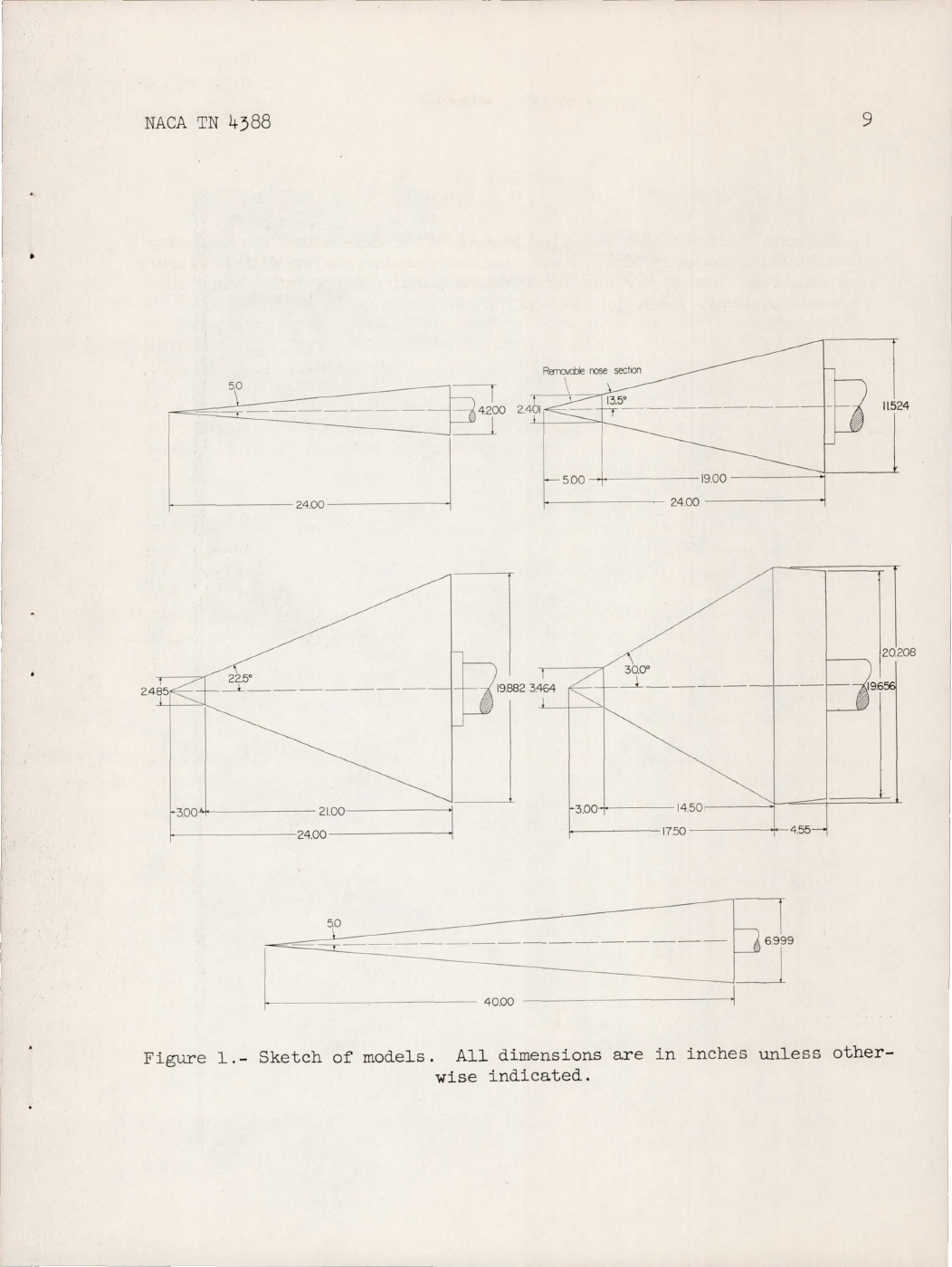
The thin region of air next to a surface is called the boundary layer. Its behaviour depends on the speed, dimensions and properties of the flow. The researchers compared the transition measurements using Reynolds numbers, which combine those quantities so that different tests can be compared meaningfully.
Within their test conditions, increasing cone angle slightly reduced the transition Reynolds number based on distance along the surface. Changes in Mach number and tunnel Reynolds number per foot had little effect over the ranges investigated. The paper states those ranges and describes the models; its conclusion belongs to that experiment. (TN 4388, summary, conclusions and Figure 1.)
Changing opportunities
In 1979 Jackson moved from engineering into equal-opportunity work, accepting a lower grade to help improve hiring and promotion for women at Langley. She retired in 1985 and died in 2005. (NASA biography.)
Her career sits beside Katherine Johnson’s orbital mathematics within Langley’s history, while the work itself differs. Johnson’s report derives a flight-path method; Jackson’s describes measured airflow. Both let us look beyond a job title to the actual research, within the wider history of women’s contributions to computing.
Sources
- K. R. Czarnecki and Mary W. Jackson, Effects of Nose Angle and Mach Number on Transition on Cones at Supersonic Speeds, NACA TN 4388, September 1958, summary, experimental description, conclusions and printed p. 9 (PDF p. 11). Primary report; the PDF title page credits both authors.
- NASA, “Mary W. Jackson”, 25 May 2017. Institutional biography: education, segregation, engineering training, later equal-opportunity role, retirement and life dates.
- NASA, FY 2022 Agency Financial Report, “HerSTORY: Mary W. Jackson”. Corroborates the 1951 and 1953 assignments, engineering qualification and later management work.