
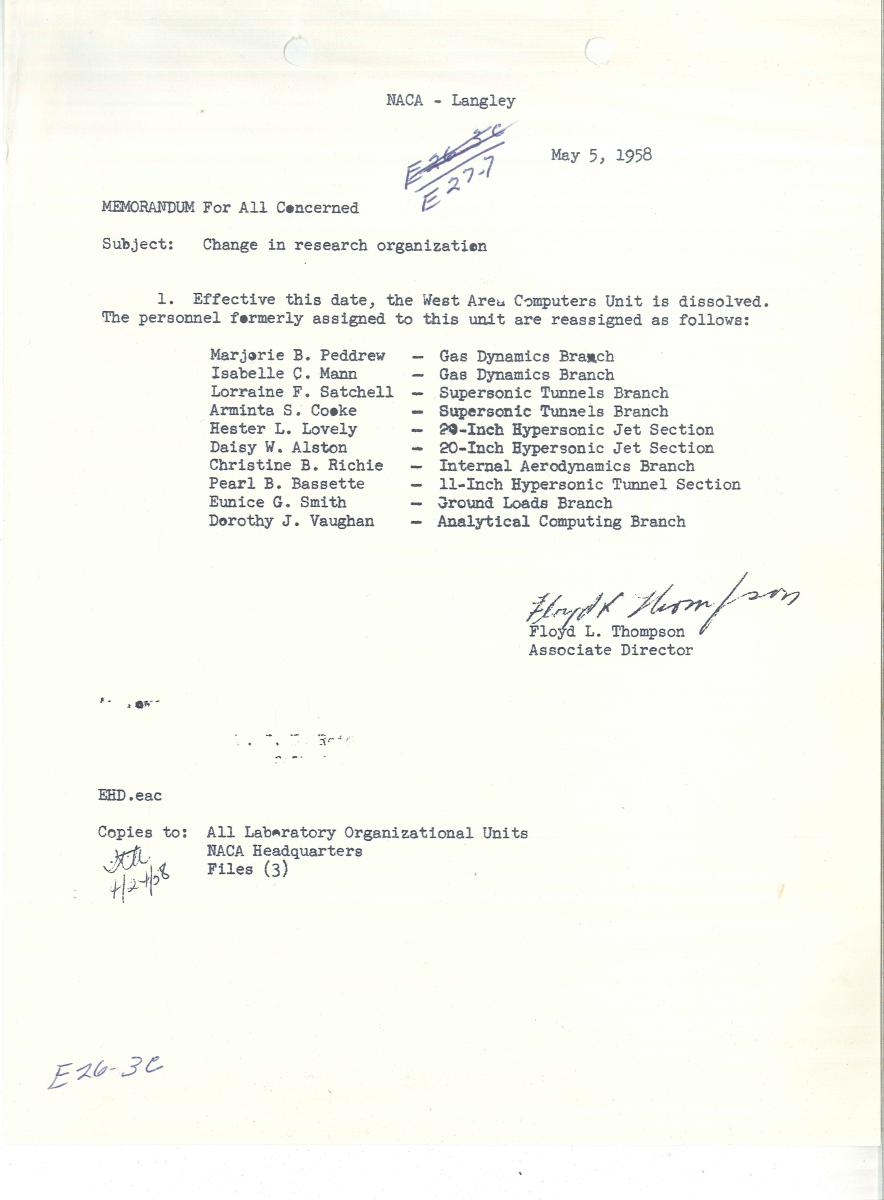
A 1958 Langley memo dissolves the West Area Computers Unit and lists ten women with their new assignments. Dorothy Vaughan appears on its final line, assigned to the Analytical Computing Branch. The unit ended; the document shows its workers continuing elsewhere. Vaughan’s career crossed that change and the move into electronic programming.
Mathematics as paid work
Vaughan was born in 1910 and earned a mathematics degree from Wilberforce University in 1929. After teaching, she joined NACA’s Langley laboratory in 1943. The West Area group was segregated: Black women calculated research results while facing separate facilities and restrictions on opportunity. (Margot Lee Shetterly’s NASA biography.)
A human computer worked through numerical methods, often using a mechanical calculator. Researchers needed reliable answers from measurements and mathematical models. The job demanded understanding the calculation well enough to carry it out and check it; a fast machine was not a substitute for knowing which problem to give it.
Supervising the group
Vaughan began leading West Area Computing in 1949. NASA’s Pioneers and Innovators: Women of Color distinguishes her initial acting role from the formal promotion in January 1951. That distinction explains why accounts can give different dates for her becoming a supervisor.
Shetterly describes Vaughan’s advocacy for the people she supervised, including recommendations for assignments and advancement. Managing the work meant matching mathematical skill to research needs as well as completing calculations herself. Katherine Johnson joined the section in 1953 before moving into flight research; Mary Jackson also began her Langley career there. Their later work took different forms.
Learning another way to compute
Vaughan became proficient in FORTRAN, a language used to express scientific calculations for electronic computers. Shetterly records work associated with the Scout launch-vehicle programme. Programming continued to require mathematical judgement, but a written program could instruct a machine to repeat the numerical steps. Vaughan retired in 1971 and died in 2008. (NASA biography.)
The memo predates NASA’s establishment later in 1958: its heading names NACA. Reading the document alongside a career history helps keep a laboratory’s organisational changes separate from the development of an individual’s work. The same wider shift appears in Annie Easley’s career at the Cleveland laboratory, where calculation, punched cards and FORTRAN overlapped in a different workplace.
Vaughan’s story also gives the broader history of women’s contributions to computing a named team and a surviving administrative record. The people and their assignments are visible on the page.
Sources
- Floyd L. Thompson, “Change in research organization”, 5 May 1958, National Archives identifier 81215360. Primary NACA memorandum, reproduced with the archive’s contextual account; ten named reassignments.
- Margot Lee Shetterly, “Dorothy Vaughan”, NASA, originally November 2016. Institutional biography: education, employment, supervision, advocacy, FORTRAN, Scout, retirement and life dates.
- NASA, Pioneers and Innovators: Women of Color, Dorothy Vaughan section. Distinguishes acting leadership in 1949 from formal promotion in January 1951.