
In 1843, Ada Lovelace published a translation of Luigi Menabrea’s account of Charles Babbage’s proposed Analytical Engine. She added extensive Notes explaining its operation and possibilities. One worked example planned the calculation of Bernoulli numbers; another passage considered how a machine might act on things represented by numbers, including music.
Learning the mathematics
Lovelace was born in 1815 and studied mathematics privately. Her surviving correspondence with Augustus De Morgan records an informal course in 1840–41, including her questions and his responses. The Clay Mathematics Institute’s edition of those papers follows her progress from earlier geometry into calculus. It makes her mathematical education visible as sustained work, with gaps to address and ideas to master.
She met Babbage in 1833 and became interested in his calculating machines. The Analytical Engine differed from his earlier Difference Engine: it was intended to carry out varied sequences of operations directed by cards. The complete machine was not built in their lifetimes. (Computer History Museum, The Babbage Engine.)
An explanation with an example
Menabrea’s original paper appeared in French in 1842. Lovelace’s English translation and Notes appeared in Scientific Memoirs in 1843. Note G sets out a table of operations for calculating Bernoulli numbers, showing how quantities would be combined and where intermediate results would go. It describes work for a proposed machine; there was no complete Analytical Engine on which to run it.
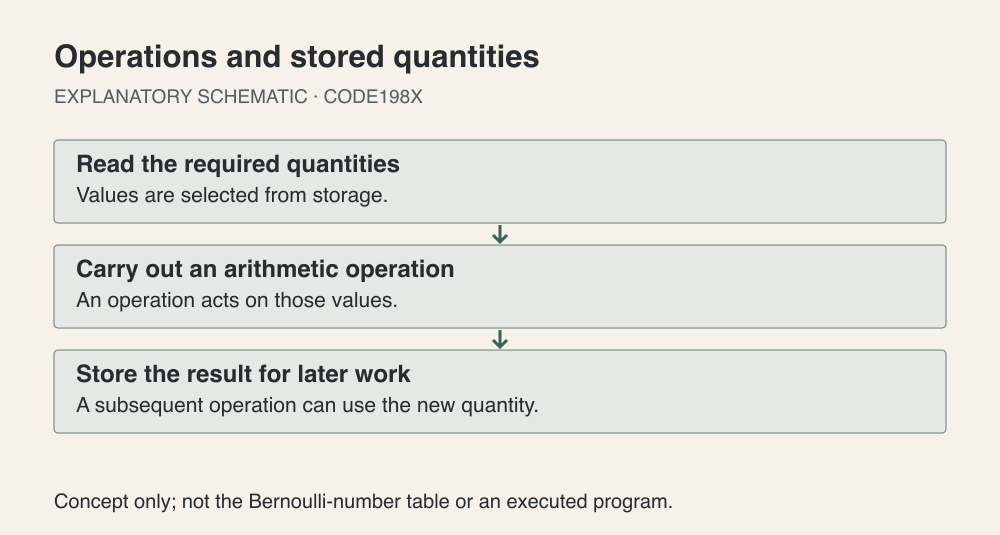
The distinction between an operation and the quantity it acts on also supports Note A’s broader argument. If the relationships in another subject could be expressed appropriately, the Engine’s operations might apply there too. Lovelace used music as a possibility. She was reasoning about representation and rules, not reporting that the machine had composed a piece. (1843 Notes A and G.)
Collaboration on an unfinished machine
Lovelace and Babbage exchanged detailed questions and corrections while preparing the Notes. Letters reproduced in the Ada User Journal show discussion of cards, notation and the developing text. Babbage’s own earlier work included programs for the Engine, preserved in his code sketches. (Raúl Rojas, “The First Computer Program”.) The correspondence records joint technical work on a changing design. Her published contribution combined detailed explanation with a worked calculation.
She died in 1852. Her Notes remain useful because they connect a machine’s proposed parts with the steps of an actual calculation. Grace Hopper’s later work on programming tools concerned electronic machines that people could use; the intervening century changed the equipment and the practical task. Both histories belong within women’s contributions to computing, with the evidence and circumstances of each kept in view.
Sources
- L. F. Menabrea, Sketch of the Analytical Engine, translated with Notes by Ada Lovelace, 1843, Notes A and G. Primary publication, read in Fourmilab’s transcription; the original appeared in Scientific Memoirs, vol. 3, pp. 666–731.
- Clay Mathematics Institute, Ada Lovelace’s Mathematical Papers. Scholarly edition and contextual account of the surviving Lovelace–De Morgan correspondence, 1840–41.
- Computer History Museum, “Ada Lovelace”, and “A Brief History”. Museum history: meeting Babbage, the two Engine projects, collaboration and the unfinished Analytical Engine.
- Raúl Rojas, “The First Computer Program”, Communications of the ACM 67(6), June 2024, pp. 78–81. Primary historical analysis of Babbage’s surviving earlier code sketches; DOI 10.1145/3624731.
- Ada User Journal, vol. 36 no. 2, June 2015, “Lovelace & Babbage and the Creation of the 1843 ‘Notes’”. Documentary account quoting their correspondence; distinguishes the developing design and collaborative preparation of the Notes.