
Suppose a collection contains ten documents. A search word that appears in eight of them does little to distinguish one document from another. A word found in only one may be a stronger clue. Karen Spärck Jones developed a way to use that difference when weighting search terms, known as inverse document frequency, or IDF.
From history to language research
Spärck Jones was born in Huddersfield in 1935. At Girton College, Cambridge, she began with history and moved into Moral Sciences, the philosophy course. She later joined the Cambridge Language Research Unit, working with Margaret Masterman on language and meaning. A background outside engineering led into questions about what computers could do with words. (John Tait’s obituary; Girton’s account.)
Her doctoral research examined synonymy and semantic classification: how words relate in meaning, and how a machine might group them. In her later account, she describes using dictionary definitions as evidence of words that could substitute for one another in particular contexts. That is a different starting point from treating a document only as a row of characters. (Some points in a time, pp. 1–3.)
Measuring how distinctive a term is
Her 1972 paper, A statistical interpretation of term specificity and its application in retrieval, investigated weighting terms by their distribution across a collection. The later retrospective gives the compact formula log(N/n): N is the number of documents and n the number containing the term. A smaller document count gives greater weight. (1972 paper; retrospective, Figure 5.)
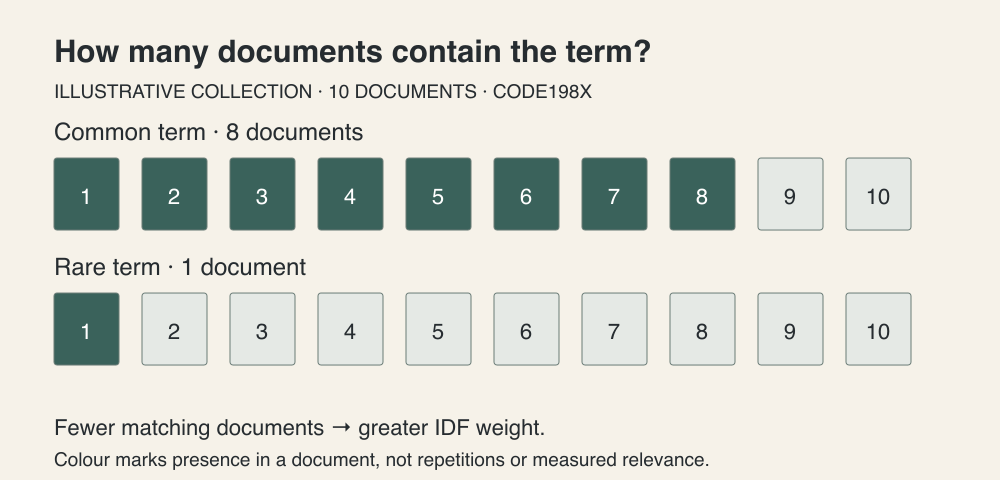
This does not make a rare word automatically relevant or a common word useless. Common terms can help retrieve more relevant documents; distinctive terms can help discriminate among them. Frequency within a single document is another quantity again. Search methods can combine these signals rather than treating one count as the whole answer.
Learning from relevance
Spärck Jones subsequently collaborated with Stephen Robertson on relevance weighting. Evidence about which documents actually answer a query can improve on a prediction based only on collection-wide frequencies. Her retrospective describes successive versions of the method, with experiments and theory informing one another. (Some points in a time, pp. 4–6.)
She also continued work in natural-language processing and evaluation. Cambridge appointed her to a personal chair in 1999; she died in 2007. Tait’s obituary describes a career spanning information retrieval and computational linguistics, along with efforts to encourage women into computing.
Her work belongs beside Barbara Liskov’s language research as an example of a precise idea that became useful through implementation and testing. Women’s contributions to computing connects both careers to work in other settings, without reducing computing to the construction of hardware.
Sources
- Karen Spärck Jones, “A statistical interpretation of term specificity and its application in retrieval”, Journal of Documentation 28(1), 1972, pp. 11–21. Primary research paper: term weighting and retrieval experiments.
- Karen Spärck Jones, “Some points in a time”, Computational Linguistics 31(1), 2005, pp. 1–14, especially pp. 1–6 and Figure 5. Primary retrospective account, adapted from her 2004 ACL award lecture: language research, IDF and collaboration with Stephen Robertson.
- John Tait, “Obituary: Karen Spärck Jones”, Computational Linguistics 33(3), 2007, pp. 289–291. Independent scholarly career account, including education, appointment and research breadth.
- University of Cambridge, obituary. Institutional confirmation of life dates and research contributions.
- Girton College, “Karen Spärck Jones: A pioneering Girtonian and interdisciplinary role model”, 9 June 2025. Corroborates her history and Moral Sciences studies.