
In River Raid, the player must decide whether to shoot a fuel depot for points or fly over it to replenish the jet’s fuel. Carol Shaw designed and programmed the Atari 2600 game for Activision. Her earlier work at Atari included board games and display routines; later papers preserve the work behind several versions of the river. (Activision’s 1982 instructions; The Strong’s Carol Shaw Papers finding aid.)
Learning before games
Shaw was born in Palo Alto in 1955. She studied electrical engineering and computer science at Berkeley, graduating in 1977 and completing a computer science master’s degree in 1978. Berkeley’s records confirm both qualifications. (Berkeley EECS; Shaw’s 2011 interview.)
In her September 1983 interview with Randi Hacker, Shaw described learning BASIC at school and Fortran at university. A program based on the coloured-cube puzzle Instant Insanity helped her decide to pursue computing. Work placements alternated six months in industry with six months studying. She already had experience of detailed, low-level programming when Atari offered her a games job in 1978. (Electronic Fun with Computers & Games, PDF pp. 77–78.)
Atari’s boards and pictures
The Strong preserves design notes, flowcharts and program listings for Shaw’s Atari work, including 3-D Tic-Tac-Toe and Video Checkers. Its archive also records Polo, an early project that did not become a normal Atari cartridge release at the time. These papers show the planning and revision behind the finished games. (Finding aid, Atari series.)
Her contribution was sometimes part of another person’s game. She recalled making a display demonstration for the 2600 Super Breakout, which another programmer finished, and graphics for Ed Logg’s Othello. Those credits differ from designing and programming a complete game. (Shaw’s 2011 interview, “Other Projects at Atari”.)
The river in 4K
By September 1983, Shaw could compare River Raid on two machines in a contemporary interview. The 2600 game used 4K; her Atari computer version used 8K, and she described substantial work on its conversion. Different hardware and a larger program changed what she could put on screen. The release name alone does not identify one implementation. (Electronic Fun, PDF pp. 78–80.)
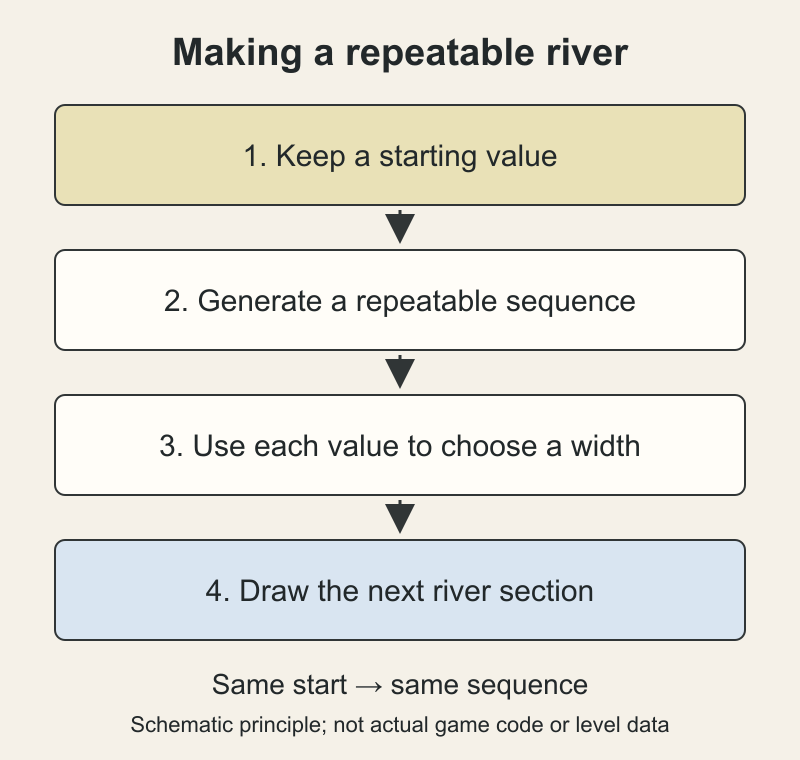
In her later account, Shaw explained that the 2600 river was built in 32-line sections. A pseudorandom generator supplied a sequence of numbers that selected subsequent widths. Starting with the same value reproduced the same sequence, allowing a player to learn the route. Procedural generation explains the technique and why it need not mean a different world on every play. (2011 interview, “Joining Activision, River Raid”.)
Activision’s original instructions name Shaw as the designer and give her playing advice. The player must judge fuel as well as enemies: flying over a depot replenishes fuel, while shooting it earns points. The manual suggests learning the river’s sections and choosing when to refuel. Those decisions give the generated landscape a purpose beyond filling the display. (1982 manual, “River Raid Basics” and Shaw’s tips.)
Shaw also described the usefulness of colleagues’ ideas in 1983. Her account credits suggestions about refuelling and other details while distinguishing them from the programming she carried out. Happy Trails, her sliding-path puzzle for the Intellivision, involved similar discussion. The surviving archive holds its source listing alongside the different River Raid versions. (Electronic Fun, PDF pp. 79–80; The Strong finding aid, Activision series.)
Larger computers and surviving papers
Shaw’s career moved between games and other computing work. She worked at Tandem between Atari and Activision, then returned to Tandem in 1984. In 2011 she described assembly-language work on a service processor, which helped start and diagnose a larger computer. She stayed until 1990, when she retired from full-time work. (2011 interview, Tandem and retirement sections.)
In 2017 she donated papers to The Strong. Its finding aid describes source printouts, handwritten annotations, design documents and company material. Those records make it possible to study what she actually worked on, alongside what she remembered in interviews. Her career also forms part of the wider history of women’s contributions to computing.
Sources
- Randi Hacker, “Gamemakers: Designing Woman”, Electronic Fun with Computers & Games, September 1983, PDF pp. 77–80. Primary contemporary interview: training, employment, 4K/8K distinction, colleagues’ suggestions and Happy Trails. The cited locator counts PDF pages.
- Benj Edwards, interview with Carol Shaw, Vintage Computing and Gaming, 12 October 2011. Conducted in May 2011. Primary retrospective testimony: birth, individual contributions, river generation, Tandem and retirement.
- Activision, River Raid: Plan of Operation, 1982, AX-020-03. Primary publisher instructions, read in AtariAge’s transcription: play, fuel and named designer’s tips.
- The Strong, Finding Aid to the Carol Shaw Papers, 1960–2017, revised January 2022, pp. 1–6. Archival catalogue of original documents, including Atari and Activision listings; the catalogue is not an inspection of the unpublished listings themselves.
- Berkeley EECS, “Celebrating Women in STEM: Video Game Designer Carol Shaw”, 8 October 2018. Institutional confirmation of her 1977 and 1978 degrees.