
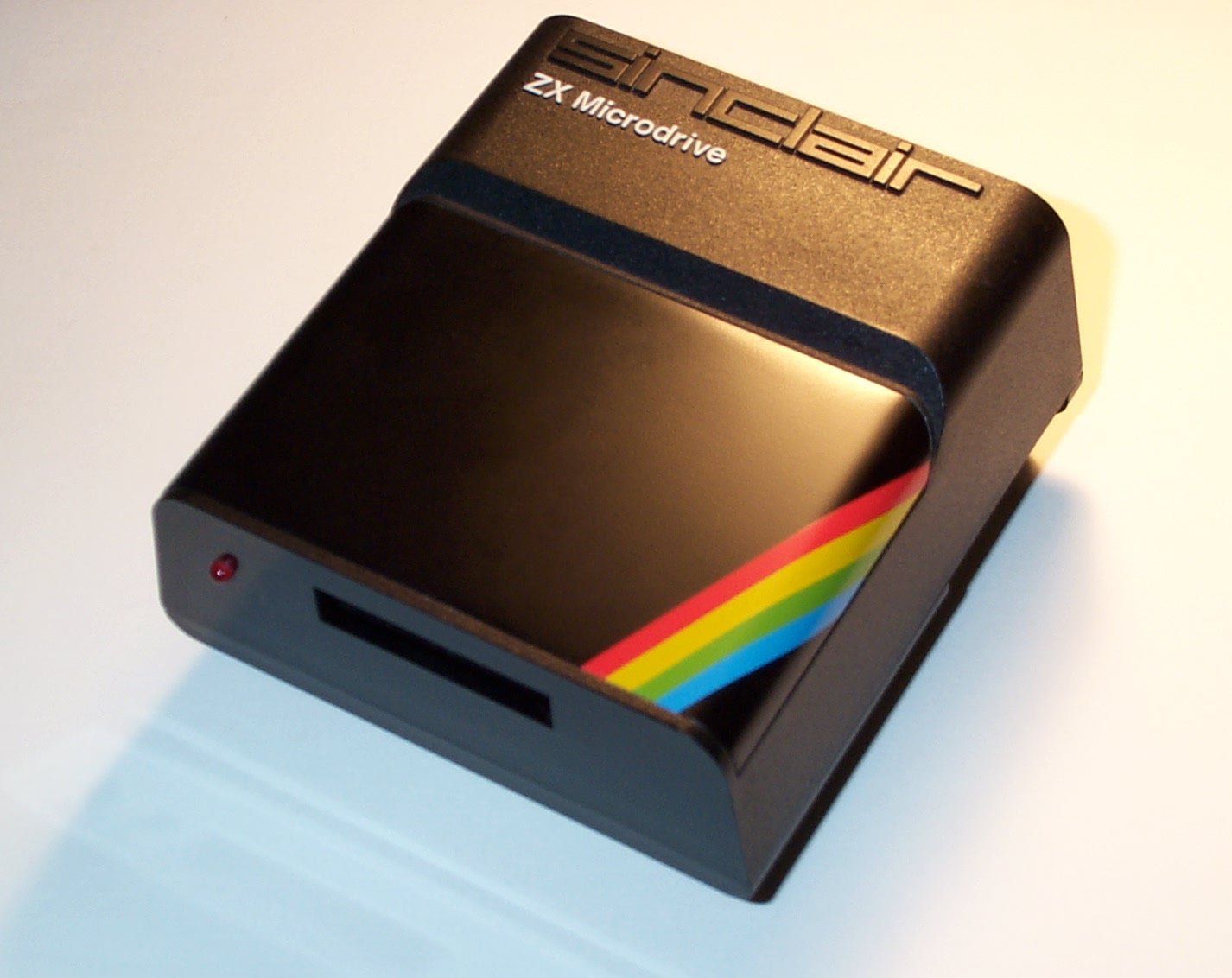
The Sinclair Microdrive put a file store beside the ZX Spectrum. You could ask for a program by name and let the computer find it. There was no cassette counter to note down and no need to find the start yourself. Inside each small cartridge, though, the information still lived on moving tape.
Sinclair Research sold the drive in 1983 for £49.95. Its September advertisement priced cartridges at £4.95 and the necessary ZX Interface 1 at another £29.95 when bought with a drive. The advertised drive price alone did not buy a working storage system. (Sinclair advertisement, September 1983, “ZX Microdrive System preview”.)
Finding a file on a loop
The service manual describes a continuous loop of narrow magnetic tape with data recorded on two tracks. The hardware switches between them, presenting the software with one longer sequence. The tape must travel past the head to reach the required data; naming a file makes finding it automatic, but does not remove that physical wait. Up to eight drives could be connected, with only one active at a time. (Service manual, sections 1.1.7–1.2.)
Electronics & Music Maker’s October 1983 announcement described cartridges holding at least 85K, with up to 50 files and a typical access time of 3.5 seconds. That was an access figure, not the time to load every possible program. Sinclair advertised a typical 48K program loading in as little as nine seconds. Both figures describe the promised experience; neither guarantees the condition of a particular drive and cartridge. (E&MM, “ZX Microdrive”; Sinclair’s September advertisement.)
What changed at the keyboard
Interface 1 supplied the extra BASIC routines. Sinclair’s manual shows commands such as SAVE *"m";1;"squares" and LOAD *"m";1;"squares": the m selects Microdrive storage, 1 names the drive and squares names the file. CAT 1 lists its contents. Before first use, a blank cartridge needed formatting, which prepared its storage and excluded unusable areas. The manual said the resulting capacity should be at least 85K. (Owner’s manual, chapters 3–4.)
The same manual was frank about wear. Cartridges would eventually need replacing; increasing delays in finding files were a warning, and important work needed backup copies on another cartridge or cassette. Named files made storage easier to manage, while the tape still needed care. (Chapter 2, “The cartridge lifespan”.)
The Sinclair QL later put two Microdrives inside the computer, with their control integrated into the QL itself. (QL service manual, section 7.1.) Its entry follows what that storage choice meant for a business machine. Rick Dickinson, who designed the cartridge, explained the grip and protective sleeve in his account of Sinclair’s industrial design. The similarly named ZX Interface 2 served a different purpose: joysticks and ROM cartridges, rather than Microdrive storage.
Sources
- Sinclair Research, ZX Interface 1 and ZX Microdrive, first edition, 1983, chapters 2–4: operation, cartridge care and BASIC commands. Original manual scan.
- Sinclair Research, ZX Interface 1, ZX Interface 2, ZX Microdrive Service Manual, public re-typeset edition edited by Brendan Alford, revision 1.1, pp. 7–9: tape and controller. Service manual.
- Electronics & Music Maker, October 1983, “News & Letters”, “ZX Microdrive”: contemporary product news, rather than a performance test. Article.
- Sinclair Research, advertisement in Personal Computer World, September 1983, Sinclair Special, “ZX Microdrive System preview”: prices and advertised loading time. Issue scan.
- Sinclair Research, QL Service Manual, section 1, paragraph 7.1.1: two integrated drives and differences from Spectrum control. Public transcription.
- Edge, issue 137, June 2004, pp. 80–87, “The Rick Dickinson guide to classic computer design”: cartridge design.