
With a game cartridge fitted, a ZX Spectrum could start playing as soon as its power came on. Sinclair’s ZX Interface 2 added the cartridge socket and two joystick ports in one box, launched in late September 1983 for £19.95. The cartridges cost £14.95 each, a substantial extra purchase beside the interface. (Sinclair User, December 1983, news and review.)
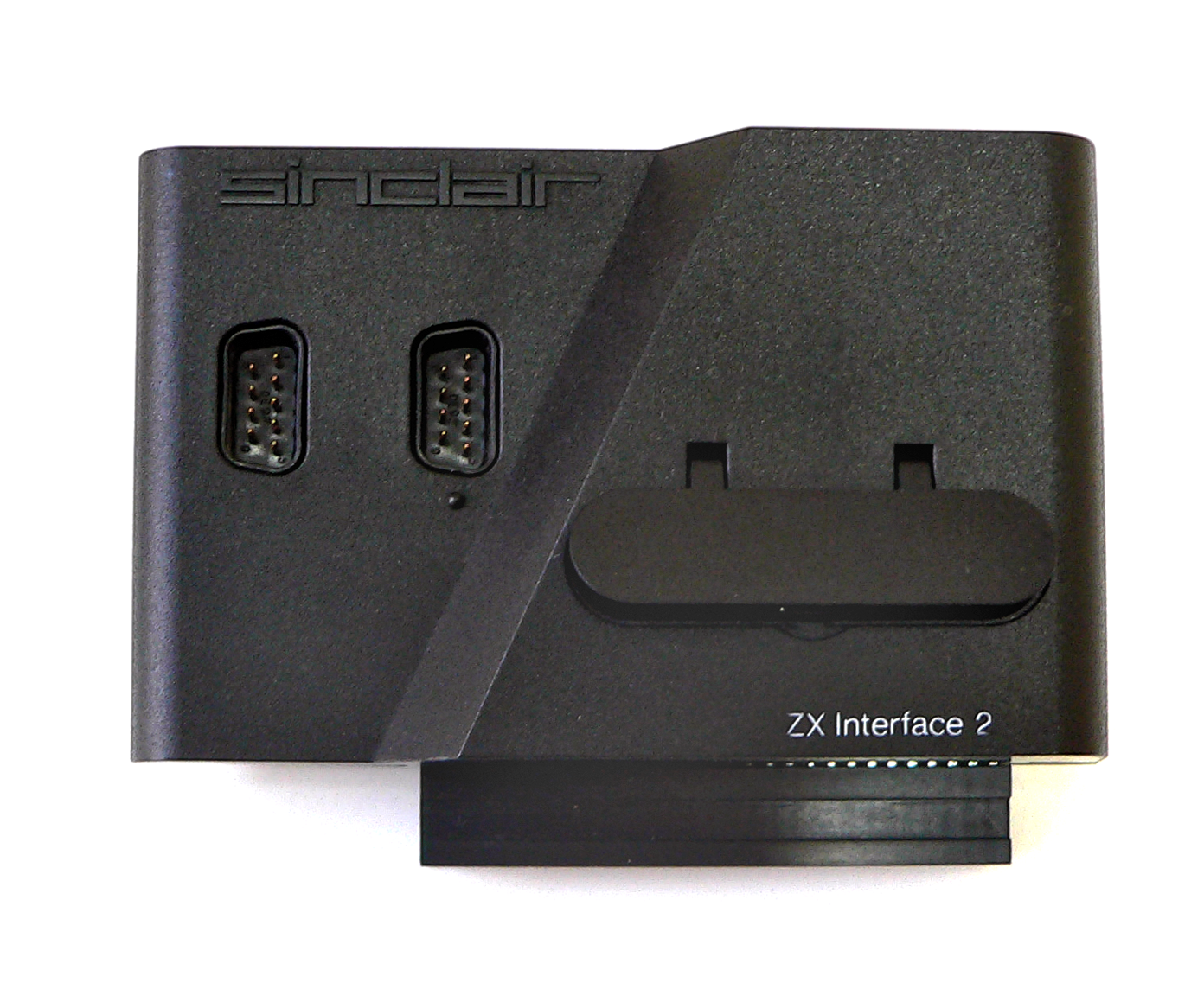
Running from the cartridge
An ordinary cassette program has to be copied into RAM before it can run. An Interface 2 cartridge holds its program in read-only memory, or ROM, which the processor can use directly. Sinclair’s service manual explains that inserting the cartridge disables the Spectrum’s own ROM and gives the processor access to the cartridge through the expansion connector. The game takes the place normally occupied by BASIC. (Service manual, section 1.3.)
That arrangement imposed a limit: without extra paging hardware to switch memory banks, a cartridge could provide only 16K of program ROM. Sinclair User’s reviewer identified the missing switching facility as a drawback. The contemporary catalogue included Jetpac, Cookie, Hungry Horace, Chess and Backgammon. Ultimate Play the Game’s early 16K releases fitted this format. (December 1983 report and review.)
Sinclair’s instruction card told owners to insert or remove cartridges only with the power off. Once fitted, the program started automatically at switch-on. The rear expansion connector accepted a ZX Printer only; other peripherals had to sit between Interface 2 and the computer. That included Interface 1, which controlled the Microdrive. The two interfaces could be used together. (Instruction card, “Connection” and “ROM software cartridges”.)
A joystick that presses number keys
The joystick sockets looked familiar, but software compatibility depended on how the computer read them. Interface 2 presented each stick as five number keys:
| Action | Joystick 1 | Joystick 2 |
|---|---|---|
| Left | 6 | 1 |
| Right | 7 | 2 |
| Down | 8 | 3 |
| Up | 9 | 4 |
| Fire | 0 | 5 |
Sinclair’s programming instructions gave IN 61438 and IN 63486 for reading the two sticks. Unlike INKEY$, these reads could detect a direction and fire together. A program needed to understand those inputs, or let the player redefine its keys; having a physically suitable plug did not make a Kempston-only game compatible. (Instruction card, “Joystick programming”; Sinclair User, December 1983 review.)
The Spectrum hardware ports reference follows those keyboard-row inputs into the later +2 and +3 joystick sockets. The cartridge story belongs alongside copy protection: ROMs avoided cassette loading, but manufacturing cost and the 16K limit made them a different proposition from cheap tapes.
Sources
- Sinclair User, December 1983, news and review; Personal Computer News, October 1983, “Plug in and go…”: introduction, prices, cartridge limits and reception. Contemporary reports transcribed at World of Spectrum. The transcription contains spelling errors; the two publications remain distinct sources, rather than the host being a third witness.
- Sinclair Research, ZX Interface 2, instruction card: connections, cartridge handling and joystick programming. Public transcription. The joystick table’s transcribed “10” denotes the
0key, as the adjacent input-bit table confirms. - Sinclair Research, ZX Interface 1, ZX Interface 2, ZX Microdrive Service Manual, public re-typeset edition edited by Brendan Alford, revision 1.1, p. 10, section 1.3: cartridge ROM selection. Service manual.