
The first Big K came with a cassette. The second promised a seven-inch flexi-disc: play it, record its sounds onto tape, then load the programs into a computer. Inside were games to type, games to buy and news about the people making them. IPC’s new magazine treated playing and programming as activities that could share the same brightly coloured pages.
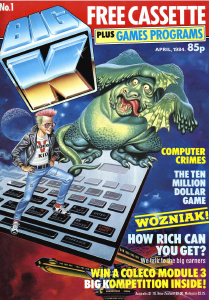
Tony Tyler edited the magazine from IPC’s King’s Reach Tower in London. Its April 1984 cover showed a monster looming over a Spectrum keyboard, painted by Ron Embleton. The contents page credited Central Art Studio with art and design, and Richard Burton as Tyler’s assistant. There was room for arcade reporting, cartoons and a Steve Wozniak interview alongside a 6502 programming feature.
More than one machine
The first issue’s listings served five computers: Rocket for the VIC-20, Bomb Run for the Oric, Demon Driver for the Commodore 64, Down Fall for the BBC Micro and Escape for the Spectrum. The game you typed depended on the machine you owned. Reading the same magazine did not mean running the same BASIC.
That mixture placed Big K between a games review magazine and a source of software. Its first contents page described the supplied C15 cassette as storage for the issue’s listings. The next month’s promised flexi-disc carried utilities for the BBC Micro and Spectrum. These were particular experiments in program distribution, before the regular cover tape became a familiar part of British computer magazines.
The reporting could look behind the finished games. In July 1984 Tyler wrote about Liverpool’s software businesses, including Bug-Byte and Imagine. Those accounts preserve what people said while the firms were operating, rather than recollections collected decades later. They are also accounts written amid publicity and competition; a company’s prediction is evidence of its plans, not proof that the promised game appeared.
A different kind of computer picture
By March 1985 the magazine was looking beyond its readers’ 8-bit machines. Tyler’s editorial defended its enthusiasm for the expensive Macintosh, arguing that its design pointed towards future computers. In the same issue Shatter appeared: a comic made with computer-drawn artwork, credited to writer Peter B. Gillis and artist Mike Saenz.
The contrast with the launch cover is striking. Embleton painted a fantasy about computer games; Saenz used a computer to draw the fantasy itself. Big K advertised Shatter as a technological first. The safer historical point is visible on the page: a games magazine was showing readers another use for a personal computer, and giving that experiment space alongside its games and listings.
March 1985 was issue twelve and the end of the run. Its last editorial was still looking forwards. The surviving issues record a brief period when a British games monthly could combine cassette software, hand-painted monsters, commercial reporting and a digitally drawn comic.
Sources
- Big K no. 1, April 1984, cover and p. 3: price, Ron Embleton’s cover credit, masthead, contents, cassette description and the following issue’s flexi-disc announcement. https://www.digitpress.com/library/magazines/big_k/big_k_apr84.pdf
- Big K no. 4, July 1984: Tony Tyler’s Liverpool software report. The company histories and its contemporary claims are discussed in Liverpool’s games scene.
- Big K no. 12, March 1985, p. 3 and pp. 76–77: Tyler’s Macintosh editorial and Shatter, by Peter B. Gillis and Mike Saenz. https://www.digitpress.com/library/magazines/big_k/big_k_mar85.pdf
- Digital Press, Big K issue archive (web, secondary catalogue): twelve issues, April 1984 to March 1985. https://www.digitpress.com/library/magazines/big_k/big_k.htm