
An early personal computer might arrive without a keyboard, a display or much software. BYTE addressed the person trying to turn those pieces into something useful. Its September 1975 premiere included an article on identifying surplus keyboards, another on writing an assembler and a series about implementing Conway’s Life. Building the computer and deciding what to run on it belonged together.
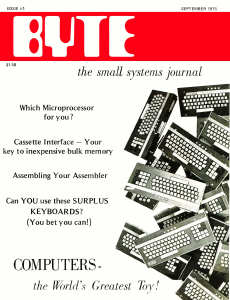
Making a magazine for the home computer
Carl Helmers supplied the editorial focus. Wayne Green, publisher of the amateur-radio magazine 73, supplied publishing experience. The first issue named Green Publishing in Peterborough, New Hampshire, as its publisher. Its opening pages let both men explain the venture: Helmers described the computing he wanted the magazine to cover; Green described looking for understandable information while trying to computerise his business.
Virginia Londner Green was part of the publishing operation too. The masthead and publisher’s credit changed during the early run, and the January 1976 issue named her as publisher. The magazine’s beginnings cannot be reduced to one editor making it alone.
Helmers organised his opening editorial around hardware, software and applications. A reader might enjoy designing circuits, prefer programming, or want a computer for a particular task. The magazine would connect those interests rather than assume that every owner wanted the same thing.
From spare parts to programs
The premiere makes that approach tangible. Carl Helmers’s keyboard article worked through unfamiliar surplus hardware, where identifying the wiring could be part of obtaining an affordable input device. Don Lancaster explained a serial interface. Dan Fylstra’s assembler article explained software that turns symbolic instruction names into machine code. The contents also made space for clubs, newsletters, books and letters.
As complete computers arrived, the magazine examined them too. Its January 1981 review of the ZX80, by John C. McCallum, is one example of an American technical magazine looking closely at an inexpensive British machine. BYTE also printed articles by designers explaining processors such as Motorola’s 6809. A product review and an engineer’s design account answer different questions; both help recover what a machine offered and why it was built that way.
Pictures for ideas
Robert Tinney’s painted covers became another way of explaining computing. In his interview with Benj Edwards, Tinney recalled Helmers’s interest in Scientific American’s covers and the invitation to paint for the new magazine. Tinney’s first appeared in December 1975, rather than on the September premiere shown here.
Tinney described approaching technology through visual metaphors without the editors’ technical background. That gave the magazine cover a different job from a circuit diagram: it could suggest an idea, a possibility or a joke before a reader reached the explanation inside.
The print run and its afterlife
The American print magazine ended with the July 1998 issue under CMP Media. Former editor Tom R. Halfhill distinguishes that closure from the later web publication using the name. His own article archive preserves part of the magazine’s later technical writing.
The full print run spans substantial changes in personal computing. A 1975 article about wiring a keyboard and a 1990s account of processor design come from different markets, but share a willingness to open the machine and explain what is happening inside.
Sources
- BYTE issue 1, September 1975: contents and publisher, p. 3; Carl Helmers, “What Is BYTE?”, pp. 4–6; Wayne Green, “How BYTE Started”, p. 9 and continuation; Dan Fylstra, “Write Your Own Assembler”, p. 50 onwards; Helmers, “Deciphering Mystery Keyboards”, p. 62 onwards. https://archive.org/details/byte-magazine-1975-09
- Michael Holley, BYTE Magazine: reproductions of Carl Helmers’s contemporary letter and early issues; early publishing credits, including Virginia Londner Green. The historical commentary is secondary; the reproduced letter and mastheads are primary. https://www.swtpc.com/mholley/byte/byte.html
- BYTE, January 1976, p. 9: the original masthead lists Virginia Green, President, under Publishers, alongside Manfred Peshka, General Manager. https://www.worldradiohistory.com/Archive-Byte/70s/Byte-1976-01.pdf
- BYTE, January 1981, pp. 94–102: John C. McCallum’s ZX80 review. The machine’s entry discusses its findings.
- Benj Edwards, “VC&G Interview: Robert Tinney, Microcomputer Illustration Pioneer”, 2006: Tinney’s first-person account, preserved on his own website. https://tinney.net/wp-content/uploads/2023/12/www-vintagecomputing-com-index-php-archives-169-vcg-interview-robert-tinney-micr.pdf
- Tom R. Halfhill, Tom’s Unofficial BYTE FAQ and Tom’s BYTE Archive: participant accounts of the print closure and subsequent web publication. https://www.halfhill.com/bytefaq.html and https://halfhill.com/bytelink.html