
The first Super Play reviewed Super Mario Kart as an import and Street Fighter II as a British release. For the magazine’s readers, those were two parts of the same Super Nintendo market. Waiting for a game’s official UK release was one option; finding out about a Japanese or American cartridge was another.
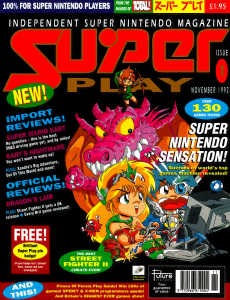
Matt Bielby edited the launch, with Traci Rochester as art editor and Sue Grant as production editor. Future Publishing’s new title concentrated on one console. The issue had a November 1992 cover date, but its invitation to phone the office explicitly identified 1 October as the day it went on sale.
The world outside the release list
Bielby’s opening editorial explained the choice to cover imports. British release dates could be distant, and importers and adaptors made overseas cartridges a practical interest for readers. The magazine would review those games as they became available, while also covering official UK releases.
Its first contents delivered that distinction. Super Mario Kart, Super Pang and Xandra’s Big Adventure appeared among the import reviews. The UK section covered Street Fighter II, F-Zero, Pilotwings and other games already available through official channels. An accompanying guide explained the console and its market.
Buying an import introduced more than a change of packaging. PAL and NTSC, region locks, adaptors and Japanese text could all affect the experience. Super Play’s coverage made these questions part of choosing a game. A review of an imported cartridge was not a guarantee that every reader’s console could run it.
The pictures and the people behind them
Wil Overton supplied the cover illustrations throughout the original 47-issue run. His work connected Nintendo game characters with an interest in Japanese comics and animation. Inside, Helen McCarthy’s Anime World column gave animation its own space rather than treating it solely as decoration around game reviews.
In his later interview with Forgotten Worlds, Overton described being asked to explore the links between anime and games, as well as his illustration work. He also recalled receiving translated Japanese magazine information through Future’s contacts. Those recollections explain some of the work behind a British magazine’s international interests; they should not be mistaken for the experience of every member of the team.
Judging the games
The attention to imports gave role-playing and action-adventure games room for discussion before their British release. Coverage of Secret of Mana examined its combination of real-time fighting and role-playing systems. The June 1994 review of Super Metroid described the atmosphere, exploration and equipment that let the player revisit previously inaccessible places.
These articles preserve more than scores. They show writers explaining unfamiliar games to readers making expensive buying decisions, sometimes across differences of language and region. The practical information and the enthusiasm were connected.
The last issue
Issue 47, September 1996, announced the magazine’s closure in Alison Harper’s editorial. The Nintendo 64 had arrived in the office, and the magazine was ending as attention shifted towards the new console. Overton later recalled Future deciding to close the title rather than turn it into an N64 magazine.
The original monthly run therefore ends in 1996. A later special using the name belongs to its afterlife, rather than extending those 47 issues into an uninterrupted publication.
Sources
- Super Play no. 1, November 1992: masthead and contents; Matt Bielby’s launch editorial and the dated invitation to call the office, pp. 6–7; Anime World, p. 14; console guide, p. 20 onwards; Super Mario Kart import review, pp. 28–31; UK reviews, p. 64 onwards. https://archive.org/details/super-play-003-january-1993-uk (collection includes issues 1–47).
- Super Play no. 20, June 1994: Super Metroid review, by Zy Nicholson; no. 47, September 1996, p. 3: Alison Harper’s final editorial. Same public scan collection.
- “Wil Overton talks Super Play magazine, anime, video games and grey imports”, Forgotten Worlds (web, primary interview): cover work, anime writing, Japanese information and the decision to close. https://www.forgottenworlds.net/blog/the-wil-overton-super-play-interview
- Out-of-Print Archive, Super Play 1 (web, secondary catalogue): independent issue identification and contents index. https://www.outofprintarchive.com/catalogue/superplay/SuperPlay1.html
- The period reviews and Ted Woolsey interview are cited in Secret of Mana.
- Nintendo Mags, Super Play Issue 48 (web, secondary catalogue): the separate 2017 special bundled with Retro Gamer no. 172. https://www.nintendomags.com/magazines/super-play/issue48/