

There is a jewel just below that rock. You can get to it. The awkward question is what happens after you do.
Digging removes the dirt. The dirt was holding something up. Now the rock has somewhere to go, and you are standing in an excellent place to be flattened.
Boulder Dash turns that tiny sequence into a wonderfully restless game. Its caves are full of things worth collecting, things worth avoiding, and things which can become either. A boulder can block a passage, kill you, crush an enemy or help contain a spreading amoeba. The difference is where it is, what is beneath it, and what you do next.
Created by Peter Liepa with Chris Gray and published by First Star Software in 1984, it began on Atari home computers. Its particular delight is still easy to recognise: you make a small change, watch a much larger consequence, and try to be somewhere sensible when it arrives. 12
A pocketful of jewels and a way out
You guide Rockford through a cave, digging through dirt and collecting diamonds. Collect the required number and the exit opens. Reach it before time runs out. The original game has sixteen caves, A to P, with short intermissions between groups and five difficulty levels. 3
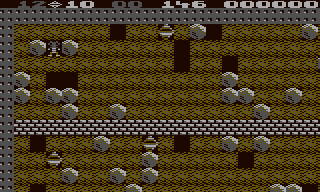
Our Emu198x capture of Boulder Dash, Peter Liepa with Chris Gray / First Star Software, 1984, Atari version running on the 800XL model. The first cave puts valuable objects and unstable supports in the same space.
That sounds like a treasure hunt. It feels more like persuading an unstable building to let you through.
Dirt is easy to remove, but removing it changes the cave. A wall stays put. A rock needs support. A diamond may be valuable, but it also occupies a square and can fall. You learn to read the arrangement rather than look for the shortest line to the nearest prize.
The first useful question is often: what is this square doing besides getting in my way?
A patch of dirt might be supporting a whole pile. A jewel might be the last thing preventing a boulder from rolling into the passage. Collecting something is not automatically progress. We need somewhere to stand afterwards.
The timer makes that thought uncomfortable. There is enough urgency to discourage endless hesitation, while the cave rewards a little patience. Sometimes the best movement is to stop and let a fall finish.
Don’t stand underneath your own idea

Our explanatory diagram, not a game screenshot or a copied cave. Clear the support from the side, then keep out of the shaft. Real caves add neighbouring rocks, rolling and time pressure.
A stationary rock and a falling rock are different problems. Rockford can stand beneath a supported boulder; moving away can leave the empty square into which it drops. Being struck by a falling object is fatal. A rock which has come to rest is something we can plan around again. 4
That gives the world a little history. Looking at a boulder’s position is not always enough: we also care whether it is already moving. A program needs to remember that distinction, just as a player learns to notice it.
Try thinking through a side approach. Dig away the support while remaining beside the column. The rock falls into the hole. A dangerous overhead object has become a stationary obstacle below. The cave now has a different route through it.
The diagram deliberately leaves out the complication which makes real play so entertaining: the next rock may roll after the first.
Rounded objects can topple off suitable rounded supports when there is room beside and below them. A single opening can therefore set off several movements. It is possible to understand each one and still be surprised by the whole heap.
This is an approachable kind of physics. We do not calculate a boulder’s mass, spin or collision angle. The cave is a grid, and objects follow a small set of rules about neighbouring squares. Those rules are convincing enough for us to reason with, while remaining much easier to read than a simulation of real rubble.
The useful lesson for game design is how much activity a few dependable rules can produce. A new situation need not require a new command or a special animation. Put familiar things in a different arrangement and the player has a fresh problem.
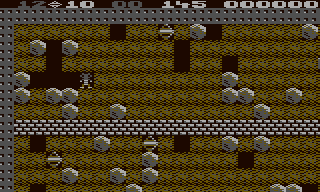
Our second Emu198x capture follows a short sequence of digging movements. The cleared passage and settled rock positions have changed; no cave completion is claimed.
The fire button is a small act of caution
Running into every reachable square is a good way to run out of lives. The fire button offers another possibility: act on an adjacent square while remaining where you are. You can collect or dig without stepping into the space you have just cleared. 14
This matters because movement and alteration are not always the same intention. We might want the dirt gone without wanting Rockford beneath the thing it supports.
A modest extra control changes how carefully we can work. It also gives experienced players something more precise to learn than moving faster. Watching a confident player can look almost surgical: take this jewel, clear that square, let the pile settle, then cross.
Pushing has its own limits. A single boulder can be pushed sideways into an empty space; a whole row is another matter. The game asks us to understand what the object permits, rather than treating the joystick as a request that must always succeed. 4
The controls stay compact. The decisions do not.
Enemies worth keeping alive
The creatures are not a separate combat system dropped into a digging game. They use the same cave, and falling objects can change what they mean to us.
Fireflies and butterflies patrol the spaces around obstacles. Touching one is deadly. A falling boulder can destroy one, and a destroyed butterfly produces diamonds. An enemy is therefore also a possible source of the things we need. 14
That changes the question from “How do I avoid it?” to “Can I arrange for it to be there when this rock falls?”
We need to consider its route, make an opening, release a weight and keep clear of the result. The pleasure is partly in seeing a plan work at a distance. We have stopped steering the object that matters most and started arranging the circumstances around it.
The amoeba makes a different demand. It spreads into available dirt and space. Contain it and it can become diamonds; let it grow too large and it becomes boulders. What looks like a threat can be a resource, but only if we manage its surroundings. 1
Magic walls make the cave stranger again. During their active period, falling boulders can pass through and emerge as diamonds; falling diamonds can go the other way and emerge as boulders. A wall becomes a machine; the objects above it become a supply. The player can put the parts to work together. 14
These are not interchangeable ways of giving us more treasure. Butterflies ask us to arrange an encounter. Amoebas ask us to shape a boundary. Magic walls ask us to feed a conversion process before its opportunity expires.
Each grows out of the same readable world. That makes the new rule easier to approach, while its combinations can take considerable practice.
Why you cannot see the whole problem
The cave extends beyond the visible screen. Scrolling lets Rockford explore a larger space, but also means that a route we cleared earlier may now be out of sight. 34
That creates a useful tension between local action and the shape of the whole cave. We want the next diamond. We also need to remember how to reach the exit, which shafts we opened and what might have fallen behind us.
It is possible to make a route less usable while collecting more of the things the game asks for. Score and safety do not always rise together.
Nor does the game need to make everything faster to become harder. Change a jewel target or rearrange the initial situation and familiar behaviour becomes harder to exploit. A cave can demand a different plan while rocks remain rocks.
This is a useful companion to Manic Miner. Both make movement and timing matter. Manic Miner’s room remains largely a place to traverse. Here our traversal changes the place, and the next visit to the same passage may be a very different proposition. That is our comparison, rather than a claim that one inspired the other.
Start with the thing that feels good
Liepa did not begin with the finished Rockford wandering through finished caves. In a later interview, he described crude objects: squares of dirt, circular rocks and a plus sign for the player. Working on digging and falling made a game worth pursuing before its character had taken shape. 2
There was an earlier starting point. A local publisher introduced Liepa to Chris Gray, whose BASIC demonstration needed more work before it could become a commercial release. Liepa recalled abandoning a straightforward conversion and developing different behaviour. He compared Gray’s demo with the arcade game The Pit, while acknowledging that Gray denied having based it on that game. Resemblance and an attributed recollection do not settle that disagreement. 2
The finished game’s credit includes both creators. Giving Liepa’s account of the work does not erase Gray from it.
What is especially useful about the rough beginning is that it separates an enjoyable action from a finished presentation. Digging through rubble could already be interesting. Jewels gave it a goal; danger gave each opening a cost; the rest of the game could develop around an activity which had proved worth doing.
A prototype does not have to demonstrate everything a finished game will contain. It can answer one difficult question honestly: is there something here we want to keep playing with?
A face large enough to change the world
Rockford has an impatient little life of his own. Leave him alone and the idle animation gives the impression that he is waiting for us, rather than ceasing to exist between commands. 34
Liepa named the little people in Choplifter as an inspiration for an early silhouette figure. A publisher wanted a more distinctive character. Enlarging the artwork helped supply one, but it also meant the existing cave would no longer fit on the screen. Liepa recalled adding scrolling as a result. 2
That is a lovely example of presentation changing play. Bigger eyes and a more readable body were not merely decoration placed over an unchanged experience. They affected how much of the world we could see.
Art, interface and design meet in that trade-off. A tiny figure can leave room for an entire map; a larger one can be easier to recognise and care about. Neither choice is free.
Rockford’s animation gives the cave personality without filling it with dialogue. The objects remain clear enough to inspect. We can enjoy the character while still seeing the square we need to dig.
A game to sell on several very different machines
The Atari release reached customers on tape, disk and cartridge. Tom Hudson’s July 1984 ANALOG Computing review listed $29.95 for tape or disk and $39.95 for the cartridge, with different memory requirements. Those were different ways into the same game, not just different objects for a collector’s shelf. 3
The visible movement also divided opinion. Hudson praised the game while objecting to its characters jumping from square to square. A clear grid helps explain the puzzle, but a reviewer could still want smoother movement. Readability and visual polish are related without being identical. 3
In Britain, the Spectrum conversion appeared through Front Runner, K-Tel’s software label. CRASH’s January 1985 review listed £7.95 and awarded 98% for playability. Its reviewers spent their space explaining the unusual rules as well as recommending the game. A static picture of rocks was not enough to convey what playing it offered. 4
There is a broader porting question here. Preserve the rules but show less of the cave and the player has less warning. Preserve the colours but change the movement and familiar timing may fail. A conversion has to carry the useful information and behaviour across, not merely recreate recognisable objects.
The route into arcades was unusual too. Exidy’s Max-A-Flex put Atari hardware inside a coin-operated cabinet. Boulder Dash could move from a home game into a different buying arrangement: paying for time at a public machine rather than owning a copy. The original game’s movement between these settings is more interesting than a neat division between “arcade games” and “computer games”. 13
New caves, then the tools to make them
Boulder Dash II followed in 1985, bringing more caves and further elements. The series then offered something particularly valuable to a game built from interacting rules: a construction kit. 15

Our invented examples use the same small vocabulary to ask different questions. The left arrangement leaves space to retreat; the right makes the order of digging matter. Neither reproduces a commercial level.
A cave editor lets someone create situations without rewriting the behaviour of every boulder. One person can build a gentle introduction; another can arrange a nasty trap which is entirely fair once you understand it.
The Construction Kit’s manual distinguishes the tools for building from the rules for playing. That distinction opens a useful door: the player can become a designer while keeping a working game underneath. 5
This is where a game can develop a life beyond the quantity of content in its original box. Players exchange new caves, learn each other’s tricks and find arrangements the original authors did not supply.
There are different ways to continue that life. Rocks’n’Diamonds, by Holger Schemel, explicitly supports Boulder Dash alongside other related puzzle traditions. Its editor and selectable game engines make the differences worth preserving, rather than treating every falling-rock game as the same set of rules with different pictures. 6
Repton offers another useful comparison within the Vault. Follow the particular game’s rules and level structure; a shared interest in rocks and diamonds does not make its puzzles interchangeable with these.
A different Boulder Dash at school
For some players, the version which defines a game is not the one its original publisher sold.
Jaroslav Švelch’s research follows unofficial adaptations in Czechoslovakia, where access to imported machines and commercial software was restricted. Antonín Spurný adapted the Spectrum game for the Sharp MZ-800 and enlarged the visible area. Ladislav Gavar’s PMD 85 version instead offered many small, single-screen puzzles, reached through a separate labyrinth. Roman Bórik later carried that version’s levels and quirks back to the Spectrum. 7
That is more than a story about getting a foreign game to run. Different hardware, places of access and makers’ decisions changed what players encountered. A school or computer club could supply a first experience of Boulder Dash whose structure differed markedly from the Atari original.
For this specific case, official release lists tell only part of the history. They do not tell us what was on the machine a child could actually use.
Forty years of rearranging the same trouble
The commercial series continued through home computers, consoles, handhelds and phones. Later versions offered new tools and presentation, while anniversaries brought their creators and old caves back into view. 1
Boulder Dash Deluxe included twenty new caves in Liepa World. The 40th Anniversary edition continues the mixture of old and new, with classic visual options and an editor alongside additional caves and elements. These are later games to investigate in their own right, rather than evidence that every release preserves the precise behaviour of 1984. 89
The interesting inheritance is larger than a character or a title. We can still recognise the pleasure of making a world respond: release a rock, redirect a danger, create a resource, survive the consequences.
That leaves plenty for someone making an original game to try. A few kinds of tile, gravity in simple steps, and a way to remove support are enough for a small experiment. Then comes the harder work: making every outcome readable, deciding when a failure is fair, and arranging situations worth solving. Any teaching example would need its own code, name and presentation; this study does not commission a remake.
Boulder Dash gives us a particularly good reason to begin small. Before there was a famous little character, there was dirt, a rock and the discovery that moving one could make the other interesting.
Sources and further reading
- First Star Software / BBG Entertainment, Boulder Dash history. Publisher’s retrospective: credits, interactions, arcade licensing, sequels and construction-kit history. Treat priority and promotional claims as claims, not independent confirmation.
- Peter Liepa, interview licensed from Retrokompott, transcription published 3 November 2022. Creator testimony about Gray, The Pit, rough prototypes, Choplifter, enlargement, scrolling, royalties and later work; memories of the 1980s.
- Tom Hudson, “Boulder Dash”, ANALOG Computing 20, July 1984, p. 19. Contemporary review, prices, memory configurations, cave structure and criticism of movement. Issue scan.
- “Boulder Dash”, CRASH 12, January 1985, pp. 74–75, preserved review. Contemporary Spectrum rules, controls, publisher, price and reception; distinguish this conversion from the Atari release.
- First Star Software / Epyx, Boulder Dash Construction Kit, instruction manual. Editing, cave elements and playing rules; a later product, not the 1984 manual.
- Holger Schemel / Artsoft, Rocks’n’Diamonds and its manual. Project’s own description of supported traditions, game engines and editing; later software.
- Jaroslav Švelch, Boulder Dash behind the Iron Curtain, 2021. Original historical research and attributed participant accounts of Spurný, Gavar/VBG Software and Bórik; specific Czechoslovak cases.
- BBG Entertainment, Boulder Dash Deluxe. Publisher’s description of Liepa World, later features and original-cave inclusion.
- BBG Entertainment, Boulder Dash 40th Anniversary, consulted October 2026. Current publisher description of classic visual modes, additional content and editor; no endorsement or claim to have played this edition.
This study has not yet been fact-checked. Selected early encounters were observed; a complete playthrough is not claimed. Original documents and source analysis support the wider account.
Boulder Dash · Peter Liepa with Chris Gray · First Star Software · Atari 8-bit · 1984. Own screenshots illustrate criticism and review. Rights in the game remain with their owners. The header and explanatory diagrams are original illustrations. Photographs and advertising carry their own credits and rights records alongside each image.
Canonical study · Evidence and capture credits · More game studies