

Your mines are doing beautifully. There is money to be made. Unfortunately, you have forgotten to grow anything you can eat.
Across the room, somebody has food to spare. They know you need it. They have noticed how well your mines are doing, too.
Welcome to M.U.L.E., where running a space colony involves farming, mining, bargaining and discovering how expensive your friends can be.
Developed by Ozark Softscape and published by Electronic Arts in 1983, it gives four settlers a little land and some ungainly robot labourers. Everyone wants to finish richest. Everyone also needs the colony to prosper. Those ambitions fit together just well enough to get people talking, and clash just often enough to make the conversation interesting. 12
First, give the robot a job
The M.U.L.E. is a Multiple Use Labor Element: a machine which can be fitted out for different kinds of work. Buy one, take it to an outfitting shop, then lead it to your land. Install it and that plot can produce something useful. 1
A river plot is a promising place for food. Open plains suit energy. Mountains favour smithore, the material used to make further M.U.L.E.s in the more demanding games. What looks like a little landscape is also a set of opportunities. 1

Our invented map, not a screenshot or a copy of an original colony layout. Terrain gives a plot a useful starting advantage; what the other settlers produce still matters.
You are choosing more than the product with the nicest selling price. You are deciding what the colony will have, what you will need to buy, and what you hope other players will want from you.
Imagine opening with a food plot. It offers some security and perhaps a surplus to sell. An energy plot offers a different bargain: you may depend on someone else’s food, but their farms and mines will need power. Neither choice makes sense in isolation from what the others do.
There is an immediate, gloriously undignified complication. You have to get the robot there.
The development phase is timed. Town is in the middle; your plot may be some distance away. A beautifully chosen investment still needs a successful walk to the right place. Spend too long wandering or leave the M.U.L.E. uninstalled when time expires and it can run away. 1
This makes the character more than a pointer on a spreadsheet. Distance, route and hesitation have consequences we can see. A purchase becomes an errand, and an errand can go wrong.
The month has a rhythm
A round alternates between moments when we watch one settler work and moments when everyone can act. Land is claimed, plots are developed, production happens, supplies are checked, and goods go to auction. The next round begins with the consequences of the last one. 1
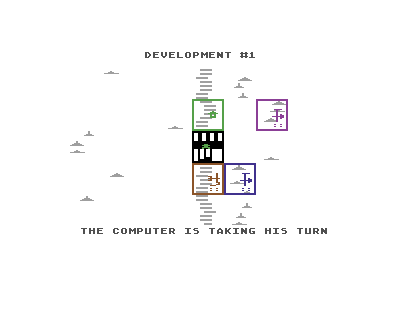
Our Emu198x capture of the C64 computer demonstration, Ozark Softscape / Electronic Arts, 1983. Each colour identifies a different settler’s land and installations. The computer players are taking their development turns; this is not a human multiplayer session.
That rhythm is part of the pleasure. The development phase gives us a short, personal scramble. Production lets everyone see what the investments achieved. An auction suddenly brings all the players together over the same shortage.
We are not waiting through four identical sets of menu choices. Different parts of the round ask us to look at the same colony in different ways.
The changing pace gives the other players something to notice. Someone has put another mine on a mountain. Someone has abandoned food production. Someone has spent an alarming amount of time hunting a creature instead of doing any work.
Information is shared, but its meaning is not announced. We have to decide what those choices might do to the next market.
A one-player game fills the other seats with computer opponents. That makes the rules available without assembling a group. It cannot reproduce every promise, complaint or distraction that humans can bring into the room. 13
An auction you can walk into
The auction is M.U.L.E.’s great invitation. You do not type a price into a form and wait for an invisible calculation to tell you what happened.
Buyers begin below and sellers above. Raise your character to offer more; lower it to ask less. When the buying and selling prices meet, units begin to change hands. Move apart to stop. A clock keeps the negotiation moving. 12

Our invented auction example, not a captured game screen. The numbers illustrate two offers meeting; they are not measured bids from a recorded match.
Watch what that looks like in the game. In this smithore auction, two computer settlers are selling. Their asks begin at 80; the buyers remain at the bottom of the screen. Nobody has traded yet.
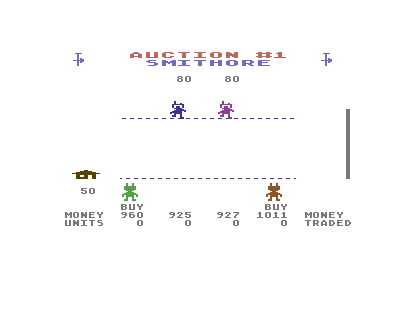
Our Emu198x capture of the C64 Beginner computer demonstration. The two asks are both 80, and the units-traded counters are zero.
The asks come down. At 50, the game records a sale: the purple seller’s cash rises from 927 to 977 and its traded count becomes one. The store is a participant in the market too; an exchange need not wait for another settler to move up to the seller. 1
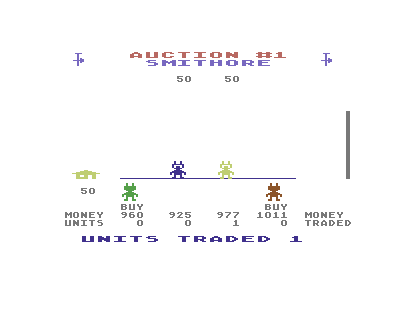
The same computer demonstration a moment later. The highlighted exchange and “Units traded 1” make the result visible. These are observed computer bids and a recorded transaction, separate from the invented example above.
It is a graph you can argue with.
Suppose you want $50 for your extra food. The other player offers $30. Nothing moves. You both have room to change your minds, and less room as the timer shrinks. Lowering your price may get a sale. Holding out may get a better one. Holding out too long may get nothing.
The simple display makes the disagreement visible. We can see the gap, feel it closing and notice somebody else making a better offer.
A trade is not a single, irreversible decision to sell the whole pile. Goods move a unit at a time. That gives us another opportunity to react: enough food has changed hands; the price no longer looks good; perhaps we should keep the rest.
The store is another participant, buying and selling from its available stock. It gives the colony a trading partner, but not a bottomless guarantee that whatever we forgot to make will be waiting on a shelf. 1
That is why a shortage can become a conversation. The program supplies the rules for a deal. It leaves room for people to decide whether they want to make one.
The joystick is doing something unexpectedly useful here. Its small movements express a quantity, but also a willingness to compromise. The interface makes bargaining physical without needing a complicated vocabulary of commands.
You can sell tomorrow’s turn
Food and energy are especially interesting because they affect what happens next. A food shortage reduces the time available for development. An energy shortage can prevent plots producing. 1
Beyond the protective Beginner rules, a sale can look successful on the money display while damaging our ability to earn later. Beginner play stops us selling below the critical level; Standard play lets us take that risk. 1
Imagine selling extra food, then realising it was not extra after all. We now have more cash and less time to get a new M.U.L.E. into place. We may have to abandon an errand, choose a nearer plot or pay heavily for food at the next opportunity. The consequence arrives through play rather than as a lecture about planning.
Energy creates another dependency. A rich mine is of little use if it cannot work. Spending everything on the land and robot while neglecting its running requirements leaves an impressive-looking investment doing nothing.

Our diagram of the products' different roles. Crystite belongs to Tournament play. This is a guide to the dependencies, not a numerical simulation of the economy.
Notice how few products are needed to make those relationships interesting. Their jobs differ. Food, energy and smithore are not just three colours of coin.
The Elite study follows a trader moving between markets. M.U.L.E. lets the people at the same market change what will be available by deciding what to produce. That is a useful comparison between two designs, without claiming a direct line of influence.
Richest is not just the cash in your pocket
The summary counts money, land and goods towards net worth. A settler can have less cash because they have bought something valuable. Another can look wealthy while owning very little productive land. 1
That distinction changes how we read the scoreboard. A payment is not necessarily a loss, and a big sale is not automatically a good decision. We need to consider what remains available to work for us.
Stored goods complicate the picture further. The reference card specifies spoilage for food and energy carried forward, so hoarding is not a perfect escape from trading. Food which we keep indefinitely is not a permanent reserve of equally useful units. 4
We can try a small invented example without pretending it is a recorded match. If a settler needs three units next turn and holds five, the apparent surplus is two. Selling four creates a shortage even though money rises. Refusing every sale may waste stock and forgo income. The interesting decision is how much security is worth, given the next turn and the other players.
The summary is there to help us judge those choices. It does not remove the need to make them.
Specialise, but choose your friends carefully
Self-sufficiency is comforting. It also has a cost.
M.U.L.E. rewards certain arrangements of production: adjacent plots making the same thing can earn a bonus, and owning several plots of one product provides another. Concentrating on a line of work can therefore be more productive than growing a little of everything. The manual connects these rules with economies of scale and learning through production. 1
Imagine two neighbours making food and energy separately. Each might do better by specialising and trading. That creates more to share, but it also makes a promise matter. If the energy producer refuses to sell, a productive arrangement can become a very uncomfortable one.
Dependence gives a negotiation weight. We are asking for a resource which helps us continue, and deciding how much trust to place in its supplier.
M.U.L.E. leaves room for sharp play. It also makes outright ruin a questionable goal: a bankrupt neighbour cannot keep buying our surplus. The colony’s overall result matters alongside individual wealth. 2
That makes cooperation a practical question. We can help someone because it is kind, because we need their next harvest, because we want a later favour, or because keeping a customer solvent is profitable. The same visible action can have several motives.
The game does not need to decide which one is ours.
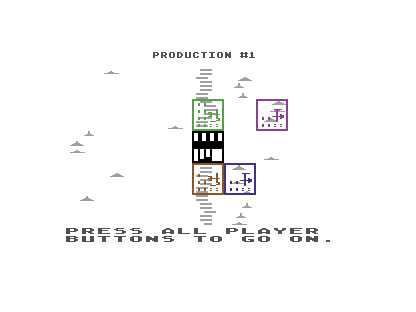
Our Emu198x capture of the C64 computer demonstration’s first production round. Development has become a result on the same plots: the game shows where the output came from before moving on to the trading screens.
A way back into the argument
A game about accumulating land and profit could become very dull for someone who falls behind early. The leader gets richer; the loser gets to watch.
M.U.L.E. makes room for another possibility. A free land grant gives each player a chance to expand. Ties in claiming land and trading favour the poorer player. Character choice can provide a handicap: the Flapper gives a beginner more help, while the Humanoid makes life harder for an expert. 12
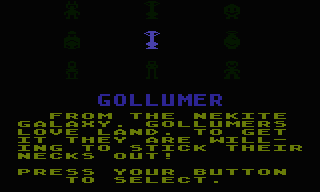
Our Emu198x capture of M.U.L.E., Ozark Softscape / Electronic Arts, 1983, Atari version running on the 800XL model. The Gollumer selection gives one of the colony's inhabitants a name and personality. This is the setup screen, not an auction capture.
These rules do not guarantee a close finish. They keep more people able to make meaningful decisions for longer.
That is worth distinguishing from secretly changing every result until everyone is equal. A player can still make a costly mistake or an excellent deal. The rules provide openings, not a promise that nobody will lose.
A handicap is also a friendly way to let people with different experience share the same game. They need not play identical starting positions for the evening to be worthwhile.
The challenge for a designer is to keep that help understandable. Players should be able to recognise why they lost a tie or why another character began with more, rather than conclude that the program is choosing favourites.
Six rounds to learn, twelve to make trouble
The Beginner game lasts six rounds and protects players against some especially costly decisions. Standard play lasts twelve, adds land trading and makes the supply of new M.U.L.E.s depend on smithore. Tournament play introduces crystite and private deals through collusion. 2
This is more than making the computer opponents tougher. Each step changes which relationships we have to understand.
Smithore ties the ability to expand back to production. The store needs two units of smithore to build a new M.U.L.E., and production takes a turn. A colony which neglects it cannot assume that robots will keep arriving. 1 A shortage can raise their cost and turn yesterday’s unfashionable mine into today’s strategic resource.
Crystite introduces a different temptation. It is an export, sold off-world, rather than something the colony needs in order to feed itself or operate. Rich deposits can be lucrative, but finding and exploiting them takes effort. They do not replace dinner. 2
Collusion permits selected players to trade privately during the auction. It creates room for an agreement which excludes the others. Trust, retaliation and persuasion can now take a more explicit form. 4
These additions arrive after the smaller game has given us something to build on. They are not all needed to understand the first useful decision.
The Wampus is not in the budget
There is more to Irata than choosing the best investment.
With time left in development, a settler can try to catch the Wampus in the mountains. It pays for its release. Going to the pub offers another way to finish the turn with some money, while ending further development. 1
The Wampus gives us something tempting and slightly foolish to do when the serious work is finished, or when we ought to be finishing it. We can weigh a safe conclusion against the possibility of a better reward.
Random events also disturb tidy plans. A good turn is not proof that our strategy will always work; a bad one is not necessarily evidence that the underlying choice was foolish.
This matters in a social game. A mishap can become a story the group remembers. An unexpected shortage can turn a comfortable player into a customer. A runaway robot has both a rule and a personality.
The humour makes the model easier to inhabit. We are still managing quantities, but we are doing it in a place with odd animals, unreliable machinery and a pub.
A business game made in Little Rock
Dani Bunten Berry had already been exploring games for several people before M.U.L.E. Her earlier Wheeler Dealers required a specially made input device so four people could bid. In a 1985 Antic interview, she described the pleasures of learning and the part Electronic Arts played in supporting the team. 3
M.U.L.E. was made by a group. The contemporary credits name Dani and Bill Bunten for design, Dani, Jim Rushing and Alan Watson for programming, Watson and Rushing for animation, and Roy Glover for music. The Little Rock Atari Addicts club is thanked for playtesting. 4
Those credits are useful starting points for understanding the work, rather than a way to assign every individual idea permanently to one person.
An auction needs numerical rules, but it also needs to make its current state clear. A character needs an appealing shape and working animation. A test session needs people who can find the confusing part without being told what to do.
The collaboration brought those jobs together. In the team’s 2023 interviews, Watson recalled watching players for confusion; Rushing remembered the challenge of the auction and cumbersome code merging; Bill Bunten remembered testing as an enthusiastic and competitive activity. Their recollections describe a game refined by seeing what people actually did. 5
There is a production lesson here which is easy to underestimate. A mathematically tidy auction can still fail if players cannot understand where to stand. The team needed the model and the encounter with it to work.
A space western with an engineering problem
Bunten later named Robert A. Heinlein’s Time Enough for Love as one source for the colony’s working mules. She also described carrying the real-time auction from Wheeler Dealers into the new game. 6
The setting makes several jobs easier to imagine. Land can be claimed, machines can be outfitted, produce can be brought to market, and settlers can meet in a small town. Familiar activities make an unfamiliar planet understandable.
The science-fiction distance also gives the artists room for odd species and invented minerals. We can understand a farming problem without requiring every plant, creature or machine to look like something from Earth.
Calling it a colony does not turn it into a comprehensive account of settlement or real economies. This world leaves out much of what historical colonisation involved. Its free land, production bonuses and trading rules are chosen parts of a game, not proof that actual societies work in the same way.
We can enjoy what the model lets us discover while remaining curious about what it has left out.
Four sockets can make a room
The Atari 400 and 800 supplied four joystick ports. M.U.L.E. could let four people move their bids at once, each holding a familiar controller. Later XL machines had two ports; John J. Anderson’s December 1983 Creative Computing review complained about the loss in exactly this game’s context. 2
That is a concrete example of a hardware specification changing who can participate in an experience. The value of the extra ports was the other people they could bring into the room.
The Commodore 64 conversion accommodated additional players on the keyboard during shared action, with joysticks used for development. Its reference card explains the split arrangements and the timing needed for collusion. 4
A port can preserve the rules and still change the furniture of play: where people sit, which keys they reach for and whether anyone has to share. Broader discussions of controls need room for those human arrangements as well as the devices’ mechanisms.
For the designers, the conversion was also work. Different graphics, sound and input hardware had to support a familiar experience. The team remembered the C64 conversion as a technical challenge; it was not a free consequence of both machines using related processors. 5
The tune came before the robot
Roy Glover’s theme gives the opening a cheerful, loping energy. In his 2024 interview with Andrew Dieffenbach, Glover recalled writing it to test his Atari music sequencer before it became the M.U.L.E. theme. He wanted to use the machine’s four voices as an ensemble. 7
His account connects that small computer tune to a much wider musical life: electronics repair, playing keyboards in bands, jazz and dance music. He specifically identified a disco-style bass as an intention, while declining to name a single conscious source for the whole tune. 7
The arrangement mattered too. Glover recalled losing a counterpoint part in the three-voice C64 adaptation and missing what it contributed. A melody can survive a port while its supporting voices change the character of the piece. 7
Sound belongs inside the game’s identity. We should ask what is carrying the feeling: the notes, the bass movement, the timbre, the pauses, or the relationship between them. Copying the main tune does not necessarily preserve all of that.
How do you sell an evening like this?
Electronic Arts’ package offered more than instructions and a disk. Its panels gave the machine a comic backstory, presented the people who made the game, and described the arguments of a fictional family game. Credits include package art by Lou Beach, photography by Allen Say, package design by Dennis McVey and liner notes by Jeffrey Goodby. 8
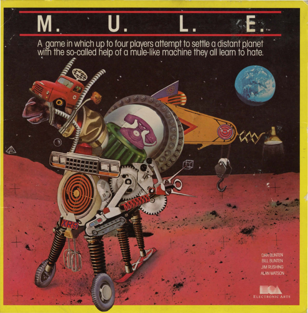
Original M.U.L.E. package front, Electronic Arts, 1983. Package art: Lou Beach; package design: Dennis McVey. Source: Museum of Computer Adventure Game History. Reduced reproduction for criticism and review; underlying rights reserved.
Source package and credits. This published-artwork excerpt has its own rights record; it is not covered by the licence for our text.
The package is trying to solve an awkward marketing problem. A screen of plots and numbers cannot, by itself, show the evening the game hopes to create.
The liner notes give the authors personalities. The illustrated situations supply motives, private plans and opportunities for mischief. They invite the buyer to imagine people playing together, rather than admire a technical feature list.
That promise is closely related to the design. The program makes a shortage possible; a person decides whether to exploit it. Packaging can describe the latter even when a screenshot struggles to show it.
Praise did not guarantee a mass-market success. Anderson warmly recommended the game in 1983; Bunten later put its sales at 30,000 copies. She did not regard that as an unqualified failure, pointing to the Atari 800’s short remaining commercial life and the game’s wider informal circulation. Acclaim, revenue and the number of people playing were different kinds of success. 26
M.U.L.E. also asked something of its audience. A group needed time, suitable controls and a willingness to learn a game whose attraction was hard to demonstrate in a glance. Those requirements help us understand the experience it offered; they do not, on their own, establish why any particular customer did or did not buy it.
Keeping the people in the game
M.U.L.E.’s later history contains ports, abandoned plans and several different answers to the question of how to bring it back.
The original team worked on the C64 version. Later editions brought the idea to further computers and the NES. Bunten also pursued a Mega Drive follow-up which did not reach release. The Strong preserves her design papers, including material for proposed sequels; some remains restricted. 59
The revival took several forms. Planet M.U.L.E. brought players together online; M.U.L.E. Returns moved to mobile devices; and a licensed board game brought the colony back to a physical table. 10
The tabletop version is a particularly apt journey. The original already needed players to make deals, while the computer kept accounts and timed their movements. A board-game adaptation must decide what people can comfortably administer for themselves and which procedures should change. It cannot preserve a real-time joystick auction merely by drawing its screen on cardboard. 11
Bunten’s children Melanie and Daniel Jr have been involved in keeping that legacy available through licensed projects. In their 2023 interview, Daniel remembered a parent who watched how he reacted to both board games and video games. That interest in the person playing sits comfortably beside the original team’s accounts of testing. 12
Familiar pictures, carefully chosen changes
Andrew Dieffenbach’s M.U.L.E. Online offers another useful response. In a 2023 interview, he described fidelity and accessibility as his aims, and said that his version combined an Atari-like visual approach with C64 mechanical and musical choices. 13
Different versions give a new maker different things to value. “Faithful” needs a follow-up question: faithful to which version, and to which part of playing it?
A shared room, a keyboard, four joysticks and an internet connection provide different possibilities. A good adaptation needs to consider how players notice one another, make agreements and understand the current situation, as well as how the production calculation works.
This is what makes M.U.L.E. such a useful game to study in full. Its arithmetic matters. So do the timer, the little walk out of town, the music, the clearer-than-it-first-looks auction, the package and the person who refuses to sell you food.
For an original teaching experiment, we might begin with two producers and one product: make something, keep enough to work next turn, trade the surplus. Later, another resource could make dependence visible. That is a possibility to assess through play, not a commissioned course or a licence to reuse the game’s name, characters, tune or artwork.
The first thing to find out would be whether people have anything interesting to say to one another while they play.
Sources and further reading
- Ozark Softscape / Electronic Arts, M.U.L.E., original player’s guide, 1983. Beginner walkthrough, economics, Standard/Tournament rules and author strategies. Original rules; diagrams here are our explanations and invented examples.
- John J. Anderson, “M.U.L.E.”, Creative Computing 9/12, December 1983, p. 114 onwards. Contemporary review: auctions, modes, participation, response and Atari joystick-port criticism.
- Arthur Leyenberger, “Interviewing Dan Bunten”, Antic 3/9, January 1985. Contemporary interview with Dani Bunten Berry under her publication name at the time; earlier games, creative process and learning.
- Electronic Arts, M.U.L.E. Commodore 64 command summary, 1983. Original conversion’s controls, collusion, credits and Little Rock Atari Addicts acknowledgement. It prints “Allen Watson”; later participant interviews use Alan.
- Christian Schiller, interviews with Bill Bunten, Jim Rushing and Alan Watson, 23 May 2023, with questions contributed by Andrew Dieffenbach. Separate interviews combined by the editor. Participant recollections of testing, roles, production, C64 and later work; retain disagreements and avoid priority claims.
- James Hague, interview with Dani Bunten Berry, Halcyon Days, 1997, preserved transcription. Participant testimony concerning earlier games, Heinlein and iterative design; later mirror, not a contemporary 1983 source.
- Andrew Dieffenbach, interview with Roy Glover, 5 June 2024. Edited participant account: sequencer, prior music, disco bass, four voices and the C64 adaptation. No music or score reproduced here.
- Electronic Arts, M.U.L.E. original packaging, 1983, Museum of Computer Adventure Game History scan. Inspectable front, liner notes, maker photograph, credits and example family game. Fictional packaging characters are not historical participants.
- The Strong, finding aid to the Dan Bunten (Dani Bunten Berry) papers, September 2013. Archival description, life chronology, approximate sales and access restrictions; not direct inspection of restricted design papers.
- Christian Schiller, later licensed revivals, 23 May 2023. Release overview cross-read with the rights-holder family and adaptation sources below; the author’s evaluations are not our play observations.
- Lautapelit.fi, M.U.L.E.: The Board Game, 2015, publisher product page. Rules and design credits for the licensed tabletop adaptation; distinguish this from the 1983 computer game.
- Christian Schiller, interview with Melanie Bunten and Daniel Bunten Jr, 23 May 2023. Family testimony about childhood play, licensing and preservation; their own wording is not silently presented as ours.
- Christian Schiller, interview with Andrew Dieffenbach, 23 May 2023. Remake author’s stated goals and Atari/C64 choices, rather than a claim to have verified their complete implementation.
This study has not yet been fact-checked. Selected early encounters were observed; a complete playthrough is not claimed. Original documents and source analysis support the wider account.
M.U.L.E. · Ozark Softscape · Electronic Arts · Atari 8-bit · 1983. Own screenshots illustrate criticism and review. Rights in the game remain with their owners. The header and explanatory diagrams are original illustrations. Photographs and advertising carry their own credits and rights records alongside each image.
Canonical study · Evidence and capture credits · More game studies