

We have drawn a few neat blocks, left some space by the river and put the power station well away from the houses. It looks like the beginning of a place we might want to live.
Then the city starts answering back.
The houses do not appear simply because we have asked for them. Roads cost money before they carry useful traffic. A growing population means more income, but also more things that need paying for. The lovely plan on the screen has become a set of promises we have to keep.
SimCity lets us make those promises. It also lets us discover what we forgot.
Maxis released the original in 1989. Will Wright designed it, after finding unexpected pleasure in the world-building tools for his helicopter game, Raid on Bungeling Bay. 1 2 There is a short Vault account of the game; here we will follow the more interesting business of making a city live.
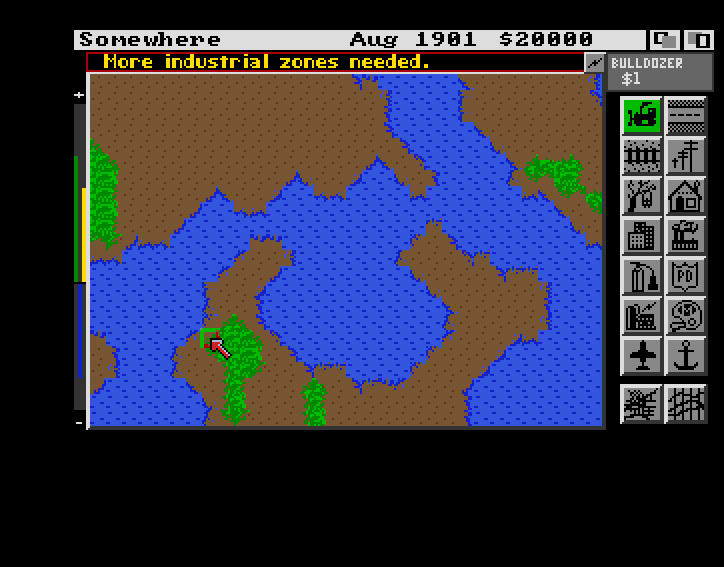
Our capture of the Infogrames Amiga edition, SimCity / Maxis, 1989. The city begins with a map, tools and money. There is no board of dots waiting to be cleared.
A place to make, rather than a board to clear
In Pac-Man, the dots tell us what remains to be done. A new SimCity map offers no comparable shopping list. There is land, there is water, there are tools, and there is a budget.
That can be wonderfully inviting. It can also leave us wondering where to begin.
The game supplies enough recognisable things to give us a foothold. People need homes. They need somewhere to work. A town needs a power supply. We can begin with those familiar relationships, try a layout and watch what happens. We do not need to understand every calculation before we can place our first zone.
The manual explicitly allows different ambitions: a dense metropolis, a small community, or several settlements. It also offers scenarios with particular problems and outcomes. 3 That distinction matters. Building freely does not mean that the game has no rules, and the existence of scenarios does not mean that every city has a finish line.
We might decide to keep a town small, improve an awkward district, or see whether a rail network can replace a sprawling road system. A population figure can become our target without being everyone’s target.
This gives failure a different shape. A disappointing neighbourhood need not end the session. It may become the next thing we want to repair. We can care about the same city because of the trouble it has survived, rather than start again whenever the plan becomes untidy.
Drawing permission to grow
Placing a residential zone is an odd sort of building action. We pay now, yet we do not get to choose a finished house and put it down.
We set aside a piece of land for a use. The simulation decides whether and how it develops. Residential, commercial and industrial zones give it different possibilities: homes, businesses and industry. Power and access matter, alongside the conditions affecting demand. 4
That gap between permission and result is where much of the game happens.
A paint program changes its picture when we apply the brush. SimCity changes the conditions under which its picture may change later. The tools look approachable, but the job is closer to tending something than colouring it in.
An empty zone is therefore useful information. We have made room, but we have not yet made that room attractive or usable. Adding another identical empty zone may increase our expenditure without solving anything.
We need to ask a smaller question. Is it connected? Is there power? Are we providing the kind of space the city needs? Have we allowed time for a response?
These questions make the first streets more interesting than their modest graphics suggest. We are learning to read absence: an undeveloped square can tell us that one of our assumptions has not worked.
A power line has to go somewhere
Power turns an abstract dependency into something we can draw.
A generating plant and a residential zone can both exist without forming a useful system. The connection is a separate piece of work. In the original rules, adjacent zones can pass power between them; lines carry it across gaps. An unpowered zone displays a flashing warning. The Amiga manual prices a coal plant at $3,000 and a nuclear plant at $5,000, with different capacity, pollution and risk. 5
So the cheaper option does not answer the whole decision. Where will it go? What will surround it? How much of our starting money will remain after we connect it?
The layout also changes the cost of the connection. A compact group of zones can share infrastructure. A picturesque settlement scattered along a shoreline may require more work to join up. The river is attractive, but getting across it is another expense.
We can see why this is satisfying to build. A line is a small mark with a large consequence: it makes some other piece of the city usable. The visible construction and the invisible dependency meet at one square.
It also gives us a useful way to think about resilience. One connection may be enough while nothing goes wrong. A second route may look wasteful until the first is lost. The extra route has value because of what might happen, even while it carries nothing.
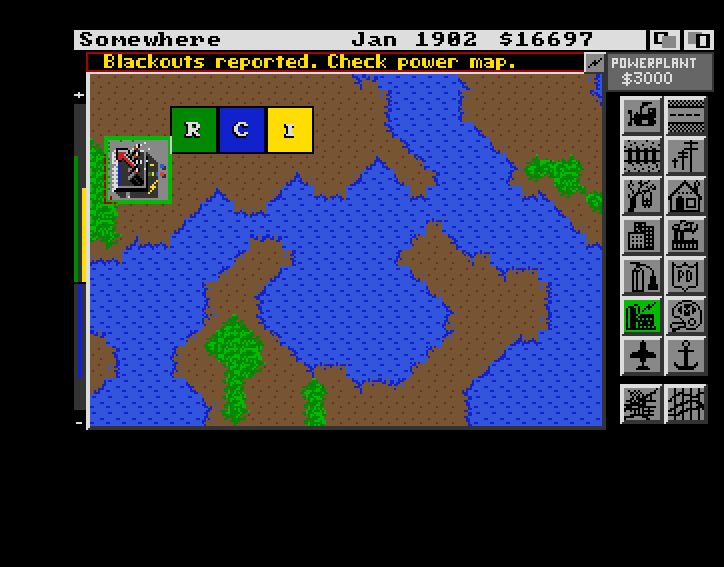
Our Amiga capture: R, C and I mark three zones beside a coal plant. The January 1902 frame still shows a blackout warning; the construction is visible before the warning has cleared.
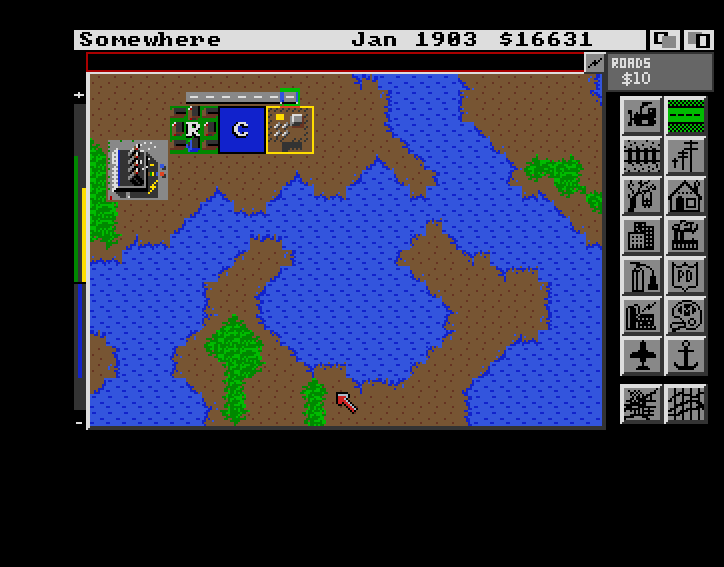
The same small city after time has passed and its budget has been confirmed. Residential and industrial structures are visible; the blue commercial zone is still empty. The three zones have not developed alike.
Spending once, paying again
A road has at least two prices in our plan: what it costs to lay and what it costs to keep.
This makes an impressive-looking city surprisingly easy to overbuild. We can spend the starting treasury on facilities long before the population can support them. The Amiga manual distinguishes construction from recurring road, fire and police funding, and supplies a yearly budget. Its speed controls also let us stop simulated time while building. 5
Pausing changes the pressure. We can consider a junction, inspect a tool or correct a layout without another month passing while we hesitate. It gives thought some room. Unpausing asks the city to test that thought.
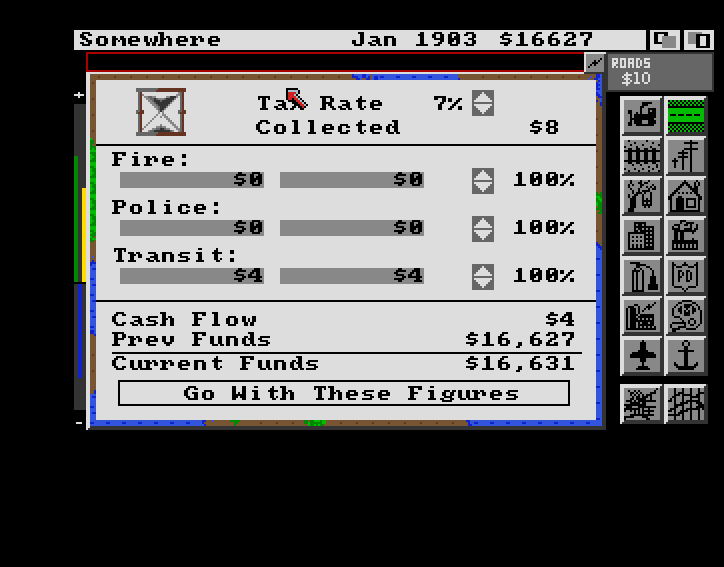
Our January 1903 Amiga budget: $8 collected, $4 for transit and a $4 surplus. The treasury moves from $16,627 to $16,631. These are observed figures; the example below deliberately uses different, invented numbers to show a shortfall.
For a deliberately invented budget, suppose our treasury contains $2,000. We spend $600 on construction, then receive $900 in tax and pay $1,100 for services. We finish with $1,200:
2,000 − 600 + 900 − 1,100 = 1,200
Those are our teaching figures, not a captured SimCity balance or its tax formula. The city can look richer while its reserves get smaller.

Our worked example, not a game capture or the SimCity tax formula. A one-off building expense and a recurring shortfall are different problems.
Next year, with no new construction and the same income and running costs, another $200 disappears. Stopping building has not removed the annual shortfall.
It is easy to understand that calculation on paper. It is harder to remember it while a new bridge would complete a beautiful waterfront. SimCity puts the arithmetic beside something we want to make.
A tax increase seems like another quick answer. Yet tax affects the conditions under which residents and businesses remain or develop. 4 Money is part of a relationship with the simulation, rather than a score that only goes up when we play well.
Waiting is an action
We can change a road immediately. We cannot immediately see every consequence of changing it.
This produces a particular temptation: make one change, notice that the city is still struggling, make three more, then wonder which one helped. A slow response can encourage frantic intervention.
A more useful experiment is modest. Keep the layout, change one condition, let time pass and compare the result. We still have to be cautious: the simulation is changing other things too. A better result after our change is a lead to investigate, not proof that we have found its only cause.
This is one reason the city needs more than a pretty map. We need ways to distinguish a current condition from a trend.
An overall map can show where a problem lies. A graph can show whether a number has been rising or falling. An evaluation can tell us what the simulated citizens are complaining about. The original Amiga documentation explains these as different views of the same city. 5
A warning is most helpful when we can do something with it. “More industry needed” suggests a kind of shortage. A power warning identifies a more local condition. Neither requires us to see the program’s variables, but both help us form a plan.

Our explanation of the player's loop. The sequence is conceptual; it is not a diagram of the original executable's update order.
The challenge for the interface is to reveal enough without doing all the reasoning. If every problem arrived with a guaranteed repair instruction, much of the pleasure of learning the city would disappear. If the screen offered only unexplained decay, there would be little to learn from.
The city we imagine and the program underneath
Small moving marks encourage us to imagine individual journeys. A row of buildings becomes a neighbourhood. An unpleasant part of town acquires a reputation in our head.
We supply more than the computer displays.
Don Hopkins, who adapted SimCity for Unix, discussed this in his account of Wright’s talks on simulation interfaces. He distinguished the computer’s model, the interface, play and the player’s understanding, and warned that people can imagine causes which the program does not actually contain. His account combines Wright’s ideas with his own comments. 6
That is a useful caution without spoiling the toy. We can enjoy a convincing little city and still ask what the program is measuring.
The publicly released Micropolis code makes some of that work inspectable. Its traffic routine attempts a bounded search through a road network; it is not a permanent, individually simulated life for every person we imagine in the town. Its simulation is divided into scheduled phases, rather than recomputing every city measure after every click. 7 8
Micropolis descends from SimCity through later adaptations. These routines help us examine that lineage; they do not prove that the Amiga executable in our captures contains identical code.
The distinction gives us two interesting questions. What does a rule actually do? And what does seeing its result make us believe is happening?
Games often need both answers. A small, workable rule can produce a much larger impression when its visible effects fit something we already understand.
Whose idea of a city?
The original gives us residential, commercial and industrial zoning, a treasury, taxation, roads, services and a mayor with extraordinary freedom to rearrange the map.
It does not ask every resident before we bulldoze a block.
That is a choice about the player’s role. It makes broad changes easy to try, and gives us a legible set of levers. It also leaves out much of what makes actual planning difficult: ownership, consent, competing institutions, different household needs and the lives disrupted by a tidy line on a map.
We can notice those omissions without asking a 1989 home-computer game to simulate everything. They help explain what kind of play it makes possible.
The model also gives particular things value. Pollution can make a location less attractive; parks and access can improve it. 4 We may learn to satisfy those rules very well. That does not establish that the same arrangement is best for every real town, or that the program has settled a political argument.
Wright said as much in a 1995 interview: he doubted that anyone could build an accurate model of something as complex as a city. 9 His remark is especially useful beside the excitement of early reviews, which sometimes treated the game as remarkably realistic.
There is room for both responses. The ability to experiment with connected consequences is valuable. The particular consequences remain worth questioning.
One interesting classroom discussion would begin with a rule we can identify, then ask what happens if we change it. We would need to distinguish evidence about the game from evidence about cities. Winning an argument with the simulation is not the same thing as winning an argument about a real place.
From bombing islands to growing them
The origin in Raid on Bungeling Bay helps explain SimCity’s unusual appeal. A tool made to support one kind of game exposed a different pleasure: arranging a world and watching it function.
In his 2002 interview with Computer Gaming World, Wright described his enjoyment of research. The accompanying account traced his urban-planning reading towards John Conway’s cellular automata and Jay Forrester’s system dynamics. 2 These offer different ways to think about many interacting parts and changes over time. They are sources of ideas, not evidence that SimCity reproduces a whole theory faithfully.
There was fiction in the mixture too. Johnny L. Wilson’s original 1989 review identified Stanisław Lem’s “The Seventh Sally”, with its miniature kingdom made for an exiled ruler, as an inspiration. 1 It is an uncomfortable companion to the enormous authority the game gives its mayor.
The cultural connection is more useful than treating the title as another fact to memorise. A tiny world can be a technical construction, a plaything and a place whose inhabitants we imagine caring about. Those possibilities do not always sit comfortably together.
The documentation encouraged readers to look outwards. The 1992 Unix manual’s bibliography includes Jane Jacobs’s The Death and Life of Great American Cities, Kevin Lynch’s A Theory of Good City Form and children’s reading such as The Little House and The Lorax. 10 A reading list does not prove that each book caused a particular game rule. It does show that the published work offered paths into other ideas about places and how people live in them.
Making something people would buy
A design can be enjoyable before a publisher knows how to describe it.
Wright and Jeff Braun founded Maxis in 1987. 11 The first commercial SimCity followed in 1989, with Brøderbund distributing the original North American release. Wilson reported that Brøderbund had encouraged the addition of city-management scenarios. His review listed $49.95 for Macintosh, $44.95 for Amiga and $29.95 for C64. 1
Those details show several jobs beyond writing the simulation: getting it onto different machines, supplying a manual, choosing a price and giving someone a reason to pick up the box.
A named scenario can make an open-ended system easier to explain. There is a city, something is wrong, and we have a job to do. It offers a starting point to someone who finds an empty map less welcoming.
Wilson also described the magazine staff making their own cities and comparing printed maps. 1 Their enjoyment had already escaped the computer screen. A city became something to show another person, discuss and defend.
That is a different social life from a simultaneous multiplayer match. We can play alone and still have something to share.
The work also grew through adaptation. The 1992 Unix credits name Hopkins’s implementation and interface work, Arthur van Hoff and Doug Scoular’s HyperLook system, and contributors to art, documentation, sound and scenarios. 12 These credits belong to that edition. They are a reminder to look for the people who made a particular version approachable, rather than let the original designer’s name stand for every part of every release.
The same invitation on another machine
SimCity reached machines which offered very different ways to point, display information and store a city.
The Spectrum and Amstrad instructions, for example, describe moving through menus with a joystick or Q/A keys and confirming with fire or the space bar. 13 The city-building idea had travelled beyond the mouse-controlled desktop. That did not make all the interfaces interchangeable.
Nintendo’s 1991 Super NES adaptation introduced its own adviser, Dr. Wright, and seasonal presentation. 14 Guidance could become a character rather than remain only a manual or menu. The version someone encountered at home could shape what they remembered as SimCity.
We should leave room for those differences when discussing “the original”. A shared design can survive a conversion while its pace, presentation and habits change.
The computer in the room mattered too. A city made on an Amiga, a family PC or a console could reach different people through different shops, publications and routines of use. The existence of a conversion establishes availability of an edition; it does not tell us how widely people in a whole country played it.
Decades of changing the view
The series did not stop at the flat map.
SimCity 2000 (1993), SimCity 3000 (1999) and SimCity 4 (2003) returned to the invitation with different tools and presentations. Maxis became part of Electronic Arts in 1997. 11 The licensed series retrospective describes 2000’s elevation and underground layers, 3000’s advisers and business deals, and 4’s connected regions. 14
Each addition changes what we can attend to. Showing an underground network gives hidden infrastructure a place we can inspect. Joining cities into regions moves some decisions beyond one map. A more detailed building can be enjoyable to look at while also making its surroundings harder to survey at a glance.
More detail is therefore a design choice with a cost, rather than an automatic measure of a better simulation.
The 2013 SimCity placed connected cities and shared services inside an online regional game. Its own manual explains regional interaction and the global market. 15 That is a different relationship with the city from keeping a self-contained 1989 town on a disk. The much-discussed troubled launch and later offline mode deserve their own detailed account; the concise Vault entry provides the wider series history.
The idea also travelled outside the brand. In 2021, Colossal Order’s Mariina Hallikainen explicitly described Cities: Skylines as an intended spiritual successor to SimCity 4. She connected its development to the studio’s smaller Cities in Motion projects and to making room for players’ modifications. 16 Here the influence is a participant’s stated aim, rather than a resemblance we have inferred from two screenshots.
There is another kind of continuation in Micropolis. The original game’s lineage became available as free software for study and modification, with Hopkins involved in its adaptation for the One Laptop per Child project. The published licence retains separate restrictions on the SimCity name. 17 We can inspect and change a model without pretending that every name, image or later game has the same permissions.
The most inviting part survives these changes. We put something in place, let the world run and discover that our plan has consequences. Then we have another idea for the city.
Sources and further reading
- Johnny L. Wilson, “What Do The ‘Sim’ple Folk Do?”, Computer Gaming World 59, May 1989, pp. 16–17. Contemporary Amiga review, distribution, scenarios, prices, Lem and the staff’s play. Original issue.
- George Jones, “Inside the Mind of Will Wright”, Computer Gaming World 214, May 2002, p. 65. Creator interview and accompanying account of research and the Bungeling Bay editor. Original issue.
- Maxis / DUX, SimCity Unix manual, 1992, introduction. Version-specific goals and scenarios; workstation features are not attributed to Amiga. Introduction.
- Maxis / DUX, SimCity Unix manual, 1992, “Inside the Simulator”. Published explanation of zoning, demand, power, pollution and land value; not a complete formula listing. Inside the Simulator.
- Maxis, SimCity Amiga manual, preserved text transcription. Original interface, power, budget, simulation speed and information displays; transcription checked against our running edition where observed. Amiga manual.
- Don Hopkins, “Designing User Interfaces to Simulation Games”. Participant’s summary and elaboration of Wright’s talks, including a Stanford class appearance. Account.
- Micropolis source,
traffic.cpp, revision c98f6b08519887b450d9be198bfca5237aab6d0c.tryDriveand bounded route work in the later C++ descendant. Source. - Micropolis source,
simulate.cpp, same revision. Simulation phase scheduling and census timing in that descendant. Source. - Alexander Antoniades, “By Design”, Game Developer, April/May 1995, printed pp. 58–61, especially p. 60. Wright’s comment on the limits of an accurate city model. Original issue.
- Maxis / DUX, SimCity Unix manual, 1992, bibliography. Reading recommendations, not proof of individual causal influences. Bibliography.
- Electronic Arts / Maxis, “About”, studio timeline. 1987 founding, 1989 original, 1993/1999/2003 sequels and 1997 acquisition. Timeline.
- Maxis / DUX, SimCity Unix manual, 1992, credits. These identify that adaptation, not the complete original Amiga team. Credits.
- Maxis / Infogrames, Sim City — Amstrad & Spectrum, 1989, loading and menu instructions. Manual transcription.
- Prima Games, “SimCity Legacy: The Whole Story”, licensed 2013 guide. Used for specific adaptation/features; its inconsistent early-release and SimCity 2000 dating is not adopted. Retrospective.
- Electronic Arts, SimCity 2013 manual. Regional play and global services in the later game. Publisher’s manual.
- Brian Shea, interview with Mariina Hallikainen, Game Informer, March 2021. Her account of the intended relationship to SimCity 4 and Cities in Motion, and support for modification. Interview.
- Don Hopkins, Micropolis release and licence notice. Code release, OLPC adaptation and separate name restrictions. Release and terms.
For deeper historical investigation, Chaim Gingold’s Building SimCity: How to Put the World in a Machine (MIT Press, 2024) studies the game’s wider simulation, educational and commercial background. Publisher’s description.
This study has not yet been fact-checked. Selected early encounters were observed; a complete playthrough is not claimed. Original documents and source analysis support the wider account.
SimCity · Will Wright · Maxis · Infogrames Amiga edition · 1989. Own screenshots illustrate criticism and review. Rights in the game remain with their owners. The header and explanatory diagrams are original illustrations. Photographs and advertising carry their own credits and rights records alongside each image.
Canonical study · Evidence and capture credits · More game studies