
The Acorn Atom could arrive as a box of parts, but the finished computer had a full-sized keyboard and a case around its electronics. Connect a television and it offered BASIC; stay at the same keyboard and its assembler let you write instructions for the 6502 processor. Acorn sold it in 1980 in both kit and assembled forms. (Atom Technical Manual, issue 2, introduction; Atomic Theory and Practice, chapters 1 and 13.)
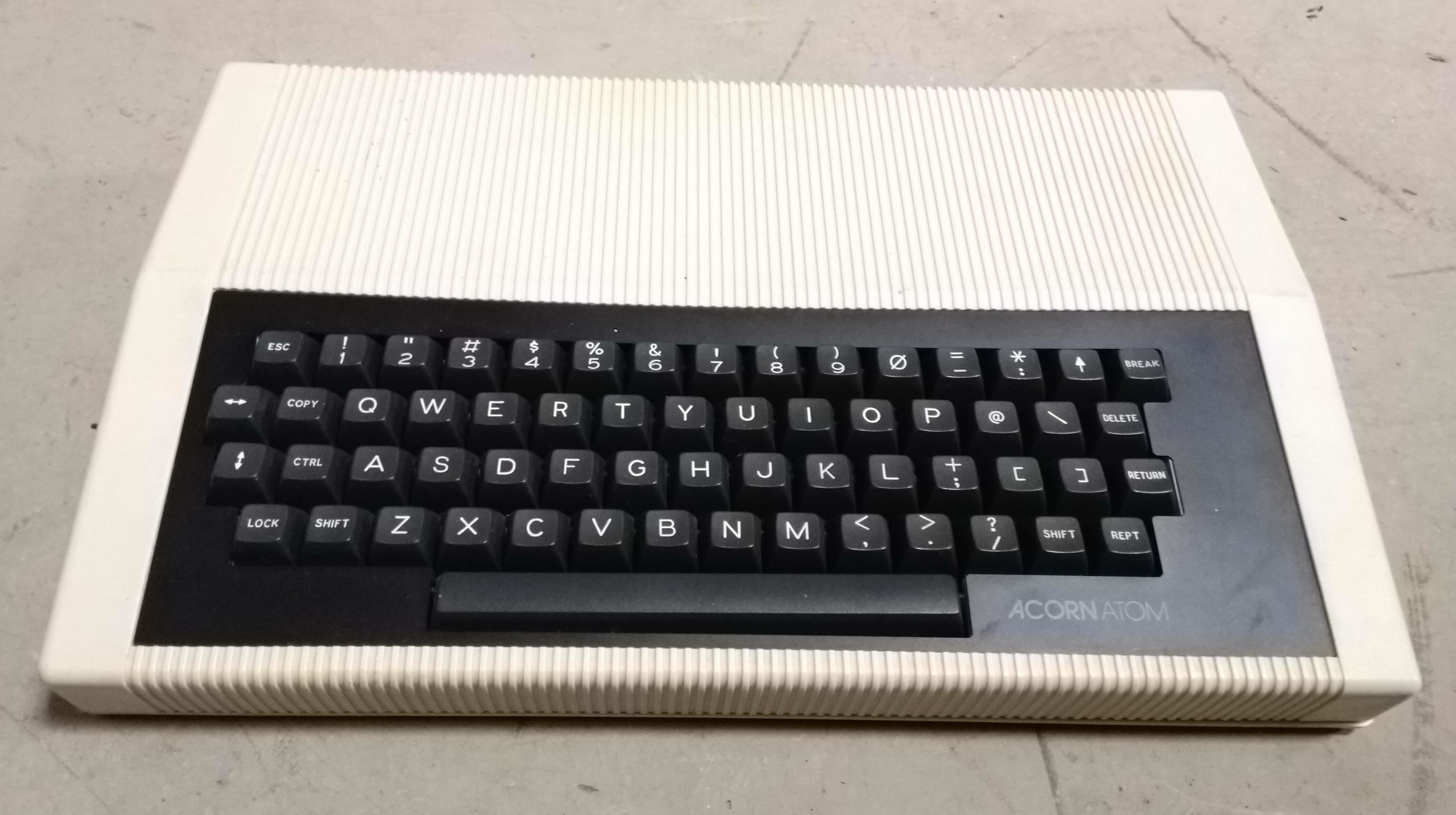
Two languages in one place
Sophie Wilson wrote the Acorn BASIC family that led through the Atom to BBC BASIC. Her biography follows that software work alongside Acorn’s computers.
The Atom’s BASIC handled whole numbers. A calculation involving division therefore discarded the fractional part unless an owner fitted the optional floating-point extension. Its assembler was already there, however: bracketed instructions could produce machine code in memory, and BASIC’s LINK command could run that code. A short BASIC program could organise the work while a machine-code routine performed a particular task. (David Johnson-Davies, Atomic Theory and Practice, chapters 2, 13, 17 and 22.)
The manual introduced this combination early. Its first chapter demonstrated text output, graphics and an assembler routine that sent memory contents through the loudspeaker as a buzzing sound. It then gave BASIC and assembler their own teaching sections. These were different ways of programming the same computer, available without replacing its language ROM or loading a separate assembler.
Jim Murray’s November 1980 review praised the manual’s quality, while warning that learning this particular BASIC did not mean learning every BASIC. He thought the book’s claim to teach both BASIC and machine-code programming needed that qualification. The Atom’s useful combination was also a distinctive dialect to learn. (Practical Computing, pp. 66–68.)
Expansion changed what the machine could do
The processor ran at 1MHz. The basic machine had 2K of RAM, but only 512 bytes initially held BASIC program text. System workspace occupied 1K; the other 1K was shared equally between the display and the program text. Extra RAM could enlarge that space and support denser graphics. The technical manual described memory additions, an optional floating-point ROM, printer connections and expansion through Acorn’s existing computer bus. (Technical Manual, circuit description, memory map and “Expanding the ATOM”, pp. 16–23.)
A Motorola MC6847 generated the picture. More detailed modes needed more display memory, and colour television output needed the appropriate colour hardware. Murray’s review machine had more memory and the floating-point option fitted. Its abilities should not all be assigned to the cheapest kit. (Practical Computing, November 1980; Technical Manual, pp. 16–22.)
A kit that became a game
The Science Museum Group preserves one owner’s route through the machine. Its record says Kevan Earl bought an Atom kit by mail order on 15 January 1981 for £150.20. He assembled it without help in one to two weeks and wrote a Backgammon program. According to the museum, Bug-Byte developed and published the game after he approached the company. That is the history of this particular Atom, rather than a standard kit price or build time. (Object Y2002.13.)
The Atom also supplied the first market for Acornsoft. Contemporary advertisements and reviews list its games alongside Bug-Byte’s offerings, before either company’s BBC or Spectrum releases. The Atom gave people a machine to program, and publishers a small audience already looking for programs to use.
The BBC Micro followed from Acorn’s later Proton project. The BBC Computer Literacy Project entry describes why showing the BBC an Atom was not enough: Acorn had to demonstrate its new machine. Both computers used a 6502, but their languages and hardware should not be treated as interchangeable.
Sources
- Acorn Computers, Atom Technical Manual, issue 2, October 1980, introduction and pp. 16–23: processor, display, memory and optional extensions. Manufacturer manual.
- David Johnson-Davies, Atomic Theory and Practice, Acorn Computer, 1980, chapters 1–2, 13, 17 and 22: programming and the floating-point option. Manual.
- Jim Murray, “The Acorn Atom”, Practical Computing, November 1980, pp. 66–68: contemporary review of a pre-production, expanded machine. Issue scan.
- Science Museum Group, Acorn Atom Computer, Y2002.13: recorded purchase and use of Kevan Earl’s machine. Object record.
- Your Computer, June, October and November 1981: Bug-Byte advertisements and Atom games review; Computer & Video Games, issue 1, November 1981: Acornsoft game-pack advertisement. The linked publisher entries discuss these sources.
- Chris Curry, interview in Your Computer, October 1981: Atom demonstration and the Proton proposal, discussed in the linked BBC Computer Literacy Project entry.