
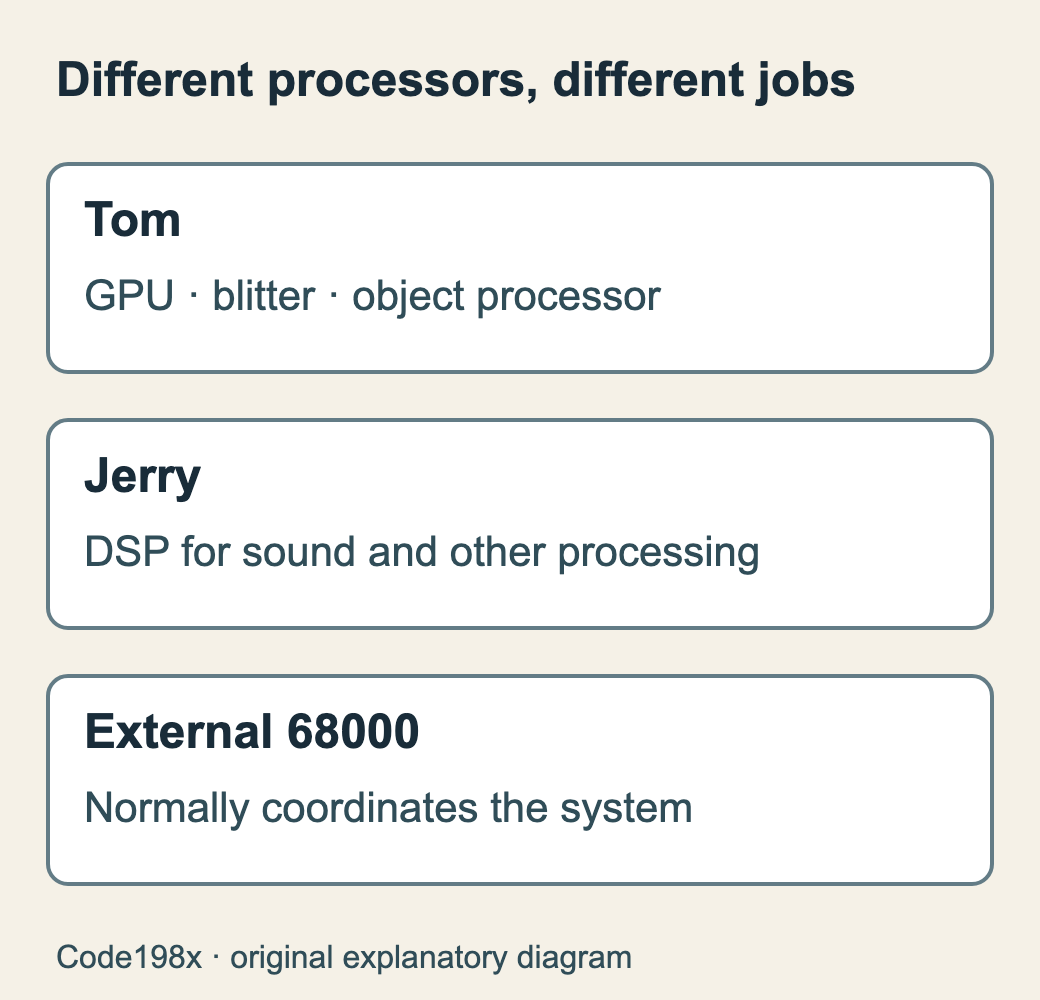
The Atari Jaguar divided work between specialised processors. Tom contained an object processor, a graphics processor and a blitter. Jerry contained a digital signal processor. An external Motorola 68000 provided another programmable processor, normally coordinating the system. A game depended on how its work and data moved between those parts.
Atari announced the console in June 1993, describing a New York rollout for the autumn and wider distribution to follow. That original press release, preserved by Benj Edwards, records the launch plan. It does not prove that the console was immediately available in every territory.
From objects to scanlines
Tom’s object processor reads an object list from memory and assembles the visible line in a line buffer. Objects can refer to bitmap data and include positioning and scaling information. The GPU and blitter can do work that produces or changes those bitmaps before the object processor displays them.
Those are separate stages. Drawing a new image into memory and arranging an existing image on screen are related tasks, but the object processor does not automatically perform every calculation needed by a 3D game. The sprite-scaling entry explains another use of changing how source pixels map onto the display.
What the word widths describe
The technical reference documents a 64-bit external memory data path and wide blitter operations alongside 32-bit GPU and DSP arithmetic. The external 68000 has its own architecture. One number on the console’s packaging therefore cannot tell a programmer the width of every register, instruction or memory transaction.
This matters when allocating work. The GPU and Jerry’s DSP have local memory as well as access to the wider system. Moving code or data, sharing memory and coordinating processors are programming tasks in their own right. The reference’s description of a 68000 manager and specialised processing units is a division of responsibilities, not a measurement of how fast every game runs. (Tom and Jerry reference, architecture and processor sections.)
Reading the technical record
The available reference is revision 8, dated 28 February 2001, and preserves earlier Atari material with 1992–93 notices. Its edition date matters when citing it; it should not be presented as an unchanged launch-day publication.
Jeff Minter’s Tempest 2000 is a useful next reading connection for the Jaguar’s software, while the Atari Lynx shows a different Atari system built around specialised graphics hardware. Neither relationship makes the machines software compatible.
Sources
- Atari, Jaguar announcement (1993-06). Original press release preserved by Benj Edwards from Atari’s CompuServe forum; republished November 2005. Rollout statements are plans. Read source.
- Martin Brennan, Tim Dunn and John Mathieson, Jaguar Technical Reference Manual: Tom & Jerry (2001-02). Revision 8, 28 February 2001, preserves 1992–93 technical material; edition date is not a 1993 publication claim. Read source.