
A NewBrain AD could put sixteen characters in front of its owner without a television. Its fluorescent display formed a narrow window onto the text, while a television or monitor could show a larger page. Both this AD model and the cheaper Model A had 32K of RAM. When Simon Beesley reviewed them in September 1982, he listed prices of £267.50 and £233 respectively. (Your Computer, pp. 86–89.)
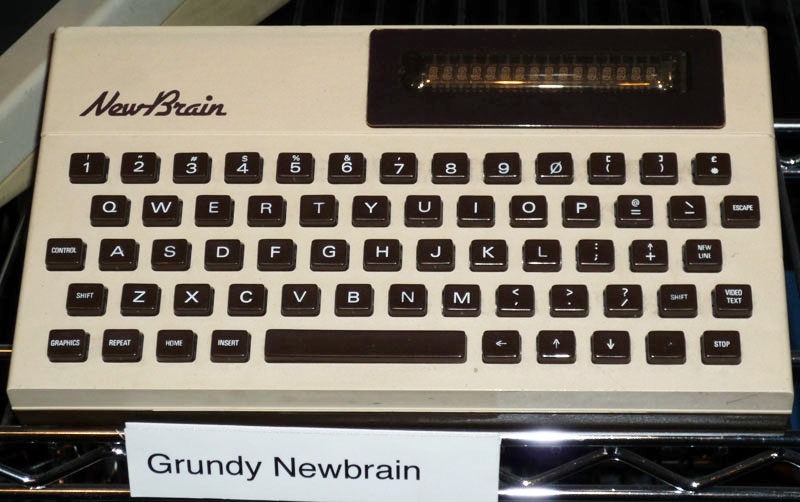
The small case did not make the standard machine a self-contained battery portable. BYTE’s January 1983 report still described a battery-equipped model as forthcoming. Inside the A and AD, a Z80A ran at 4MHz, with a second processor, the COP420M, handling input and output tasks. The machine produced monochrome video; colour and a built-in sound facility were absent. (BYTE, January 1983, p. 47; Beesley’s review.)
Screens as devices
The NewBrain’s flexibility came partly from its input/output system. A program opened a numbered stream: a connection to a device handled by a driver. The driver dealt with the details of the screen, cassette or other equipment, while the program sent or requested data through the connection. Grundy’s technical manual separates this I/O system from the operating system’s memory and keyboard management. BASIC was one user of those services, rather than the definition of the whole machine. (Software Technical Manual, sections 1.1–1.4 and 3.)
This mattered at the keyboard. A program could direct text to the fluorescent display separately from the television display. It could also work with a text area larger than the visible window. Beesley found the screen editor effective, but thought the documentation did too little to explain the more unusual facilities. Powerful controls were present; finding out how to use them was part of the owner’s work. (September 1982 review, “Expandable memory” and “Not so user-friendly”.)
High-resolution graphics were another strength. BYTE described selectable horizontal resolutions up to 640 pixels and a graphics-only display 250 rows deep, with text and graphics also able to share a screen. The cost was memory: drawing a larger image required storing more of it. These were monochrome capabilities, not a hidden colour mode. (BYTE, January 1983, p. 47.)
A design overtaken by its timetable
The design passed through several organisations before it reached shops. Former Grundy employee Gerald McMullon recalled Mike Wakefield designing the hardware and Basil Smith writing software for a project begun at Sinclair’s earlier business. It moved to Newbury Laboratories and then Grundy. The Sinclair Research story follows the separation between Radionics and Sinclair’s later computer company. (McMullon’s account, “Nutshell history”.)
The NewBrain was considered during planning for the BBC Computer Literacy Project. The production BBC machine was Acorn’s Proton, which became the BBC Micro. BYTE recorded the NewBrain’s earlier place in that process. Consideration is not evidence of a production contract being awarded and then taken away. (January 1983, p. 47.)
After Grundy
Expansion promises need the same care. Extra memory, disk storage and CP/M appeared in accounts of the system’s potential, but they were not all in the base machine. Grundy’s own technical manual explicitly distinguishes unexpanded A/AD software from expanded systems. Its catalogue of interfaces should not be read as a list of equipment every owner received.
McMullon dated GBS’s collapse to August 1983. He recalled Tradecom acquiring the remaining stock for a Dutch schools project, and subsequent hardware work and user groups continuing beyond Grundy. That is a participant’s account of how the NewBrain carried on, rather than a reason to put a neat end date on every machine. (Recollection, “The NewBrain moves to Holland” and subsequent notes.)
Sources
- Simon Beesley, “NewBrain review”, Your Computer, September 1982, pp. 86–89: A/AD, prices, display, software and reception. Public transcription.
- Grundy Business Systems, NewBrain Software Technical Manual, copy carrying copyright 1981–1983, preface, sections 1.1–1.4 and 3: unexpanded system and I/O organisation. Manufacturer manual.
- BYTE, January 1983, “The Grundy Newbrain AD” section, pp. 47 and 51: hardware, monochrome graphics, BBC context and planned expansions. Issue scan.
- Gerald McMullon, former Grundy employee, notes reproduced with permission by Binary Dinosaurs, publication date unspecified: origins and later history. These are retrospective recollections. Account.