
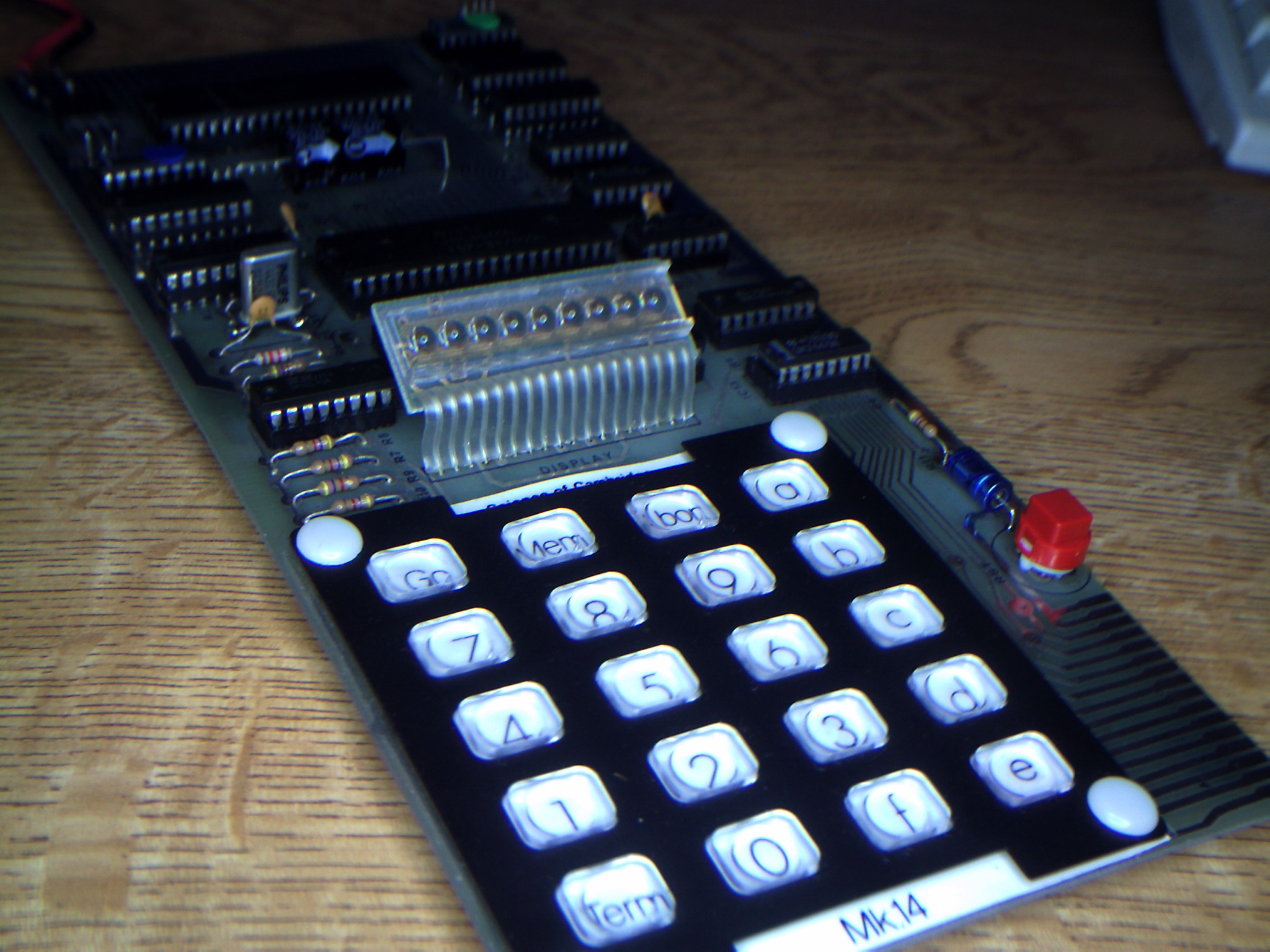
The MK14 let an owner build a computer and reach straight into its memory. There was no television picture or BASIC prompt in the standard kit. You entered numbers on a small keypad, inspected them on a red LED display and told the processor where to start. The controls were sparse, but the machine exposed the work they did.
Science of Cambridge, the company that later became Sinclair Research, was advertising the kit by March 1978. The headline price was £39.95; with £3.20 VAT and 40p postage, the order form asked for £43.55. Buyers supplied the soldering work. The advertisement listed 256 bytes of RAM and a 512-byte monitor program in permanent memory. (Wireless World, March 1978, p. 113.)
Talking to the monitor
Here, a monitor means the small program that accepts commands, rather than a screen. The MK14 manual begins its operating exercise by showing how to look at a memory location and change its contents. Addresses identify locations; the numbers stored there can be data or instructions. Hexadecimal notation uses the digits 0–9 and letters A–F to write those numbers compactly. The monitor lets the owner enter a machine-code program and run it. (MK14 Manual, part 1, sections 5–8.)
The processor was National Semiconductor’s SC/MP II. The basic RAM could be extended on the board with another 256 bytes and a RAM/input-output device containing a further 128 bytes: 640 bytes altogether. Those input and output connections also made the board useful for controlling external equipment. A cassette interface and a television display required additional hardware. (A. A. Berk, Practical Electronics, May 1979.)
Landing with numbers
The manual’s Moon Landing turns the LED readout into a spacecraft’s instrument panel. It displays altitude, descent rate and remaining fuel. Keys 1–7 choose the thrust; stronger thrust spends fuel faster. The player has to reach the surface gently, and the final display reports the result. No drawn landscape is needed to make that trade-off playable. The same applications section includes Duck Shoot, Mastermind and music programs. (Part 2, “Games” and “Music”.)
The application programs are credited to David Johnson-Davies, except for individually marked contributions. His name connects this small training board to Acornsoft and the Acorn Atom, whose manual also made programming examples central to learning the machine. The games here were listings to enter, rather than a ready-loaded collection.
Cheap hardware still needed support
Berk’s May 1979 review welcomed the low price but found the manual difficult for beginners in places. He criticised the conductive-rubber keypad and described receiving his own kit in January after ordering the previous summer. That is evidence of one owner’s experience, not a delivery time for every order. He also described revised boards and optional switches that addressed some of the shortcomings. (Review.)
The ZX80, sold in 1980, offered a different starting point: a case, a television display and BASIC. The MK14 had already put a cheaper, more exposed machine into customers’ hands before Clive Sinclair left Radionics in 1979. It belongs to the earlier kit business, rather than the aftermath of that departure.
Sources
- Science of Cambridge, advertisement, Wireless World, March 1978, p. 113: kit, price, VAT, postage and specification. Issue scan.
- Science of Cambridge, MK14 Manual, part 1, sections 5–9; part 2, contents and Games section: operation, programs and credits. Manufacturer manual. The manual establishes operation, not an exact release day.
- A. A. Berk, “Science of Cambridge MK14”, Practical Electronics, May 1979: independent owner’s review, including expansion and shortcomings. Public transcription.
- Sinclair User, issue 51, June 1986, p. 47: Sinclair’s departure from Radionics and the subsequent company names. The March 1978 advertisement establishes that the MK14 was already offered before that departure.