
Tell the player what a guess means before asking for one. Add a title, a compact picture of the lock and the rules needed to read its clues.
Add lines 20, 30, 40, 50, 60, 70, 80, 90, 100, 110, 120, 130, 140, 150.
  20 PRINT AT 3,7; INK 5;"L O C K S M I T H"
  30 PRINT AT 5,5; INK 6;"+--------------------+"
  40 PRINT AT 6,5; INK 6;"+   ?   ?   ?   ?    +"
  50 PRINT AT 7,5; INK 6;"+--------------------+"
  60 PRINT AT 10,2; INK 7;"Four digits. Each from 1 to 6."
  70 PRINT AT 11,2;"Digits may repeat. Ten tries."
  80 PRINT AT 13,2; INK 4;"EXACT: right digit and place"
  90 PRINT AT 14,2; INK 6;"OTHER: right digit elsewhere"
 100 PRINT AT 16,2; INK 7;"Each digit counts only once."
 110 PRINT AT 19,6; INK 5;"S starts. Q quits."
 120 GO SUB 9000
 130 LET k$=INKEY$: IF k$="" THEN GO TO 130
 140 IF k$="q" OR k$="Q" THEN GO TO 8000
 150 IF k$<>"s" AND k$<>"S" THEN GO TO 130
RUN the changed program.
Complete source at this checkpoint
  10 BORDER 0: PAPER 0: INK 7: BRIGHT 1: CLS
  20 PRINT AT 3,7; INK 5;"L O C K S M I T H"
  30 PRINT AT 5,5; INK 6;"+--------------------+"
  40 PRINT AT 6,5; INK 6;"+   ?   ?   ?   ?    +"
  50 PRINT AT 7,5; INK 6;"+--------------------+"
  60 PRINT AT 10,2; INK 7;"Four digits. Each from 1 to 6."
  70 PRINT AT 11,2;"Digits may repeat. Ten tries."
  80 PRINT AT 13,2; INK 4;"EXACT: right digit and place"
  90 PRINT AT 14,2; INK 6;"OTHER: right digit elsewhere"
 100 PRINT AT 16,2; INK 7;"Each digit counts only once."
 110 PRINT AT 19,6; INK 5;"S starts. Q quits."
 120 GO SUB 9000
 130 LET k$=INKEY$: IF k$="" THEN GO TO 130
 140 IF k$="q" OR k$="Q" THEN GO TO 8000
 150 IF k$<>"s" AND k$<>"S" THEN GO TO 130
 200 RANDOMIZE : DIM c(4)
 210 FOR i=1 TO 4: LET c(i)=INT (RND*6)+1: NEXT i
 220 LET t=1: LET g$="": GO SUB 1000
 230 GO SUB 9000
 240 GO SUB 2000
 250 LET k$=INKEY$: IF k$="" THEN GO TO 250
 260 IF k$="q" OR k$="Q" THEN GO TO 8000
 270 IF k$="r" OR k$="R" THEN GO TO 200
 280 IF k$=CHR$ 13 THEN GO TO 400
 290 IF k$="d" OR k$="D" OR k$=CHR$ 12 THEN GO TO 350
 300 IF k$<"1" OR k$>"6" THEN GO TO 230
 310 IF LEN g$=4 THEN GO TO 230
 320 LET g$=g$+k$: GO TO 230
 350 IF LEN g$>0 THEN LET g$=g$( TO LEN g$-1)
 360 GO TO 230
 400 IF LEN g$<>4 THEN PRINT AT 18,2; INK 6;"Enter four digits first.     ": GO TO 230
 410 GO SUB 3000
 420 GO SUB 4000
 430 IF bulls=4 THEN GO TO 5000
 440 IF t=10 THEN GO TO 5100
 450 LET t=t+1: LET g$=""
 460 PRINT AT 18,2;"                            "
 470 GO TO 230
1000 CLS
1010 PRINT AT 0,1; INK 5;"LOCKSMITH";AT 0,21; INK 7;"10 TRIES"
1020 PRINT AT 2,1; INK 7;"Digits 1-6. Repeats allowed."
1030 PRINT AT 4,1; INK 5;"TRY";AT 4,7;"CODE";AT 4,19;"EXACT";AT 4,26;"OTHER"
1040 FOR j=5 TO 14: PRINT AT j,1; INK 1;"-";AT j,7;". . . .";AT j,21;".";AT j,28;".": NEXT j
1050 PRINT AT 16,1; INK 5;"------------------------------"
1060 PRINT AT 20,1; INK 7;"1-6: digits   D: erase"
1070 PRINT AT 21,1;"ENTER: check  R: new  Q: quit"
1080 RETURN
2000 PRINT AT 17,1; INK 5;"TRY ";t;" ";AT 17,7; INK 7;"_ _ _ _"
2010 FOR i=1 TO LEN g$: PRINT AT 17,5 +2 *i; PAPER 1; INK 7;g$(i): NEXT i
2020 RETURN
3000 DIM g(4): LET bulls=0: LET total=0
3010 FOR i=1 TO 4: LET g(i)=VAL g$(i): IF g(i)=c(i) THEN LET bulls=bulls+1
3020 NEXT i
3030 FOR d=1 TO 6
3040 LET cc=0: LET gc=0
3050 FOR i=1 TO 4
3060 IF c(i)=d THEN LET cc=cc+1
3070 IF g(i)=d THEN LET gc=gc+1
3080 NEXT i
3090 IF cc<=gc THEN LET total=total+cc
3100 IF gc<cc THEN LET total=total+gc
3110 NEXT d
3120 LET cows=total-bulls: RETURN
4000 PRINT AT 4 +t,1; INK 7;t
4010 FOR i=1 TO 4: PRINT AT 4 +t,5 +2 *i; PAPER 1; INK 7;g$(i): NEXT i
4020 PRINT AT 4 +t,21; INK 4;bulls;AT 4 +t,28; INK 6;cows
4030 RETURN
5000 PRINT AT 17,1; INK 4;"OPEN! Attempts used: ";t;"      "
5010 GO TO 5200
5100 PRINT AT 17,1; INK 6;"LOCKED. Ten tries used.        "
5200 PRINT AT 18,1;"                              ";AT 18,1; INK 7;"The code: ";
5210 FOR i=1 TO 4: PRINT c(i);: NEXT i
5220 PRINT AT 20,1;"R: new code   Q: quit          "
5230 PRINT AT 21,1;"                              "
5240 GO SUB 9000
5250 LET k$=INKEY$: IF k$="" THEN GO TO 5250
5260 IF k$="r" OR k$="R" THEN GO TO 200
5270 IF k$="q" OR k$="Q" THEN GO TO 8000
5280 GO TO 5250
8000 PAPER 0: INK 7: BRIGHT 0: PRINT AT 21,1;"LOCKSMITH finished.           ": STOP
9000 IF INKEY$<>"" THEN GO TO 9000
9010 RETURN
RUN now opens at the title. S starts and Q quits. Once playing, the editor and ten-guess rules behave as before. The game is deliberately silent, so nothing needed to understand a clue depends on hearing a sound.
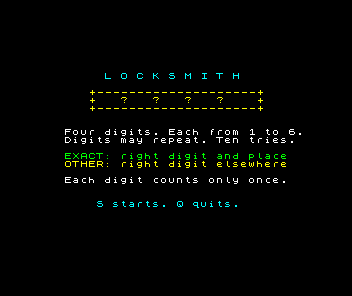
Fit the rules to the game
The title answers the questions a new player needs: four digits, values 1–6, repeated digits, ten tries. EXACT means the right digit in the right place; OTHER means the right digit elsewhere. “Each digit counts only once” is the rule our frequency counts enforce.
The lock drawing uses ordinary characters. Its four question marks match the four spaces the player will fill. Colour separates headings, clues and controls, while words carry their meaning. We do not need a new drawing subsystem to make this small game readable.
Three places to wait
The title loop waits at 130 for S or Q. The game loop waits at 250 for digits, editing and round commands. The result loop waits at 5250 for R or Q. Each has a different set of valid actions because the program is in a different state.
Line 150 rejects anything other than S. When S is recognised, execution continues to 200 and creates a round. It does not need an explicit GO TO because 200 is already the next numbered line.
Why does R jump to line 200, while RUN starts at line 10?
Show the explanation
R requests another round, so it recreates the code, attempt count and board without repeating the title. RUN starts the program from the beginning, including the initial display settings and instructions. The two entry points offer different journeys into the same game loop.
Check Q at the title, then RUN and S. Enter a short guess, complete it, delete a digit and replace it. Finish a round, replay with R and quit with Q. RUN should bring the title back.
If S seems unresponsive, release it after pressing: the round’s release gate waits before accepting a guess. If R returns to the title, check that its branches still point to 200. Keep the final listing before trying changes to the wording; a PRINT that runs past the intended row can disturb the board around it.
Sources
Steven Vickers, edited by Robin Bradbeer, ZX Spectrum BASIC Programming, second edition (Sinclair Research, 1983), chapter 5, chapter 15, chapter 18. Subroutine returns, positioned printing and key polling support the title and the three input loops.
Run it here
This unit's program, built for you.
- Program
- locksmith.tap
- Machine
- ZX Spectrum 48K (PAL)