
The first Amazing Computing offered a graphics program in ABasiC, a terminal program for communicating over a modem, tutorials in C and Lisp, and a guide to the Amiga’s command-line interface. Its cover called it the user’s issue. Inside, managing editor Don Hicks invited those users to become contributors.
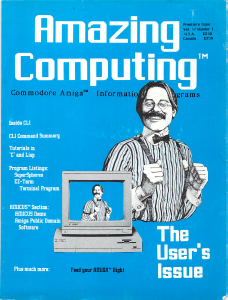
PiM Publications produced the magazine in Fall River, Massachusetts. The premiere named Joyce A. Hicks as publisher, Doris Gamble as circulation manager and Don Hicks as managing editor. Its founding authors included Kelly Kauffman, John Foust, George Musser Jr., Perry Kivolowitz, Daniel Zigmond and Bela Lubkin. The Amiga supplied the common interest, but the contributors approached it through different kinds of work.
The new user and the programmer
Hicks’s first editorial addressed two audiences. Some readers wanted technical detail; others wanted to choose software and hardware for a job, without an ambition to write programs. The magazine promised to explain products through their use and invited ideas from starting writers.
That promise took concrete forms. Kauffman’s EZ-TERM was a 300-baud terminal program written in ABasiC. Musser’s Inside CLI examined the command-line interface, with a separate command summary. Foust began a C tutorial, while Zigmond introduced Lisp. A reader could use the Amiga’s existing software, inspect a listing or learn a language unfamiliar from 8-bit BASIC.
The list of contents is also a reminder that ABasiC was a particular interpreter, not a name for every BASIC on the Amiga. Articles written for it should not be assumed to work unchanged in AmigaBASIC, AMOS or Blitz BASIC 2.
Software passing between people
Foust brought the AMICUS network into the premiere, alongside a public-domain software section. Lubkin introduced the AmigaForum on CompuServe. These were ways for users to exchange programs, information and questions beyond the magazine’s printed pages.
This mixture helps explain why Amazing Computing is a source for Amiga animation culture as well as programming. Pictures and animations travelled through collections of freely distributable disks, while articles explained the software used to make them. The magazine followed both applications and the channels through which owners encountered new work.
By February 1991 its contents ranged from colour and image-processing software to tax preparation, games and hardware. Graphics work was becoming a collection of practical tasks: choosing a package, preparing images, managing files and finding out what a particular Amiga could run. The magazine’s technical interests did not prevent it from examining those everyday jobs.
Outlasting the manufacturer
Amazing Computing continued after Commodore’s 1994 collapse, reporting on the changing ownership and prospects of the Amiga alongside software and hardware. It survived longer than the American print run of AmigaWorld.
By the end of 1999 it too had closed. Amiga Update’s 4 January 2000 newsletter reported the loss, carrying a dated 31 December item about PiM’s bankruptcy. Its announcement marked the loss of another source of American Amiga coverage, five years after Commodore’s collapse.
Sources
- Amazing Computing vol. 1 no. 1, Premiere, copyright 1986: masthead, p. 2; contents, p. 3; Don Hicks, “From the Editor”, p. 4; Kelly Kauffman’s SuperSpheres and EZ-TERM, pp. 5 and 11 onwards; George Musser Jr., “Inside CLI”, p. 25 onwards; John Foust’s C tutorial and AMICUS report, pp. 37 and 56 onwards; Bela Lubkin, “AmigaForum”, p. 44 onwards; Daniel Zigmond’s Lisp tutorial, p. 52 onwards. https://commodore.bombjack.org/amiga/magazines/amazing-computing/amazing-computing.htm
- Amazing Computing vol. 6 no. 2, February 1991: contents, masthead and application, games and hardware coverage. https://vtda.org/pubs/AmazingComputing/Amazing_Computing_Vol_06_02_1991_Feb.pdf
- Amazing Computing, July 1994, p. 55: Commodore’s liquidation announcement and events leading to it; discussed in Commodore.
- Brad Webb (ed.), Amiga Update, 4 January 2000, including the item dated 31 December 1999, “…As Is Amazing Computing” (electronic newsletter, contemporary reporting): closure and reported bankruptcy. Public republication: https://amiga-news.de/en/news/AN-2000-01-00042-EN.html