
The first AmigaWorld put business charts on the computer screen on its cover, then filled its contents with sound, graphics, games, education and a look inside the 68000 processor. The Amiga was new enough that explaining what it was could occupy a substantial feature. What people would make with it was still an open question.
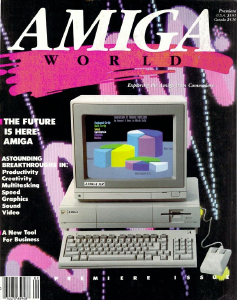
The premiere’s masthead named Stephen Twombly as publisher and Guy Wright as editor-in-chief. CW Communications/Peterborough published it in New Hampshire, initially every two months. It was an independent magazine, and its masthead explicitly said it was not connected with Commodore Business Machines. It belonged to the publishing family associated with IDG.
Explaining a new machine
Twombly’s opening article described seeing an unfinished Amiga prototype in December 1984 and deciding that the computer should have a magazine of its own. His expectations ranged from business applications to film, video and music. They were a publisher’s enthusiastic predictions; the pages that followed began the more practical work of explaining the machine.
Margaret Morabito’s “A First Look at the Amiga” introduced its features. Brian Epstein examined the 68000. Guy Wright wrote about sound and educational uses. Jim Forbes reported on Electronic Arts and interviewed Trip Hawkins. The issue’s Digital Canvas department showed work by Amiga artist Jack Haeger.
That range matters. AmigaWorld did not present a choice between creative applications and understanding hardware. The same computer could be examined as a collection of chips, used to make a picture and considered as a platform for commercial software.
From possibilities to working methods
By April 1995, the articles addressed an established collection of tools. The final issue included landscape-generation software, image morphing and an introduction to ARexx, the scripting language used to control and connect applications. An ARexx program could make other programs do parts of a job rather than require a user to repeat each operation by hand.
Games remained part of that working-computer magazine. Peter Olafson was games editor, and the issue’s Game Preserve pages sat alongside graphics and programming articles. The mixture gives the magazine value beyond launch announcements: it records the applications, techniques and practical difficulties that occupied Amiga users over time.
After April 1995
AmigaWorld ended with its April 1995 issue. Its American subscribers subsequently received Amiga Computing, a British title then also owned by IDG. A letter accompanying the June 1995 issue welcomed them to its US edition and apologised for delays in transferring the subscriber database. The magazines were separate publications, even though one inherited subscriptions from the other.
The American Amazing Computing continued through the rest of the decade. It offers another view of Amiga users’ software, programming and hardware interests after AmigaWorld closed.
The later AmigaWorld.net community website is another distinct subject. Its own account traces its origins to an IRC channel in 1999 and an associated website in 2000. The shared name should not turn the print magazine into a history of that service.
Sources
- AmigaWorld vol. 1 no. 1, Premiere 1985: contents, pp. 2–3; masthead and cover credits, p. 4; Stephen Twombly, “A Vision”, p. 8 onwards; the listed features by Morabito, Forbes, Wright and Epstein, and “Digital Canvas”. The original issue says “Premiere 1985”, rather than printing a month in its masthead. https://commodore.bombjack.org/amiga/magazines/amiga-world/amiga-world.htm
- AmigaWorld vol. 11 no. 4, April 1995: masthead; landscape-generation feature, “Exploring ARexx” and Game Preserve. Preserved in the same issue archive.
- Amiga Computing US Edition, June 1995: covering letter to former AmigaWorld subscribers; transfer of subscriptions and delay. The arrangement is described in Magazines Across Borders.
- University of Missouri Special Collections, Amiga World premiere holding (web, secondary catalogue): volume 1 no. 1, 1985. https://library.missouri.edu/specialcollections/items/show/1873
- AmigaWorld.net, “Site History and the Team” (web, primary participant account): the separate community site’s beginnings. https://amigaworld.net/aboutus/