
You could open the first Your Computer without having chosen a computer. Its June/July 1981 issue reviewed the ZX81, explained how to assemble a Microtan 65 kit, compared versions of BASIC and printed programs for readers to enter. Choosing, building and using a home computer were all part of the magazine’s job.
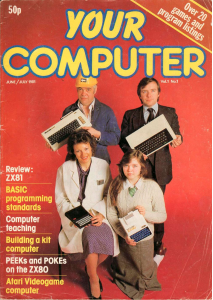
This was the British IPC title, rather than the Australian magazine with the same name. Duncan Scot edited the premiere, Bill Bennett was staff writer and Toby Wolpe production editor. The masthead named IPC Electrical-Electronic Press as publisher and IPC Business Press as copyright holder. The British run continued into 1988.
One magazine, several BASICs
The contents of the first issue show why a magazine could not assume that its readers shared a machine. Tim Hartnell tested the ZX81 against its ZX80 predecessor. David Bannister examined Atari’s personal computers. John Dawson built the Microtan kit. Bill Bennett described an educational program for the Acorn Atom.
Peter Laurie’s article on BASIC standards addressed the problem directly. BASIC had a common name, but manufacturers’ versions differed. A useful program on one computer could need changes on another. The magazine therefore had to explain both the general idea and the particular machine, an everyday concern behind type-in listings.
Martyn Thomas’s article on the ZX80’s PEEK and POKE went below the language’s ordinary commands. These let a program read or change a numbered memory location. They gave owners access to facilities BASIC did not expose directly, but tied that part of a program to the computer’s memory map. An address useful on the ZX80 was not automatically useful elsewhere.
Readers supplied software too
The premiere’s Software File was a place for readers’ programs, ideas and discoveries. Its submission instructions asked contributors to check their work. A listing had to survive the journey from the author’s computer through editing and typesetting to someone else’s keyboard, with plenty of chances for an error along the way.
Those pages also supplied a route into publication. A reader did not need a boxed commercial release to have other people encounter their program. In the same market, advertisements connected software businesses with potential customers and programmers. Bug-Byte advertised in the magazine, while the people who formed Ocean used its pages to seek programs and sell games.
IPC’s later Big K also combined reviews with listings, but made games its centre. Your Computer’s premiere ranged further, from educational uses to assembling the computer itself.
Computing as a public argument
The first editorial challenged the BBC’s decision to associate its computer-literacy project with one manufacturer’s computer. Scot questioned the effect on competing firms. This was a position taken during the argument, not a later verdict on the BBC Micro.
That is part of the value of Your Computer as a historical source. Its reviews, listings, letters, news and advertisements preserve different kinds of evidence on the same pages. A review describes a particular machine as tested; an advert records what a seller offered; a letter records a reader’s concern. Keeping those distinctions makes the magazine useful long after the offers and recommended purchases have expired.
Sources
- Your Computer vol. 1 no. 1, June/July 1981: cover; contents, masthead and editorial, p. 3; Tim Hartnell’s ZX81 review, p. 12 onwards; Peter Laurie, “BASIC Standards”, p. 26 onwards; Martyn Thomas, “PEEKS AND POKES ON THE ZX-80”, p. 29 onwards; John Dawson’s Microtan kit article, p. 40 onwards; “Software File”, p. 47 onwards, and submission guidance, p. 55. https://archive.org/details/your-computer-magazine-1981-06
- World of Spectrum, Your Computer archive (web, secondary catalogue): British issues from 1981 to 1988, including the second, August/September 1981 issue. https://worldofspectrum.org/archive/magazines/your-computer
- Period advertisements and the participants’ accounts of recruiting programmers are cited in Bug-Byte, Ocean Software and the bedroom coder.