
Give the finished crossing its own opening instructions. S starts the game; Q can leave the title without beginning an attempt.
Replace lines 10.
Add lines 5000, 5010, 5020, 5030, 5040, 5050, 5060, 5070, 5080, 5090, 5100, 5110, 5120, 5130.
  10 GO SUB 7000: GO SUB 5000
5000 BORDER 0: PAPER 0: INK 7: CLS
5010 PRINT AT 3,11; INK 5;"QUICKSTEP"
5020 PRINT AT 6,3;"Six lanes. One halfway rest."
5030 PRINT AT 8,3;"I up   J left   K down"
5040 PRINT AT 9,3;"L right"
5050 PRINT AT 11,3;"Step into a gap, then watch."
5060 PRINT AT 13,3;"Plan beyond the next lane."
5070 PRINT AT 15,3;"Reach the green exit at top."
5080 PRINT AT 17,3;"R retries. Q quits."
5090 PRINT AT 20,11; INK 6;"S starts."
5100 LET k$=INKEY$
5110 IF k$="q" OR k$="Q" THEN GO TO 9000
5120 IF k$<>"s" AND k$<>"S" THEN GO TO 5100
5130 RETURN
RUN the changed program.
Complete source at this checkpoint
  10 GO SUB 7000: GO SUB 5000
 100 DIM p(6): DIM d(6): DIM t(6): DIM v(6): DIM r(6): DIM a$(6,30): DIM b$(6,30)
 110 LET x=7: LET y=8: LET steps=0: RESTORE 7100
 120 FOR i=1 TO 6: READ p(i),d(i),v(i),r(i): LET t(i)=v(i): NEXT i
 140 FOR i=1 TO 6: FOR j=0 TO 2: FOR k=0 TO 3
 150 LET c=2 *p(i)+10 *j+k: LET c=c-30 *INT (c/30)+1
 160 LET a$(i,c)=CHR$ (144 +k): LET b$(i,c)=CHR$ (148 +k)
 170 NEXT k: NEXT j: NEXT i
 180 GO SUB 1000: GO SUB 3000: LET dx=0: LET dy=0: POKE 23560,0: LET tick=PEEK 23672
 200 LET k$=INKEY$
 220 IF k$="q" OR k$="Q" THEN GO TO 9000
 230 IF k$="r" OR k$="R" THEN GO TO 100
 280 LET elapsed=PEEK 23672 -tick: IF elapsed<0 THEN LET elapsed=elapsed+256
 290 IF elapsed<32 THEN GO TO 200
 291 LET k$=INKEY$: IF k$="" THEN LET k$=CHR$ (PEEK 23560)
 292 POKE 23560,0: LET dx=0: LET dy=0
 293 IF k$="q" OR k$="Q" THEN GO TO 9000
 294 IF k$="r" OR k$="R" THEN GO TO 100
 295 IF k$="i" OR k$="I" THEN LET dy=-1
 296 IF k$="k" OR k$="K" THEN LET dy=1
 297 IF k$="j" OR k$="J" THEN LET dx=-1
 298 IF k$="l" OR k$="L" THEN LET dx=1
 300 LET tick=PEEK 23672: LET nx=x+dx: LET ny=y+dy
 310 IF nx<0 OR nx>14 OR ny<0 OR ny>8 THEN LET nx=x: LET ny=y
 320 GO SUB 2000
 330 IF hit=1 THEN LET e$="That gap was not clear.": GO TO 4000
 340 IF nx=x AND ny=y THEN GO TO 350
 341 GO SUB 3100: LET x=nx: LET y=ny: GO SUB 3000
 350 FOR i=1 TO 6: LET t(i)=t(i)-1
 360 IF t(i)>0 THEN GO TO 430
 370 LET t(i)=v(i): LET p(i)=p(i)+d(i)
 380 IF p(i)=15 THEN LET p(i)=0
 390 IF p(i)=-1 THEN LET p(i)=14
 400 IF d(i)=1 THEN LET a$(i)=a$(i,29 TO 30)+a$(i,1 TO 28): LET b$(i)=b$(i,29 TO 30)+b$(i,1 TO 28)
 410 IF d(i)=-1 THEN LET a$(i)=a$(i,3 TO 30)+a$(i,1 TO 2): LET b$(i)=b$(i,3 TO 30)+b$(i,1 TO 2)
 420 GO SUB 1200: IF y=r(i) THEN GO SUB 3000
 430 NEXT i
 440 GO SUB 2000: LET steps=steps+1
 450 IF hit=1 THEN LET e$="The lane caught you.": GO TO 4000
 460 IF x=7 AND y=0 THEN LET e$="Across! A well-timed journey.": GO TO 4000
 470 LET dx=0: LET dy=0: GO TO 200
1000 BORDER 0: PAPER 0: INK 7: CLS
1010 PRINT AT 0,1; INK 5;"QUICKSTEP";AT 0,21; INK 4;"EXIT ABOVE"
1030 FOR j=0 TO 8 STEP 4
1040 PRINT AT 2+2*j,1; PAPER 1; INK 5;s$;AT 3+2*j,1;s$
1060 NEXT j
1070 PRINT AT 2,15; PAPER 4; INK 7;"  ";AT 3,15;"  "
1080 FOR i=1 TO 6: GO SUB 1200: LET z$=">": IF d(i)=-1 THEN LET z$="<"
1081 PRINT AT row,0; PAPER 0; INK colour;z$;AT row,31;z$
1082 NEXT i
1090 PRINT AT 20,2; PAPER 0; INK 7;"I up  J left  K down  L right"
1110 PRINT AT 21,2; INK 7;"R retry              Q quit";
1120 RETURN
1200 LET row=2 +2 *r(i): LET colour=6: IF d(i)=-1 THEN LET colour=5
1210 PRINT AT row,1; PAPER 0; INK colour;a$(i);AT row+1,1;b$(i)
1240 RETURN
2000 LET hit=0: IF ny=0 OR ny=4 OR ny=8 THEN RETURN
2010 LET lane=ny: IF ny>4 THEN LET lane=ny-1
2015 LET delta=nx-p(lane): LET delta=delta-5 *INT (delta/5)
2020 IF delta<2 THEN LET hit=1
2030 RETURN
3000 LET shade=0: IF y=0 OR y=4 OR y=8 THEN LET shade=1
3010 IF y=0 AND x=7 THEN LET shade=4
3020 PRINT AT 2+2*y,1+2*x; PAPER shade; INK 7;h$;AT 3+2*y,1+2*x;f$
3030 RETURN
3100 IF y<>0 AND y<>4 AND y<>8 THEN PRINT AT 2+2*y,1+2*x; PAPER 0;"  ";AT 3+2*y,1+2*x;"  ": RETURN
3110 PRINT AT 2+2*y,1+2*x; PAPER 1; INK 5;g$;AT 3+2*y,1+2*x;g$: RETURN
4000 PRINT AT 1,1; PAPER 0; INK 6;e$
4010 PRINT AT 20,2; PAPER 0; INK 7;"R plays again. Q quits.    "
4020 IF INKEY$<>"" THEN GO TO 4020
4030 LET k$=INKEY$
4040 IF k$="q" OR k$="Q" THEN GO TO 9000
4050 IF k$="r" OR k$="R" THEN GO TO 100
4060 GO TO 4030
5000 BORDER 0: PAPER 0: INK 7: CLS
5010 PRINT AT 3,11; INK 5;"QUICKSTEP"
5020 PRINT AT 6,3;"Six lanes. One halfway rest."
5030 PRINT AT 8,3;"I up   J left   K down"
5040 PRINT AT 9,3;"L right"
5050 PRINT AT 11,3;"Step into a gap, then watch."
5060 PRINT AT 13,3;"Plan beyond the next lane."
5070 PRINT AT 15,3;"Reach the green exit at top."
5080 PRINT AT 17,3;"R retries. Q quits."
5090 PRINT AT 20,11; INK 6;"S starts."
5100 LET k$=INKEY$
5110 IF k$="q" OR k$="Q" THEN GO TO 9000
5120 IF k$<>"s" AND k$<>"S" THEN GO TO 5100
5130 RETURN
7000 RESTORE 7200: FOR j=0 TO 103: READ n: POKE USR "a"+j,n: NEXT j
7010 LET h$=CHR$ 152 +CHR$ 153: LET f$=CHR$ 154 +CHR$ 155
7020 LET g$=CHR$ 156 +CHR$ 156: LET s$="": FOR j=1 TO 15: LET s$=s$+g$: NEXT j: RETURN
7100 DATA 0,1,3,1,9,-1,4,2,11,1,2,3
7110 DATA 7,-1,3,5,1,1,4,6,10,-1,2,7
7200 DATA 0,0,63,127,120,120,120,120
7210 DATA 0,0,255,255,24,24,24,24
7220 DATA 0,0,255,255,24,24,24,24
7230 DATA 0,0,252,254,30,30,30,30
7240 DATA 127,127,127,127,63,7,7,0
7250 DATA 255,255,255,255,255,192,192,0
7260 DATA 255,255,255,255,255,3,3,0
7270 DATA 254,254,254,254,252,224,224,0
7280 DATA 0,7,15,13,15,7,3,31
7290 DATA 0,224,240,176,240,224,192,248
7300 DATA 63,55,7,7,6,6,14,0
7310 DATA 252,236,224,224,96,96,112,0
7320 DATA 0,0,0,0,0,16,0,0
9000 PAPER 0: INK 7: PRINT AT 21,0;"Finished. RUN to try again.     ";: STOP
The title describes six lanes, the halfway rest and the controls. Start with S, cross or fail, then use R to replay. The movement, traffic, artwork and contact rules are the same as in the previous lesson.
Three places to wait
The program now has three distinct loops. The title loop at 5100 waits for S or Q. The play loop at 200 polls controls, waits for the update target and advances the crossing. The result loop at 4030 listens for R or Q after the world has stopped.
These loops do not need a new state variable because the program’s current control flow already selects the phase. Nothing calls the traffic update from the title or result loop.
Line 10 creates the UDGs and strings, then calls the title routine. S lets that routine RETURN. Execution continues at line 100, where arrays, lane records and starting position are established. Q jumps to the shared finishing routine instead.
The title displays “Six lanes. One halfway rest.” That describes the central resting strip between the two banks. The starting and finishing strips are safe too. The exit is the marked centre cell, not the whole top edge.
Why does R return to line 100 while RUN begins with line 10?
Show the explanation
R resets the game state using artwork already initialised in this running program. RUN begins the complete program, creating that artwork before showing the title. A fresh load must take the complete initialisation path too.
Check the complete cycle
Try Q from the title, then enter RUN and start with S. During play, try R and confirm that the person and all six lane patterns return to their initial positions. Deliberately enter traffic, release your key and retry from the result.
Finally reach the exit. The success message should freeze the game. Retry once more, then quit. A held key at the result must be released before R or Q is accepted there.
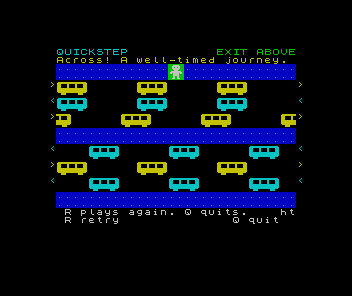
If the program starts in the middle of an attempt, use RUN rather than jumping to an internal line. If the title runs into game code without S, check its return and wait branches. If vehicles continue moving behind a result, check that the result loop returns to 4030 rather than 200.
This is the complete game: six predictable lanes, one halfway rest and a marked destination. Its difficulty comes from combining the lane patterns and the two contact checks. The last lesson keeps a copy that can rebuild all of this in a fresh machine.
Sources
Steven Vickers, edited by Robin Bradbeer, ZX Spectrum BASIC Programming, second edition (Sinclair Research, 1983), chapter 5, chapter 18. Subroutine return and keyboard polling provide the title path. The three control loops and reset boundaries are choices in this program.
Run it here
This unit's program, built for you.
- Program
- quickstep.tap
- Machine
- ZX Spectrum 48K (PAL)