
The opponent can spot a threat and still lose. Use the program from the previous lesson; there is no new BASIC to enter.
Complete source to use
  10 BORDER 0: PAPER 0: INK 7: BRIGHT 1: CLS
  20 DIM b(9): LET moves=0
  30 GO SUB 1000
  40 GO TO 250
 250 GO SUB 9000
 260 LET k$=INKEY$: IF k$="" THEN GO TO 260
 270 IF k$="q" OR k$="Q" THEN GO TO 8000
 280 IF k$="r" OR k$="R" THEN RUN
 290 IF k$<"1" OR k$>"9" THEN GO TO 250
 300 LET n=VAL k$
 310 IF b(n)<>0 THEN PRINT AT 18,2; INK 6;"Taken. Choose an empty square.": GO TO 250
 320 LET b(n)=1: LET moves=moves+1: GO SUB 2000
 330 GO SUB 3000
 340 IF winner>0 OR moves=9 THEN GO TO 4900
 600 PRINT AT 18,2; INK 6;"O is choosing...             "
 610 GO SUB 4000
 620 LET n=mv: LET b(n)=2: LET moves=moves+1: GO SUB 2000
 630 PRINT AT 19,2; INK 5;"O chose ";mv;": ";a$;"        "
 640 GO SUB 3000
 650 IF winner>0 OR moves=9 THEN GO TO 4900
 660 PRINT AT 18,2; INK 7;"Your move: choose 1-9.        "
 670 GO TO 250
1000 CLS
1010 PRINT AT 0,8; INK 5;"THREE IN A ROW"
1030 INK 1: FOR i=0 TO 3: PLOT 56 +i*48,32: DRAW 0,120: NEXT i
1040 FOR i=0 TO 3: PLOT 56,32 +i*40: DRAW 144,0: NEXT i
1050 FOR n=1 TO 9: GO SUB 2000: NEXT n
1060 PRINT AT 18,2; INK 7;"Your move: choose 1-9."
1090 PRINT AT 21,2; INK 7;"1-9: place  R: reset  Q: quit"
1100 RETURN
2000 LET row=INT ((n-1)/3): LET col=n-1 -row*3
2010 LET x=80 +col*48: LET y=132 -row*40
2020 PRINT AT 5 +row*5,10 +col*6; INK 7;" "
2030 IF b(n)=0 THEN PRINT AT 5 +row*5,10 +col*6; INK 7;n: RETURN
2040 IF b(n)=2 THEN GO TO 2100
2050 INK 5: FOR z=0 TO 1: PLOT x-10 +z,y-10: DRAW 20,20: PLOT x-10 +z,y+10: DRAW 20,-20: NEXT z
2060 RETURN
2100 INK 7: FOR z=0 TO 1: PLOT x-6,y+10 -z: DRAW 12,0: DRAW 4,-4: DRAW 0,-12: DRAW -4,-4: DRAW -12,0: DRAW -4,4: DRAW 0,12: DRAW 4,4: NEXT z
2110 RETURN
3000 LET winner=0: LET wl=0: RESTORE 9500
3010 FOR w=1 TO 8: READ p,q,f
3020 IF b(p)<>0 AND b(p)=b(q) AND b(q)=b(f) THEN LET winner=b(p): LET wl=w
3030 NEXT w: RETURN
4000 LET mark=2: GO SUB 4500
4010 IF mv>0 THEN LET a$="win": RETURN
4020 LET mark=1: GO SUB 4500
4030 IF mv>0 THEN LET a$="block": RETURN
4040 IF b(5)=0 THEN LET mv=5: LET a$="centre": RETURN
4050 RESTORE 9530
4060 FOR j=1 TO 4: READ v
4070 IF mv=0 AND b(v)=0 THEN LET mv=v
4080 NEXT j
4090 IF mv>0 THEN LET a$="corner": RETURN
4100 FOR j=1 TO 9: IF b(j)=0 THEN LET mv=j
4110 NEXT j: LET a$="edge": RETURN
4500 LET mv=0: RESTORE 9500
4510 FOR w=1 TO 8: READ p,q,f
4520 IF mv=0 AND b(p)=mark AND b(q)=mark AND b(f)=0 THEN LET mv=f
4530 IF mv=0 AND b(p)=mark AND b(f)=mark AND b(q)=0 THEN LET mv=q
4540 IF mv=0 AND b(q)=mark AND b(f)=mark AND b(p)=0 THEN LET mv=p
4550 NEXT w: RETURN
4900 LET r$="DRAW. No line completed."
4910 IF winner=1 THEN LET r$="X WINS. Three in a row."
4920 IF winner=2 THEN LET r$="O WINS. Three in a row."
4930 IF wl>0 THEN GO SUB 6000
4940 PRINT AT 18,2; INK 6;r$;"      "
5000 GO SUB 9000
5010 LET k$=INKEY$: IF k$="" THEN GO TO 5010
5020 IF k$="q" OR k$="Q" THEN GO TO 8000
5030 IF k$="r" OR k$="R" THEN RUN
5040 GO TO 5010
6000 RESTORE 9500: FOR w=1 TO wl: READ p,q,f: NEXT w
6010 LET row=INT ((p-1)/3): LET col=p-1 -row*3
6020 LET sx=80 +col*48: LET sy=132 -row*40
6030 LET row=INT ((f-1)/3): LET col=f-1 -row*3
6040 INK 6: PLOT sx,sy: DRAW 80 +col*48 -sx,132 -row*40 -sy: RETURN
8000 PAPER 0: INK 7: BRIGHT 0: PRINT AT 21,2;"Three in a Row finished.     ": STOP
9000 IF INKEY$<>"" THEN GO TO 9000
9010 RETURN
9500 DATA 1,2,3,4,5,6,7,8,9
9510 DATA 1,4,7,2,5,8,3,6,9
9520 DATA 1,5,9,3,5,7
9530 DATA 1,3,7,9
Start a fresh round with R and play 1, 8, 7, 4, waiting for each O reply. Before entering 4, stop and inspect the board.
| Your move | O’s reply | Why O chose it |
|---|---|---|
| 1 | 5 | Centre is free |
| 8 | 3 | First free corner |
| 7 | 9 | Block the bottom row |
| 4 | No reply | X completes the left column |
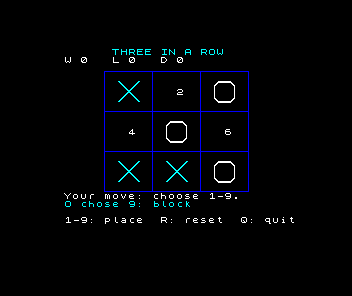
One move, two threats
After you place X at 7, the left column has X in 1 and 7, leaving 4. The bottom row has X in 7 and 8, leaving 9. This is a fork: two different winning moves are available next turn.
The search finds the bottom row before the left column because rows precede columns in DATA. It returns 9, and O reports block. That statement is truthful. It blocked one immediate threat; it did not establish that the board was safe.
Choosing 4 instead would not solve O’s problem. You could then finish the bottom row at 9. Once this fork exists, one defensive move cannot fill both gaps.
Would reversing the winning-table order prevent this defeat?
Show the explanation
It would change which threat O blocks. The other remains available. Preventing this fork requires an earlier decision, before both threats exist; changing the tie order at the final block is too late.
Keep the limitation visible
Our program considers immediate wins and threats, followed by positional preferences. It does not try future replies and their replies. Many careful rounds will draw, but a draw in several trials does not prove that a policy is unbeatable.
Replay without following the table. Can you identify a threat before the computer labels its response? Understanding the chosen rule is the point of the reason caption. We will keep this fallible opponent for the finished game and add a session around it next.
Run it here
This unit's program, built for you.
- Program
- three.tap
- Machine
- ZX Spectrum 48K (PAL)